This week we study the portion “Vayakhel”, Exodus 35-38:20. We also read the portion of “Pekudei” this year, in leap years they are separate. Our learning focuses on the construction of the Mishkan, the Tabernacle, a portable Sanctuary complex.
We explored the reasons building the Tabernacle was necessary, and the importance of the donations being voluntary. This week the Bible describes how the people brought the materials for the Tabernacle and wove or constructed the materials to create the Tabernacle and the items used within such as the Holy Ark, Table, and Menorah.

At the outset, Moses reminds the people that doing work on the Sabbath is forbidden, Ex 35:2. We already know about the centrality of Shabbat in conventional Judaism:
Conventional Jews for millennia have refrained from constructive work in the Sabbath, from dusk on Friday through Saturday night. God commands us to observe the Sabbath as a remembrance to Creation, which occurred over six days. It also serves as a time of freedom after a period of work, making it a reminder of our Exodus from slavery in Egypt. The Jewish Sabbath is the origin of the nearly universal concept of a weekend, so the Sabbath is also a gift to every person in the world…
Jews who fully observe the Sabbath are assumed to keep conventional Jewish law in all areas, since it takes a great commitment and dedication to properly keep the Sabbath.
The Sabbath is a Divine command, but also has practical social effects. It gives Jews a chance to get together once a week, as a family and as a community. We pray and learn together and enjoy deluxe meals (cooked before Shabbat). It is an opportunity to meet people, invite friends over, and socialize. Customarily it was also a time to set up young men and women on dates (as we have learned, this not to arrange marriage, but to help the younger generation focus their prospects).
Moses was reminding the Jewish nation about the Sabbath for a particular reason. God had just commanded the people to begin work on the Tabernacle. They may have thought that a Divine command to accomplish something, such as construction, would trump a command to avoid doing something, such as working on the Sabbath.
We have a general concept that a positive command “get up and do” overrides a negative command. The restrictions of the Sabbath, as a key facet of Jewish observance and identity, were not overridden by building the Tabernacle.
The “get up and do” concept works in your own life, in any area. There is much more value in doing something now than waiting around for something to be happen for you. Choosing not to take action is itself a choice, and not always the correct one. If you feel lethargic, just going outside or exercising can snap you out of that.
Certainly developing your own wisdom, learning new approaches to life, working on your business or body will override whatever negativity you are feeling. Use “get up and do” as a motto whenever you are not accomplishing on the level you could.

The people were later told to stop bringing materials for the Tabernacle, since they had enough (36:6), and because bringing items from the public domain to the camp of the Levites, where the construction was taking place, was forbidden on the Sabbath.
We see from here that despite the donations being voluntary (except for the one small coin used as a census), everyone pitched in and there was more than enough material. The people who had already given wanted to bring more and more and Moses had to tell them to stop.
There is a deep concept here: when you are in a giving more, putting your personal energy and ideas out into the world, you will always have something to give. If you are focused instead on taking and getting from others, you will not have enough to give.
There are people who are “takers” in life, often in the form of taking time from other people for their own emotional needs. They tell you all their problems and troubles and you feel drained and they are not better for it.
Friends, don’t let them take your time and energy. There are other people, who even when you give them from your time, you are also recharged and invigorated after. That is what you want to find.

Cherubim
The Bible describes the construction of the famous Cherubim (37:7). Commonly these are understood as having the shape of angels or angelic children. God told us at Sinai not to make any idols (Ex 20:4) and also “don’t make the image of anything you saw with me” (Exodus 20:20). Rashi on this verse notes this includes a prohibition on making other Cherubim for synagogues like they had in the Tabernacle and Temple.
However, we again see the concept that a positive command “get up and do” to build Cherubim overrides a negative command. Since we were commanded to make these Cherubim, that overrides the command to not make images (not that they were idols, but even making a statute for non idol purpose is forbidden).

Naturally we need to clarify, angelic topics can be a source of confusion. We don’t pray to angels. They have no independent power or existence, they are messengers and agents only.
Angels are often misunderstood. Christian theology depicts an evil angel or Satan opposing God, with the ability to choose to fight against God. If you believe in an omnipotent Creator, then believing his angels can fall and rebel is farcical. Judaism understands that Satan is a tool of God just as much as the other angels, having no independent will and no abilities other than what God allows.
The best comparison for modern men to understand the function of angels is to imagine a programmer making scripts, apps, or robots to do exactly what he wants. They can’t examine or change their own code, they have no awareness of the entire system, only what their specific programmed purpose is.
In this way, Men are superior to angels, we can, within limits, make free will decisions while angels are locked into their programming. “Satan” means impediment, the role of this angel is to impede our spiritual progress so we put in the effort needed to overcome it, and in so doing strengthen or personal powers.
Deuteronomy 4:15 seems to refer to God Himself having no form, implying there was some kind of angelic forms visible. We assume there were angels appearing with God at Sinai, and that is why the command was given. Our sages stated these were actually forms of children, but with wings. Hence the popular artistic depiction of “angels” as winged children. The actual angels who visited Abraham appeared as nomads or Bedouins.
The cherubim had their wings spread out above, shielding the cover with their wings. They faced each other; the faces of the cherubim were turned toward the cover, 37:9. This was a sign of Divine favor to the Jewish people. However, if they turned away from each other, this was a bad sign.

Mirror, mirror on the wall, who is the sexiest one of all?
Exodus 38:8 teaches that the women come to donate their copper mirrors to the Tabernacle. We mentioned this briefly in Exodus. This episode is one of the greatest proofs of the steadfast loyalty of Jewish women to their husbands and families.
Our ancient sources, passed down generation to generation from the people who were there, explain the back story to these mirrors. The Bible calls them The women who “gathered” (38:8) וַיַּ֗עַשׂ אֵ֚ת הַכִּיּ֣וֹר נְחֹ֔שֶׁת וְאֵ֖ת כַּנּ֣וֹ נְחֹ֑שֶׁת בְּמַרְאֹת֙ הַצֹּ֣בְאֹ֔ת אֲשֶׁ֣ר צָֽבְא֔וּ פֶּ֖תַח אֹ֥הֶל מוֹעֵֽד׃
It is obvious that they gathered to donate the mirrors. The Bible is using this peculiar word to allude to another gathering, during the harsh slavery in Egypt, when these women “gathered” meaning birthed many children. Rashi, a famous Biblical commenter describes based on earlier Medrashim, how righteous women saved our nation with sexuality:
The Jewish women owned mirrors of copper, which they used when they adorned themselves. Even these did they not hesitate to bring as a contribution for the Tabernacle.
Moses was about to reject them since they were made to increase vanity and sexual desire, but the Holy One, blessed be He, said to him, “Accept them; these are dearer to Me than all the other contributions, because through them the women reared vast hosts in Egypt!”
When their husbands were exhausted through the crushing slave labor, their wives used to bring out to them food and drink and feed them. Then the wives would take the mirrors, and each gazed at herself in her mirror together with her husband, and seduce him by saying, “See, I am more attractive than you!”
Thus they awakened their husbands’ desire and subsequently became the mothers of many children, at it is said, (Song 8:5) “I awakened thy love under the apple-tree”, (referring to the fields where the men worked). This is what the Bible means when it states, מראות הצבאת “the mirrors of the women who reared the hosts (צבאות)” (Midrash Tanchuma, Pekudei 9).
Another account of this event is also in the Talmud, Sotah 11b, and begins:
As the reward for the righteous women who lived in that generation the Israelites were delivered from Egypt. When they went to draw water, the Holy One, blessed be He, arranged that small fishes should enter their pitchers, which they drew up half full of water and half full of fishes. They then set two pots on the fire, one for hot water and the other for the fish, which they carried to their husbands in the field, and washed, anointed, fed, gave the men to drink…
When the Egyptians enslaved the Jews and were working us to death, often literally, the men gave up hope and lost their libido. They knew if they had more children they could not protect them from the Egyptian brutality. So why bother?
It was only the loyal dedication of the Jewish women towards their husbands that saved the Jewish people. The women believed that God would redeem us, so they knew there was still a point in having children in difficult circumstances. I was overjoyed when I saw that Rabbi Eliezer Melamed, a genius and prominent teacher in Israel, makes this same point in his guide to marital intimacy.

The women would use their mirrors to beatify themselves, that is obvious. The use of the mirrors to tease their husbands requires contemplation and explanation. The women were using their sexual appeal to refuel the libido of their husbands.
By teasing “I am more attractive than you”, these women hinted to their husbands that since the men were enslaved and debased, the women had a higher level of attractiveness. There would be an unspoken undertone that, had they not been loyal, the Jewish wives could have attracted Egyptian men and gone over to their powerful captors.
The Jewish men would get interested, partly due to their wives feeding them after hard labor, combined with her looking good and being affectionate. The men also needed to show their wives that they still had their mojo. The Jewish men did their part and gave the women a good time. Jealousy of a potential rival can do amazing things for the testosterone and libido.
The mirror was used not only for women to adorn and make themselves up, but also to arouse a bit of jealousy. While jealousy is usually a bad trait, here it was used for holy ends, to get the husbands back in the race as competitors. In this way the loyal women maintained procreation even during the years of slavery.
War Brides
The implied threat of Jewish women being taken by the Egyptians was a real danger. Typically when one group overpowers another, the women go over to the winners, as we discussed in Exodus: Women and assimilation:
Historically, when a dominant conquering nation comes in, the local subjugated women are tempted to be with those victorious higher status men. This happened in Nazi occupied Europe, and throughout the ages.
Rollo has an excellent essay about the War Brides dynamic and we mentioned this concept in context of The abduction of Dinah. However, even living under the absolute rule of the Egyptians, who enslaved them and subjugated the men, the Jewish women did not stray. The Jewish women in Egypt stayed loyal to their husbands, even when their men had lost their will to procreate.
Now these copper mirrors that had incited holy jealousy were used, by Divine command, to build the laver, a water container used in the Tabernacle for purity. This shows that items these women used to increase physical beauty and sexual passion belonged in a holy place. Not only that, they were appropriate material to fashion a vessel used to purify the Priests before they engaged in sacrificial service.
This may be why God tells Moses that this donation was more dear to Him than anything else. These women were giving the mirrors back to God, after using them to enhance their physical beauty and seduce their husbands in order to save God’s nation.
The lesson for us is that our natural human urges, which some faiths consider to be merely animalistic and carnal, are truly holy when used appropriately. After all, God Himself made us with our biological desires. It is up to us to use them in a creative and giving way, in the appropriate context. For Jewish readers check out Rabbi Melamed’s halachic work “The Joy and Blessing of the Home”.
Women stigmatizing women
The other use of this copper water vessel made from these holy mirrors was to prepare the special potion given to a wife suspected of infidelity (a Sotah). Rashi explains, based on the Talmud: “it was for this reason that the laver was made of the mirrors, because it served the purpose of promoting peace between man and wife.”
Through giving of its waters to be drunk by a woman whose husband had warned her and who nevertheless had been alone with another man (Numbers ch. 5) thus affording her an opportunity to prove her innocence (Sotah 15b).”
If a suspected adulteress had betrayed her husband, the potion made with the water from the copper laver would cause her to die painfully and publicly.
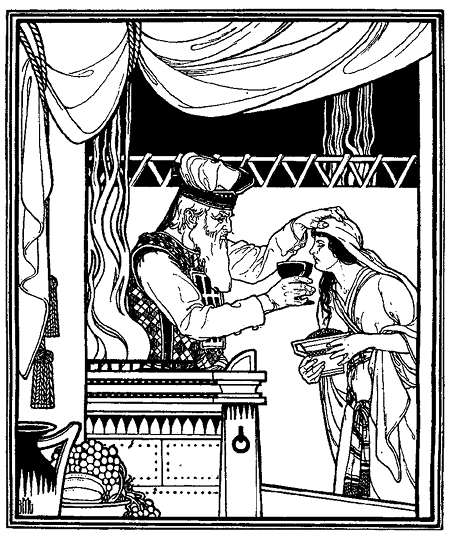
Gentlemen, this is truly interesting. The water container made from the mirrors of the loyal women was used in the loyalty test of a suspected adulteress (Sotah). You can imagine how a wife suspected of straying felt drinking this Sotah potion. She knew the water came from the copper vessel which was made from the mirrors of thousands of wives who had chosen their own downtrodden and enslaved husbands over the dominant, powerful Egyptians.
If the accused wife had truly been loyal, she would join generations of upstanding Jewish wives who had channeled their bodily desires into holiness. If she had really strayed and betrayed, she would have felt as if millions of female eyes were on her, judging her… Countless loyal Jewish women through the ages condemning her to death.
When a suspected adulteress perished in this test, the other women would use her name as a curse and warning to their daughters “don’t flirt and drink with men and end up like her…”
Naturally, this leads us to a critical sociological observation:
When a society judges infidelity as a very evil thing, that society will get less infidelity. This is especially true when women are the ones doing the judging and stigmatizing. They are experts at it, and can create the most effective social buffers against it.

(See also https://m.youtube.com/watch?feature=youtu.be&v=OMMGDQXRie8)
In modern mainstream ‘culture’, the stigma against all manner of things like infidelity, divorce, abortion, and out of wedlock births has been annihilated. There is no negative judgment on people in indulge in all forms of things that 75 years ago were utterly anathema. And we see the results.
The next things on the ‘social justice’ agenda seem to be normalizing transgender identity, transgender competition against normal athletes, euthanasia and pedophilia. Society has stopped shaming insane, perverse and destructive behaviors. And so we get more of them. Simple social economics.
We also observe that when a group wants to promote destructive behaviors, the first thing they do is demand an exemption from any criticism and stigma. We have talked about this concept, asking who gets to define normal for you?
The more vehement and aggressive a group is in attacking anyone who questions their behavior, the more they demand exemption from criticism, then the more they know deep down that their behavior set is wrong.
Some groups and lifestyles demand zero criticism, and try to ruin the lives of people who speak out or do not accept them, they cannot tolerate any critique. This is because their ideology has no real moral truth and their behavior is immoral. Recall that in totalitarian societies, the first thing the regime thugs do is to violently stamp out public criticism of the regime.
The Bible shows us that it used to be the case that society as a whole, especially the women, would openly judge people and hold them accountable for indecent and immoral behavior.
This use of stigma obviously shamed individual women who did not heed their sisters, but certainly benefitted the society and families in general. The positive use of shame and stigma is almost completely lost in modern secular society, and we see the results.






 Red Pill Rabbi