Daily dose of wisdom, Shabbat 77: Wine and wisdom, dance like a fool

Today is the first full page of our new chapter “One who takes out wine”.  We are continuing the topic of carrying items from a private domain out into the public sphere, which is forbidden on Shabbat if the item is of sufficient size or importance.  We learn that the amount of wine in question is enough for a good cup – a cup we would say a benediction over.

Now, we say blessings on any amount of food or drink.  The Gemara here refers to the fact that a Jewish man holds a cup of wine while saying many other blessings.  This includes the famous “Kiddush” marking the onset of Shabbat and holidays and Havdala at the end of Shabbat, the blessings during a marriage and during a Brit (circumcision).  A cup of wine is used to mark important events in our lives.

Wine is central to Jewish observance, and using wine as a spiritual marker shows how Jews combine physical and spiritual aspects into a unified whole. Jewish wisdom teaches that God gives us both physical and spiritual tools for growth.  Our holy men do not abstain from wine, food, and intimate activities, we use them consciously as means to serve and appreciate God.

Today’s page of Talmud launches into etymology, and also describes some biological features of animals that show God created (or evolved) them to fit their environments.  The Maharal and others explain that whenever our ancient sages discuss seemingly innocuous themes, they are hinting at deeper spiritual meanings.

The Gemara states them in hidden terms since they are complex and difficult for neophytes to grasp, they require an experienced rabbi to identify and explain.  [See also Ben Yehoyada and the Gra here.  Much of Jewish wisdom about esoteric topics is still in this form; even though you can find translations of the Zohar, you wont understand the true depth of the words without one on one guidance from a learned sage.]

The Gemara notes the word for bricks is cognate to sons, explaining that men build permanent structures planning for their sons to make use of them. We value generational continuity, and know that a man wants to build a legacy for his children.

One of the words our sages explain is Shutita, the myrtle branch. This was traditionally held during dancing at a wedding party. The word is cognate to Shtut – stupidity or foolishness. Rashi explain when people dance they appear like fools. Our sages are not talking about elegant ballroom dance, this dance is an intense physical expression of joy, combining body and soul.

Even honored rabbis are willing to demean themselves somewhat, foregoing their own honor, to bring happiness to bride and groom.  This shows that there are times we consciously belay our own dignity to give to others, and use our physical bodies to celebrate life events, increasing spiritual joy.

Another etymology today is cloak, which is almost identical to “no shame”. Your clothing prevents other from seeing what is underneath, a fine outer cloak can cover a tattered undershirt. This is a double edged sword – if you only care about your appearance to others, you may invest in that but ignore developing your inner aspects, your intellectual, spiritual, and personal side.

Ideally, your inner life should match your outer appearance.  It goes without saying that you should carry yourself and dress yourself with dignity fitting for a man created in the image of the Divine.  Your outer, physical garments should match the elegant inner life you are creating through personal growth and self development.

Bamidbar: Numbers in the desert, why to marry a young woman

This week we read Numbers 1:1–4:20, starting the fourth Book of the Bible, Bamidbar meaning “in the desert”.  This book is known as Numbers in English due to the enumeration of the tribal populations.

God commands Moses to enlist the prince of each tribe to conduct the census (1:4).  Each tribe had their own self government and distinct way of life, but they all worked together for the larger divine mission.

The total population was 603,550 men of draft age, men between 20 to 60 years.  Per divine command, the tribe of Levi is counted separately, with 22,300 males age one month and older.  The Torah goes on the describe the layout of the Jewish camp in the desert, the tribes in four directions, with the Levites and Tabernacle at the center.

We discussed last week, at the close of Leviticus, how the Bible values connection between generations.  Last week it was in the context of land:

Judaism is an individualist faith, and the Bible states that the ideal situation is each man living on his own ancestral land, working for himself.  A man tending his own land, the land of his fathers, has a deeper connection to his work and respect for the land.  He will not let the land be wasted or polluted since it is his family heritage.

He husbands the land with care since it will be used by his sons and their sons.  His daily work connects him to the land, past, present and future.  We understand intuitively that there is something special about a family owned farm or business that has been in the same family for generations.

This week, we examine connection through genealogy, tribal affiliation, and family lineage.

Conventional Judaism is very tribal.  Jews have been known as “the tribe”, though in fact we descend from 12 tribes fathered by the 12 sons of Jacob.  The Bible emphasizes that each individual counts as part of the nation, and also as part of his own tribe.

While united as the Jewish nation, each tribe has their own prince, government, high court, and flag.  The Bible details how each has their own position in the camp, and a unique role to play in the larger Jewish nation (2:2).  The original Biblical political structure was a federation of related tribes with independent governments and courts.

Jews today are in different groups depending on levels of observance, customs, languages, and origins.  But we are all the same as members of the whole.

A Jew who eats shrimp and pork chops, though I hope he stops, is just as much of a Jew as I am.  I just happen to be in the camp of the Orthodox or Haredi or Yeshivishe Jews, while he is wherever he is, under whatever flag he chooses.  A Jew is a Jew and he is my brother.

For any man, be aware of what groups you are a part of, by choice or accident of birth.  You may choose to associate with certain people who have a shared hobby, style, music, or faith. Be conscious with these choices and make the best ones for you.

You may have been born a Texan (by the grace of God), or a voodoo believer in Haiti.  This has a profound consequence on how you see the world and make your decisions.  Realize that your tribe, chosen or not, impacts your personal development.  By default, you see and process information through the lens of your society or tribe.  Be aware of what groups you are part of and how that affects you.

Modern people tend to reject the idea that tribalism is a guiding force in life.  This is an error.  Even in today’s interconnected society we don’t see more unity, but less of it.  Now people associate themselves with specific groups tribes, each having competing ideals and plans.  Technology is used to connect to your own tribe, not to erase distinctions.

The Census and the firstborns

A Census is a gold mine of information to determine patterns in populations and extrapolate human behavior.  Even if you don’t accept the Bible as true or Word, you can use it as a window into how people lived over 3000 years ago.  In fact, the census data from the ancient Jews tells us about how they formed their families, as we shall see, God willing.

Bamidbar contains the command of redeeming the firstborn (bechor) Israelites with the Levites (Leviim) 3:12.   God had sanctified the firstborn Jews in Egypt when He smote the firstborn Egyptians (3:13).  They were set aside with a certain holiness, as one who was saved from death.  Before the appointment of the Levites to attend to the Tabernacle, the firstborn son of the family was responsible for spiritually connecting his family with God.  This is why Jacob bought that right from Esav (Genesis 25).

Now, God commands for the Levites to step into that traditional duty, redeeming the firstborn sons from all the other tribes.  This was needed after the Jews did not stand up against the sin of the golden calf.  Each Levite man can redeem one firstborn.  But there are leftover men, who must redeem themselves with money.  Hold on, with a little math this is going to get really interesting.

There are 22,273 firstborn Israelites, but there are only 22,000 Leviim.  Rashi (Num. 3:39) notes that 22,000 is the count of Leviim available to redeem a firstborn Israelite.  There are also 300 firstborn Leviim who cannot redeem a firstborn Yisrael, since these Leviim redeem themselves.  The extra 273 Israelite firstborns with no corresponding Levi have to pay 5 silver shekels as redemption.  [Interestingly, at some supermarkets in Israel, you must deposit a 5 shekel coin to use a shopping cart.  A coin is returned when you replace the cart].

Here is the critical sociological observation – there are 300 firstborn Leviim out of 22,300, or 1 in 74.  The implication is that, on average, Mrs. Levi gave birth to her first son… then to 73 other sons!

Amazingly, by the other tribes, there are 22,273 firstborns out of 603550, or 1 in 27.  Which means your average non Levi Jewess had a firstborn son, then 26 more sons.

Once you get over the shock of the size of the ancient families, you should realize the huge problem with the census data.  Again, there are only 22,000 Leviim (counted from 1 month and up), while the other tribes (counted from age 20-60) are all significantly larger.  Yehuda tops the list at 74,600 draft age men, while the average non-Levi tribal population is 50,295.  If the Leviim were having three times more sons per family, why are there only 22,300 of them compared to over 50,000 in other tribes?!

One of my own rabbis suggested that this the discrepancy in firstborn numbers may be due to the dangerous nature of their work.  By being in close contact with the holy Ark and holy vessels of the Tabernacle, Leviim are more likely to die due to the tremendous spiritual forces at work.

Mistakes involving the holy Tabernacle can be fatal, illustrated by the death of Uzzah by touching the Ark when King David first tried to bring the Ark into Jerusalem, 2 Samuel 6.  This could cause significant attrition among the Leviim, especially among their firstborns who would presumably have the most important job of carrying the Ark. 

With many firstborns deceased by the time of the census, the ratio of firstborns to regular sons could be somewhat skewed.  However, the Bible never mentions Leviim dying in this manner during the years in the wilderness.  In addition, only one specific family of Leviim was tasked with moving the Ark.

One could also answer that perhaps it was more common among Levi for a couple to have a daughter first, so they would not have a firstborn son.  In Moses’ own family the oldest child was his sister.  Still, this would require a whole lot more girls as firstborns compared to the other tribes.

I would like to suggest an additional answer based on sociological and mathematical analysis.

Our Sages in “Pirke Avot” (Wisdom for/of fathers) encourage a man to marry at age 18.  We can assume most of the Israelites married around age 18 and started building a family.  The Talmud in Sanhedrin 76b advises a man to marry off his children even younger if possible, and in Kiddushin 29b one sage reports he was married at age 16 but wishes it had been at 14.

However, as we discussed regarding MGTOW, Jewish wisdom teaches us that a man learning Wisdom can delay marriage (Kiddushin 29b).  A man has to make something of himself and become self sufficient before he can undertake to support a family.

The Leviim were the premier Torah scholars and teachers, and also responsible for following the exacting laws of the Tabernacle including ritual purity and impurity.  Those are very complex and nuanced topics which require massive study and practice.

I suggest that the men of Levi were deeply involved in learning and married later.   The same Mishnah in Pirke Avot says a man pursues a career at age 20.  But the Leviim did not begin their service in the Tabernacle until age 25.  At 25 they began to serve as an apprentice and learned the job, and actually took over the ritual service at age 30.

They were not on vacation for a decade, they were learning how to perform their duties without bringing ritual contamination to the Tabernacle and the holy vessels.  I humbly suggest that the men of Levi married and began their families about a decade after the other Jews would marry,  around age 28 or 30.

This leads us to the critical sociological observation:  Even though the Leviim may produced more children per couple, each of their generations were spaced much further apart than those of the Israelites.

Our sages tell us that when the subjugation in Egypt worsened, God gave the Jews a blessing to have extra children.  This blessing was fulfilled through our loyal women, who seduced their exhausted husbands.  Therefore, most of the Jewish population would have been born during the last 86 years in Egypt, the time when we were most harshly enslaved.  During these 86 years the non Levi Israelites, beginning a generation every 18 years, would have produced 4.78 generations.

The Leviim, waiting until around age 30 to marry, would have 2.96.  It appears necessary to say that the original parents were still having their children when their eldest son started his own family, so we can assume that in those 86 years there were 4 complete generations of Israelites and 2 full generations of Leviim, who obviously would take much longer to have 74 kids.

To illustrate, an Israelite couple would average 27 children, and each of those could produce 27 children, and so on.  After four generations the total population from this single couple would be 2+ 27 + 27×27 + 27x27x27 + 27x27x27x27, which comes to 2+ 27+ 729 + 19683 + 531,441 = 551,881 total.

However, a Levite family would have only produced 2 full generations in the same time span: their 74 sons would each have 74 sons, making 5476 grandchildren and a total population of 5552.  This difference in average age at marriage accounts for the much smaller population of the Leviim despite their prolific child bearing.

See the source image

Now we have another problem with our census data:  The census in Bamidbar shows the other tribes are not 100 times more populous than Levi, but on average 2.5 times greater.  The explanation for this was that four fifths of the Jews remained in Egypt (see Rashi on Exodus 10:22 and 13:18).  The Jews who were too assimilated chose not to leave.

However, certainly all the Leviim left in the Exodus due to their spiritual and leadership responsibilities.  Also, countless Jews perished from the oppression and slavery which the Leviim were not directly subjected to.  This would cut the numbers of non-Levite Jews significantly, explaining why the non-Levi tribes were on average 2.5 times greater in number.

Closer to the past

Another interesting point to ponder: since the Leviim produced fewer generations than other Jews, in their families fewer generations had passed since Jacob came to Egypt. This may explain why, (there are many other reasons), the men of Levi maintained their Jewish identity in Egypt more successfully than other tribes.  Each successive generation would create more distance from the original source, since were fewer generations from Jacob to Moses among the Leviim, they followed more closely the footsteps of our Patriarchs.

Compared to the modern secular view, Jews view the progress of time upside down.  The generations closer to Moses and the giving of the Torah are assumed to have enjoyed more spiritual insight and sensitivity than we have today.  We are more spiritually distant from our national origin than our fathers and grandfathers.  So we look up to older men and older generations as having some advantages we lack.

Other people feel that prior generations were backwards due to primitive technology or patriarchal society structures.  They think that with the passing of a few centuries, humanity has evolved and progressed so far that we should ignore what came before us.  Jews recognize that despite new technology, modern people often ignore common sense and useful wisdom that served mankind well for millennia.

When you think about your own origins, your parents, ancestors, country of ancestry, it helps to have some respect and reverence for what they accomplished.  After all, if your ancestors had not been successful, they would not have reproduced and you would not exist.  They may have been backwards and patriarchal, but it worked and people were generally happy.

Indeed, unhappiness, especially among women, has increased astronomically in the past decades. For all of our technology, conveniences, and culture, people in modern society are not any happier than our grandparents.  When you compare your history to your present, have an open mind.

What the Jewish census means for you

The ancient census in the desert indicates that most men married quite young (by modern standards) and had many children, Thank God.  Generations were closely spaced, and a man could still be having new children as his older children themselves began families.

The census also shows that men who needed a more advanced technical education would delay marriage to work on themselves, but would make up for the delay with a serious commitment to becoming fruitful and multiplying.  Again, a man must become something first in order to lead a family.

We are going to get a little controversial.  Really, none of this should be controversial.  However, in modern mainstream society, this line reasoning is abhorrent to the feminist narrative and agenda, since tells a man to put his own needs first, not those of women.

A man needs to know what he wants out of life.  You need to be the one to sit down and decide what is best for you.  We have discussed many times how the media, society, consumer culture, and other people are pushing their goals on you.  Everyone is trying to saddle you as their beast of burden.  You need to make the choice of what is best for you, or by default you will always be doing what is best for other people or best for someone’s bottom line.

I have talked to men who don’t want children.  That’s fine if that is their choice.  It’s your life.  If you decide that you want a family, you need this ancient wisdom.  But first of all that needs to be your decision.  If you don’t make a decision, the woman in your life will make the decision for you.

If you let your woman be solely responsible for birth control, you are literally handing her control over if a birth will happen.  At certain points in a woman’s life, she has a biological imperative to become pregnant.  She may or may not be able to overcome or control this.  Birth control is not woman proof.  You need to be vigilant in this area or it will be out of your control.

I have also counseled a man who had married a single mother (he didn’t ask my opinion first).  Then he realized she doesn’t want more children.  She can’t readily handle the ones she already has, and was trying to get him to do that job, even though he is not their actual father.  This man has an indescribable pang of something missing in his life.

I have the experience and objectivity to describe it: by letting this woman lock him down, he gave up his chance to have his own biological children.  He is getting frustrated investing himself in someone else’s seed, giving away the time and energy that on a deep unspoken level he knows should have gone into his own legacy.

If you are a man of any age who wants family, the conventional wisdom, based on the Bible, is to marry a young woman.  Today, thank God, we have new technologies and medical treatment to help infertile older women.  This is amazing and practically miraculous, but it is a mere bandage over the biological reality that female fertility declines drastically with age.

The other issue, which we discussed in depth regarding Sarah, Isaac and Rebecca, is that a woman’s emotional capacity to fully and deeply bond with a family declines with age and experience.  Before I get stoned, I am not saying an older single mother can’t make a suitable mate for you…

But if you decide you want your wife to be fully invested in you and your family, your own biological children, then you need to look for a young woman without children.  So yes, a man in his 20s who wants to start a family should marry a woman in her early 20s, at the peak of her fertility.  A man in his 30s should look for a wife in her 20s.  And a man in his 40s the same.

See the source image

Never be bored

Consider this: in modern secular America the vast majority of divorces are initiated by women.  Many of these, from what we hear, are when middle aged women become bored after the kids grow up and need less direct supervision, or sometimes when the kids move away.  These bored mothers feel that they are still young enough to find new excitement in life, and are now free of the responsibility of raising small children.

Of course, sometimes there are valid reasons for divorce (God willing we will get into that another time, there is tremendous practical wisdom in how Jewish Law handles divorce).  I have a theory about the bored wife archetype.  I suspect she is not very invested in her children, so once they are out of sight they are much less in her mind.  She doesn’t have them close by to invest in and live vicariously through their success, so she wants to generate her own thrills, even if that requires detonating her family.

Contrast this to a doting Jewish mother, who is very much fixated on the growth, development, and success of her children, even after they grow up.  Some would say excessively or obsessively so – giving rise to the Jewish mother stereotypes.  Our culture places a high value on investment in children.

A conventional Jewish mother, herself married at a young age and having many children, will likely still have young children at home when her oldest child gets married and moves out.  In the orthodox setting, the majority of people are married by age 25, and almost everyone by age 30.

There is actually a Jewish joke about this, which contrasts various streams of Judaism:
At an Orthodox Jewish wedding, the bride is a virgin and her mother is pregnant.  At a Conservative wedding, the bride is pregnant.  At a Reform wedding, the “rabbi” is pregnant.

It’s not just a stereotype, I have seen such a wedding.  Often we see a young man around 24 marry a woman around 20, this is not out of the ordinary.  In general, since she started having children in her early 20s, a conventional Jewish woman may still be having children when her oldest turns 20.  A Jewish mother at 45 years old could easily be driving her 5 year old kid to preschool – along with her own daughter’s 4 year old.

And she loves this, it brings tremendous pride and “Yiddishe nachas”.  When a woman is highly invested in her children and grandchildren, and they are around her, she is never bored.  Her offspring are a continuation of her, her living legacy that will last beyond her own lifetime.  Her pride and joy is through her family.  Conventional Jewish wisdom also teaches us that a woman earns her spiritual reward through the learning and prayers of her entire family, and this is even greater than a man’s reward for those deeds.

It helps that many young families choose to live close to their own parents, to get some practical assistance and guidance on a day to day level.  One of my own rabbis told his kids: you better have children while your mother is still young.

When people, men and women alike, have regular interactions with their children and grandchildren, they learn the value of continuity.  In our subculture we don’t typically see the phenomenon of bored middle aged women initiating divorce.  We don’t see married women trying to get our so they can go back into the sexual marketplace to feel thrills again.

We understand that our long term reproductive success is best ensured by helping our own children find suitable mates, and assisting them with our grandchildren.  In a sense, a Jewish woman does live vicariously through their children and grandchildren.  This brings her what we call “nahat” or “yiddishe nahas”, AKA pride in the accomplishments of her family.  She harnesses the normal female trait of seeking affection and emotional energy, and uses this to help her own offspring get married and settle down.  This is a much healthier outlet for innate energies than wrecking a marriage and family to try to gain new male attention after discarding her husband.

Again, Jews (and all humans) are tribal in nature. Women are very sensitive to what their tribe thinks and feels.  When the world she lives in values marriage and family, and building the next generations, then women share those values and live them.  If the tribe she lives in denigrates marriage and child bearing, she will share those values.

Modern people seem blissfully unaware that human beings are created/adapted/programmed to function in a tribal setting.  Recognize this reality and how it affects you and the women you interact with.  A man who wants to continue his legacy through his children needs to look for a woman who realizes the value of family.

Daily dose of wisdom, Shabbat 76: his thoughts, your actions

Amazing concept in today’s Talmud learning. We were discussing the overall concepts of Sabbath liability, then turned back to the labor of carrying into the public domain, which we had started examining in earlier chapters.

Rabbi Shimon ben Elazar stated a principle:  Anything that is not fit to be stored and people do not typically store items like it, but it was considered fit to be stored by this person and he stored it, and another person came and carried out the object that was stored, that second person who carried it out is rendered liable by the thought of this person who stored it. Once one person deemed it significant by thought and action, it is considered significant for all people.

According to this opinion, Jim is liable for carrying out something that Joe thought was important enough to set aside, even though other people don’t value that item.


Everything we think has an impact on those around us.  Our beliefs and attitudes impact others. Your positive outlook and smile on your face changes the emotional state of the people you interact with.  Your actions can change their moods.  Our sages say that a human soul is like water, it reflects other souls around it (based on Proverbs 27:19).

This is a double edged sword, you can influence the people around you, but they can impact you. Be aware of the attitudes and thoughts of your friends and family, they do affect you.  Stay away from negative people and complainers, lest you become like them.


The other level is you need to realize that the thoughts and agendas of other people are important to them and guide their actions.  You may dismiss a certain movement as nonsense; many treat MGTOW like this. But realize that what is a “bubbe meiseh” to you is an important frame of life to him.  When you interact with others, you need to account for their beliefs and the agendas they buy into.  You don’t need to believe it, just to know how their mindset influences their behaviors and interactions with you.  Your plans with them need to consider where they are coming from, don’t be surprised that they really think the way they do and act accordingly.

Daily dose of wisdom, Shabbat 75: Magi

The Talmud works to define the word Magush, cognate to Magus:

Rav Zutra bar Toviya said that Rav said: …one who learns even one matter from a Magosh is liable to receive the death penalty.

Rav and Shmuel disagreed about the meaning of “Magosh” in this context. One said that they are sorcerers, while the other said they are heretics.  The Gemara adds: We can prove that Rav is the one who said that they are heretics, as Rav Zutra bar Toviya said that Rav said: One who learns one matter from the magosh is liable to receive the death penalty.  Since if it should think that they are sorcerers, wasn’t it written: “When you come into the land which the Lord your God gives you, you shall not learn to do after the abominations of those nations.  There shall not be found among you any one that makes his son or his daughter to pass through the fire, one that uses divination, a soothsayer, or an enchanter, or a sorcerer” (Deuteronomy 18:9–10)? And the Sages infer:  You shall not learn to do, but you may learn to understand and to teach the topic of sorcery, and convict sorcerers in court.

One of the methods that we were given at Sinai to understand the Bible is that a specific negative statement implies the contrapositive: “don’t learn sorcery to do like them” implies we do learn sorcery in order to understand the topic in order to bring forbidden sorcerers to justice.  The Rabbis needed to know what was real sorcery and what was innocuous.  [If you do what is nowadays called “magic”, don’t worry; that is sleight of hand and the Jewish court will not execute you. Such sleight of hand entertainment is called juggling in the Talmud, see Sukkah 53a].

It appears from some ancient sources that there was real magic, sorcery, and necromancy in the world in the past. When we learned about Lilith and other demons we noted:

When the forces of purity are stronger, as they were 2000 years ago, then the opposing forces of impurity were given more freedom to influence men.  This balance is needed to allow men free will: if the power and allure of holiness in this world was great then men would obviously choose that, but without really exercising free will.  God make an opposing forces so men can make a meaningful choice between good and evil.  This is a key concept in the Jewish philosophy of free will.

In our generation, the spiritual is relatively weak and hidden, so the opposing powers are also mostly hidden.

The Magus in history was a Persian priest, typically identified as Zoroastrian.  The Jews in Babylonia and Persia were familiar with these people, and the Talmud reports that they mumbled magic incantations but did not understand the spells they were saying (Sotah 22a).  Here the Gemara identifies Magush as a blasphemer, so it is quite possible they refer to the idolatrous priests, or perhaps to a Jew who became a priest.


This topic is literally arcane, but there is a practical wisdom here:  keep an eye on your competition.  Understand how they operate.  This is especially true in business and sales, but also for a man among men.  Pay attention to how other men dress, act, and present themselves.  Then do better than the rest, stand out among your group.

Daily dose of wisdom, Shabbat 74: bring the whole basket

The Talmud is discussing the labor of sorting, taking the unwanted out of what you need on the Sabbath.  The classic example is winnowing the grain to separate the chaff.  This would also apply to a mixture of two foods, if he takes out the food type he does not want then eats the other, he has done a forbidden act.

When Rav Dimi came from Israel to Babylonia he said: It was the Shabbat of Rav Bibi to serve food to the students, and Rabbi Ami and Rabbi Asi came.  He placed before them a basket of fruits without removing the leaves and the stems.  I do not know whether he did so because he holds that it is prohibited to select food from waste when not for immediate consumption, or whether he did so because he intended to show generosity to his guests by creating the impression that the basket was full and letting them take as much as they wish. Therefore, there is no clear proof from this event.

First of all, we see that the Rabbis took turns preparing and serving the food.  It seems that students went to a different teacher’s home each Sabbath for meals.  This is still done in our time, your rabbi is more than a teacher but also a friend and role model.  In any event, they were not just together for learning, but also together for meals and chores.  We have a concept in conventional Judaism that you learn more from the teacher outside of the classroom than inside.

When you work with a group but want a higher level of connection, you also need to come together outside of the work area and have a chance to socialize.  We also see that a man who does not want to put in the effort to give back to the group is not fully invested.


Second, serving a big basket of fruits, even with the leaves and stems, looks more generous than just giving each man one fruit.  Even though you can’t eat the extra stuff in there with the fruit. This is a concept used in sales, a savvy salesman throws in more options, warranties, etc to make the sale.  As a buyer you also need to be aware that you may pay more for extras you won’t use. Focus on getting just what you really need and don’t waste time and money on the extras that make the product look more attractive.


Today’s page of Gemara also discussing spinning and weaving wool while it is still attached to the animal.  This amazing feat was actually performed by wise women working on the Tabernacle.  We discussed that the women were very involved in donating materials and building the Tabernacle.  When given an important mission, people rise to the occasion.

Daily dose of wisdom, Shabbat 73: intent and extent

This chapter has been discussing the general concepts of liability, knowledge and intention.  This requisite intent for a violation of Shabbat is illustrated with these key examples:

One who intended to throw an object two cubits in the public domain, (which is not liable), and it turned out that he threw it four cubits, in violation of the Torah law, Rava said: He is exempt.  Abaye said: He is liable.   Rava said: He is exempt, as he does not intend to execute a throw of four cubits, so he did not intend to perform a prohibited act. Abaye said: He is liable, as he intends to execute a throw, and ultimately a throw that traveled a prohibited distance was executed.  Another dispute between them was stated.  One who thought that he was in the private domain and threw an object more than four cubits, but it was found to be the public domain, Rava said: He is exempt.  And Abaye said: He is liable. The Gemara elaborates: Rava said: He is exempt, as he does not intend to execute a prohibited throw. (In a private domain, he may throw an object as far as he chooses). And Abaye said: He is liable, as he intends to do the act of throwing.

This is not merely an arcane question of cubits.  Our sages have a profound psychological observation about intention.

We all do this. We originally intend to have one drink, then we just add another. We sat down to play a video game for only an hour, and didn’t get up for four hours. We planned to go out with friends to one bar and chat, and ended up down the street at a shady club with some other people you don’t really know or like.  This comes as a result of not living up to the plans and boundaries you originally set.  Our great Sage Abaye points out that you intended to engage in this activity, so you can easily overdo it and go overboard.  You planned to do something for a certain time or to a certain extent, and once you start it is easy to keep going.  You need to set limits, even timers, so you don’t lose focus, time and energy on pursuits that are not furthering your mission.


Today’s learning also holds the famous Mishnah listing the 39 categories of forbidden work on the Sabbath.  We have been learning the Talmud on Shabbat for 72 days already! And just now we get to the list of work? Keep in mind that students of conventional Jewish wisdom had already learned and mastered the Mishnah before beginning the Gemara. And as children they had mastered the written Bible before starting on the oral Mishnah. The Bible itself, in commanding that the construction of the Tabernacle does not override Shabbat, teaches that all the activities needed to build the Tabernacle are those same that are forbidden to perform on the Sabbath. When you are learning, start with the original sources and learn the themes and general concepts.  Only then can you master the intricate details.

Daily dose of wisdom, Shabbat 72: hold my offering while I sin

Today’s Gemara has this juicy case:

Ulla said one who had relations with a designated maidservant five times is only liable to bring one guilt-offering (even if he became aware of his transgression between each instance of relations with her).  Rav Hamnuna strongly objects to this: But if this is so, one who had relations with a designated maidservant, and again had relations, and designated an animal for the offering, then said: Wait for me before sacrificing the offering until I have relations again, so that the guilt-offering will atone for this transgression as well, would he is only be liable to bring one guilt-offering?  Ulla said to him: You refer to an action performed after designation of an offering?  I did not say the rule with regard to an action that was performed after designation.

To explain, this servant woman is not technically married at all, but she is designated to a slave as a mate for procreation.  We briefly touched on Biblical slavery and explained how it was nothing like American slavery and slavery as usually understood.  Here, since she is not married the man getting with her is not liable to death, but he was definitely doing something wrong and needs atonement with a guilt offering.


But even though he knows it’s wrong and designates his offering, he basically says “hold on, I want another go with her before I get the atonement and mend my ways”.  Our sages say that doesn’t work, if he goes back for more sin he will need a second guilt offering.  [Another opinion states he needs a separate offering for each act with her.]

frmail


This is a familiar human issue.  Think of the smoker who says he will quit tomorrow, or after he finished this last pack.  The habitual drinker who needs one more drink before he goes home, needs to finish that one bottle…. Then they will change! Tomorrow!  They know it’s wrong, but their comfortable habit pulls them back in for “just one more”.  They know she is wrong but they give her “one more chance”.

When you know something is undermining your growth, life, or mission, then summon the courage to make a clean break.  Just one more time gets men in a lot of trouble when they are putting up with bad behavior in relationships.  If it’s wrong then stop now, don’t let your bad habits rule your life and ruin your progress.


Daily dose of wisdom, Shabbat 71: small problems add up


Subtle message in today’s Talmud.  Our sages are discussing when committing half of an act combines with another half for liability.  For Shabbat, liability for writing require two letters, what if he writes one letter then realizes his error, then later on writes the second?  For non Kosher food, this applies to eating less than the minimum level for liability, then later eating more to get to the required amount.  Our Gemara asks about if the non Kosher food has been cooked into two separate dishes, perhaps his meat pie and BBQ ribs both contain forbidden fats, but he only eats a little bit of each.  This too is problematic and requires an atonement offering.


The take away here is you can get derailed from you mission by a series of small, short interruptions.  Just because a problem or distraction is minor or didn’t take much time does not mean that it does not have a negative impact.  Things can add up to become a massive time suck.

For a simple example, how many spam phone calls do you get? Maybe one a week? Taking about 11 seconds to answer each call you have lost 10 minutes in a year.  It sounds like nothing, but you can accomplish so much in 10 minutes.  How about one hour of video games a week?  Sure, it helps you relax, but how much do you need?  Maybe you could do something else to relax that brings long term gains.  There are numerous distractions every day, so many problems getting under your skin.  Eliminate them and put the time and energy into your chosen mission.

Daily dose of wisdom, Shabbat 70: guilty of a mistake

Today the Talmud continues discussing when a man is liable for performing a forbidden act on Shabbat.  A man needs awareness that the day is Sabbath and an awareness what he is doing is forbidden to be liable for stoning (he also needs to be warned and witnessed).

If a man does the act by mistake, he is still liable to bring an atonement offering.

This shows the amazingly high standard we are held to.  There is liability even for accidents – you are responsible even for your accidents because you are supposed to live life with awareness about what you are doing.   I didn’t know is not a defense since you are supposed to learn. It was an accident is not a defense since you are suppose to be aware of your actions.


The take away here is to be more aware of what you are doing, how you are leading your life.  Be purposeful in your actions, and act after considering the outcome.

Behar and Bechukotai: Sabbatical and Jubilee; freedom, brotherhood, and exile

This week we study both Behar and Bechukotai, Leviticus 25:1–27:34, closing out the Book of Leviticus with a critical message for your life.

Behar starts by explaining the commandment of the seventh year, the Sabbatical year and the Jubilee year after seven cycles of seven years. This is the origin of the concept that there is a special importance to the seventh and the seventh seven.

There is a practical agricultural reason for allowing the land to lay fallow, it improves the yield in the following years.  There is also a benefit to the hard working farmers to have a personal sabbatical to pursue their education and self development. A man locked into a constant daily struggle of earning his bread from the land does not have the chance to reflect on his progress and fix his errors.

One of the worst patterns a man can get locked into is becoming too busy with daily life to step back and reassess where his life is going. This is a real danger modern men face. We are so busy that we seldom take the time to stop and reflect on our lives, which is the first step to self change.

The Sabbatical year gives farmers the chance to realize they are more than just a worker, and are worth more than just a paycheck or bushel of produce. They can take stock of their material and spiritual situation, and realize how to improve their lives over the next six years.
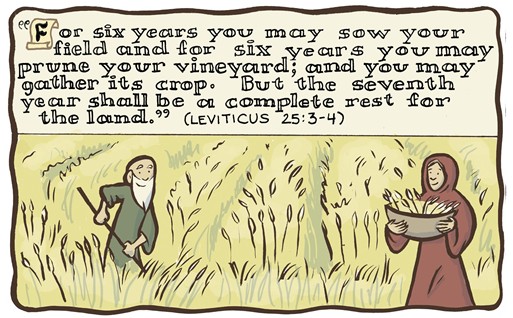
The seventh year is also a test of faith.  The Torah itself notes: “You may wonder what will we eat in the seventh year if we do not sow or gather our grain?” (Leviticus 25:20). This is the obvious question a famer would ask.  The Bible answers that God will take care of it. While we do not plant on the Sabbatical, we do eat what grows by itself, but cannot sell it.

Not planting any new seeds is a test of faith. The farmer could think that his income depends purely on his personal effort. If he doesn’t plow and plant how will anything grow?!

Of course, he could plant his seeds, and there could be drought, storms, disease or crop failure. His planting is not a guarantee of success. The sabbatical year is a reminder of this. Your personal efforts are necessary, but they are not the only cause of your achievements.

In modern life, you make your effort and invest your energy, but still so much depends on other people, situations, and luck or blessing. But this is not an excuse to refrain from putting in your time and talent. Changing yourself into the best version of yourself makes a much bigger difference in your success than whatever external factors you face.

The Jubilee year, every 50 years, adds an additional level of freeing Jewish slaves. This was only for those men who  had chosen to stay on after their original 6 year term. Other slaves already were freed every seventh Sabbatical year, only those men who volunteered to stay with their master still need to be freed on the Jubilee year.

Even though very few men were actually freed, there was a great public celebration of the concept of freedom on the Jubilee year, to remind us that we are supposed to be servants of God, not servants of other men.

The other additional practice of the Jubilee is returning ancestral land to the original family that it was granted to when the Jewish people divided the Holy Land. In ancient times a man and his family had a much deeper connection to their ancestral land.

This is a powerful idea that sadly is lost in modern society, when men are typically much less connected to the land they own. In modern times perhaps we buy a house and live there for a decade or two, maybe make a little garden or plant a tree.

In the ancient agrarian society in Israel, a man’s field had been in his family for centuries. Men were tending trees that their great grandfathers had planted, drawing water from the wells that the Patriarchs had dug.

The personal family connection to the land ran deep. If a family became poor and had to sell their ancestral plot, this was shameful, and they would work very hard or borrow money to get it back. However, even an ancestral field that had been sold out of necessity was returned to the family at Jubilee, cementing the family to their land. Our ancestors would sell, really rent, ancestral land on a prorated basis to account for this, see 25:15.

The ancient Jews blew shofar throughout the land to signal the Jubilee (Lev 25:9), the year of reconnecting men to their land and freedom from even voluntary bondage.  This verse is on the famous Liberty Bell in Philadelphia: “Proclaim Liberty Throughout All the Land Unto All the Inhabitants thereof.”  Lev 25:10.

Your Brother and independence

In Behar the Bible repeats your responsibility to act “when your brother becomes impoverished” and directs us to take care of our brothers (Lev 25:25, 35, 39, 47). We are commanded to treat other men fairly, even when they become poor and must hire themselves out as workers or as slaves.

It is important to understand what the Bible actually means by taking care of others. When your fellow loses money and needs to sell his ancestral field, you try to get him set up with a job to earn what he needs to buy it back. We want this man to be able to work for himself on his own land instead of hiring himself out to work someone else’s plot.

The Bible wants us to help keep a man connected to his ancestors and his heritage. When he loses his fields and money, we are urged to help him to buy a field, or lend money to start a business or give him merchandise to sell on commission. If he falls deeper into debt and has to sell himself as an indentured worker or slave, we are urged to help him buy his freedom and get back on his own feet.

When he works for you, you don’t treat him in a demeaning way or give him meaningless busy work. You have to use his work wisely to contribute to your business, so he actually adds to your production. This saves his self esteem.  Even though he is working for another man, his work is considered valuable and respected, he does not feel that his talents are wasted.

The highest level of charity is to give your brother, to give any man, a handout but not a hand up. The Bible does not want men to remain dependent on others, God intends for us to help other men become independent. When a man is dependent on you for his livelihood, you must make sure he feels that he is contributing.

The worst thing for a man is to be paid to sit idle or worse. A man gets used to doing what he does on a regular basis.  When a society subsidizes men to be idle, to waste their time and fail to develop their talents, that society will get more of that in the future.

Your own land

Judaism is an individualist faith, and the Bible states that the ideal situation is each man living on his own ancestral land, working for his own family.  A man tending his own land, the land of his fathers, has a deeper connection to his work and respect for the land.

He will not let the land be wasted or polluted since it is his family heritage, not just another asset on a corporate ledger.  He husbands the land with care since it will be used by his sons and their sons.  His daily work connects him to the land, past, present and future.

This is much better for the ecosystem than a large corporate farm which is focused on profits and often exploits the earth, animals, and farmers.  We understand intuitively that there is something special about a family-owned farm or business that has been in the same family for generations.

You can’t put a price tag on a man’s pride and his connection to his ancestors and heirs.  It’s preferable, spiritually and psychologically, for a man to own and work his own humble plot than to be a tiny cog in a corporate machine.

Yes, in modern times the large corporations are more efficient on a purely economic level (when ignoring negative externalities).  It appears that the Torah values a man being attached to his ancestral heritage even at the expense of some overall economic efficiency.

This is not to ignore economics entirely, the Bible and Talmud endorse free market economics.  Those “Jews” (many were not really Jewish but children of people who had abandoned Judaism) who espoused communism, socialism and the like were totally ignorant of our tradition and wisdom.  The Bible endorses the exact opposite of communism in Deuteronomy 15:11 and 2 Kings 7:1.

The Torah goes on to describe the blessings that will come from observing the sabbatical year, Lev 26:3-13.  These begin with rain, produce, and bountiful harvests.  Amazingly, these are physical blessings of abundance.  You would think that the Bible would reward us in spiritual terms.  God promises we will have plenty, then that He will be among us.  This is a deep lesson.

Sometimes wealth leads men to reject God, thinking that their own skill or brains brought success.  Here, since we have proved our faith by keeping the sabbatical year, God knows we will use the material gain for even more spiritual growth.

We will have plenty, but not grow arrogant from this (God does not reside with the arrogant).  The bounty will give us extra time to devote to learning and personal growth, not to stuffing ourselves with meat and wine.  We will reinvest our time to build up our souls.


The Rebuke

Now the scary part.  A failure to observe the sabbatical year and God’s commands bring curses, disaster, desolation, and death, Lev 26:14 et al.

But if you will not hearken to Me, and will not do all these commands; if you shall despise My statutes, if your soul shall abhor my laws, so that you will not do all My commandments, and break My covenant, I also will do this to you; I will appoint over you terror, consumption and fever, that shall consume the eyes, and cause sorrow of heart…

I will set My face against you, and you shall be slain before your enemies; they that hate you shall reign over you, and you shall flee when none pursues you…

I will make your skies like iron, and your earth like brass. Your strength shall be spent in vain, for your land shall not yield her produce, neither shall the trees of the land yield their fruit…

The Torah goes on to detail off the atrocious calamities and epic disasters that will come upon the Jewish people.  A serious student of history will tell you that over the millennia since Sinai, every single one of these curses have come to pass.

Planting on the seventh year causes destruction and curses?
Remember what the Sabbatical symbolizes. It is a reminder you must take time to improve yourself, not get lost in the daily grind.  A reminder that you are not the end all be in in this world.

You will some day pass from this world to the next world. The land will remain when you are buried in it. The Sabbatical provides much needed perspective on life and personal growth.

The other cause to these disasters and curses was the lack of brotherhood. The Bible has just commanded us over and over to take care of our brothers: help them to get their land, start a business, redeem themselves from debt and slavery.  To support and treat them well even when they are poor, working for us, or even enslaved.

These commands of responsibility to our brothers are juxtaposed to the curses, and this is for a good reason. The lack of brotherhood brought the destruction.

What follows is such a heinous story that I am reluctant to reveal it, but in modern times our ancient Talmud is already translated and online for anyone to see.  We are just lining up the dots to learn the lessons from this abomination.

The Talmud in Gittin describes the destruction of the Temple, and our sages delve into the causes and consequences.  Among the causes our sages recount in Gittin 58 is an incident where one Jew took advantage of his fellow in the worst way:

Rav Yehuda says that Rav says:  What is the meaning of that which is written: “And they covet fields, and take them by violence; and houses, and take them away; so they oppress a man and his house, even a man and his heritage” (Micah 2:2)?  This refers to an incident involving a certain man who set his eyes on his master’s wife. He was a carpenter’s apprentice.

Once the master carpenter needed to borrow some money, and his apprentice said to him: Send your wife to me and I will give her the money. The carpenter sent his wife to him, and the apprentice stayed with her for three days.

He then went back to his master carpenter before she did, and the master said to him: Where is my wife whom I sent to you?
The apprentice said to him: I sent her back to you immediately, but I heard that on her way, a group of youth sported with her and lay with her.

The master said to his apprentice: What shall I do?
The apprentice said to him: If you listen to my advice, divorce her.
He said to him: But her marriage contract is large and I do not have the money to pay it.
The apprentice said to him: I will lend you more money, so you can pay off her marriage contract. The master arose and divorced her, then the apprentice went and married her.

When the time came that the debt to the apprentice was due, the carpenter did not have the means to repay it. The apprentice said to his master: Come and work off your debt with me.
And they, the apprentice and his new wife, would sit and eat and drink, while he, the woman’s first husband, would stand and serve them their drinks.

Tears would drop from his eyes and fall into their cups, and at that time the Jewish people’s sentence was sealed.  And some say that the Jewish people were punished for two wicks in one lamp (a euphemism for the sin of adultery committed over the three days while the woman was still married to the master carpenter).

This apprentice does the opposite of what the Torah commands. He covets a married woman, the wife of his own teacher who is helping him learn his trade. The apprentice concocts a scheme to steal not only the wife, but also defraud the carpenter and enslave him via debt. He brings the wife in on the plot to betray and humiliate her own husband.

The wife was by him for three days; those who blame the destruction on “two wicks in one lamp” say that during this time they did indeed commit adultery.  Even if they did not actually have intercourse, she was abandoning her loyalty to her husband as they hatched their plan to entrap him.

What the apprentice and the carpenter’s wife did was the opposite of what the Bible requires. We are commanded to help our brothers get out of debt and out of slavery, to aid them in becoming independent and self sufficient. These horrific sinners who should have had the most respect for him defrauded the carpenter into debt slavery.

It is interesting that crimes of the apprentice were motivated by his lust for the carpenter’s wife. A woman can easily come between two men who had been loyal friends. A lustful man can put his desire for a woman before his obligations to his fellow men. The faithless wife was happy to go along with the plot.

The Blue Pill carpenter

The master carpenter himself is an interesting character. No man in a healthy marriage would immediately believe that his wife had taken his money and run away with a group of men for illicit purposes. In Jewish law, we do not typically believe a single witness, we require two qualified witnesses to establish any legal reality. Rumors are only somewhat credible when they are “the talk of the town” for a time (Yevamot 25).

It seems insane that he would decide to divorce his wife based on only an unconfirmed rumor. Probably this carpenter had already seen some reasonable indications that his wife was less than loyal. Maybe she was flirting with other men and seeking male attention. As we learned in another frightening Gemara, such behaviors became more common just before the first destruction of Jerusalem, as Jewish women emulated Greek and Roman behaviors.

Married woman seeking attention from other men was a contributing cause of the destruction and exile. These faithless wives mirrored the Jews who were straying after idols. The carpenter already realized that his wife was less than loyal, which is why he believed the story from his apprentice.

The master carpenter was also very careless, sending his wife to collect a large sum of borrowed money, when he should have sent two men as witnesses to payment. Then he does nothing for three days, perhaps not even realizing his wife was missing. Then he believes the story that a group of men sported with (seduced) the wife.

If something like that really happened, he would be able to find witnesses, or at least rumors that would clarify if the wife was actually involved in such behavior. If she was willing to participate in adultery, she would lose her marriage contract entirely. In Jewish law a man does not pay a penny to a faithless wife, and cannot remain married to her. We do not allow a woman to profit off of adultery or branch swinging.

The carpenter was ignorant of basic Jewish law regarding witnesses and marriage contracts, and he had also dug himself into a bigger hole by adding on to the basic amount of the marriage contract. A Jewish marriage contract states how much a woman can collect when a marriage ends, the default amount is the only the value the food a person needs for one year.

Perhaps this woman was very pretty and the extra money he promised to her was an inducement to marry him.  However, she only could collect that extra money upon his death or divorce. Promising a large amount in a marriage contract could incentivize her to engage in bad behavior (as long as it did not rise to the level of adultery) to precipitate a divorce and payout.

This carpenter was victimized in a horrendous manner. He lacked the education and ability to create and enforce boundaries with his money, his wife, and his apprentice. He let his wife, already suspicious in his eyes, handle a large amount of money, and did nothing about it for three days. Then he did not even investigate her alleged abduction/seduction by a gang of young men. Jewish law has a test for suspected adultery, but it only works if the husband demands it. He did not know enough about the law or about women.

This is a strange situation, it seems the carpenter never learned fundamental Torah laws and also lacked an understanding of what a disloyal wife could be capable of. He was what is today called “blue pill”, meaning unaware of the reality of human nature and relationships. The carpenter was also unaware of the religious laws that are needed to control the excesses of human greed.

Our sages bring this story since it illustrates not only a heinous lack of loyalty between men and a man and his wife, but it also shows that there was a lack of will to educate such men with the wisdom to avoid such pitfalls.

Our ancient society just before the destruction allowed men to remain ignorant of the dark side of human nature and female nature. For the “people of the Book” who value learning and teaching, this was a profound educational failure which led some to fall into terrible traps. That is why that society was doomed.

We must carefully consider how modern mainstream society in America educates young men today. Often they are indoctrinated to prioritize the wellbeing of women above their own goals, and to ignore and excuse bad behavior by others.

Many young men spend their time, energy, and money providing a soft landing for women who made serious life mistakes. This is in large part because they were acculturated to do so. Some men realize the issues and become MGTOW, or become “lost boys” seeking guidance and masculine wisdom to provide answers that society never did.

Mainstream culture does more than just fail to educate, it actually misleads men into becoming white knights, at their own expense. Is contemporary society any less guilty of a massive failure of education which results in countless men being mislead and misused?


The Chosen People(s)?

Even though Behukotai teaches that the Jews were cursed and rejected, this state is explicitly temporary:

Then I will remember My covenant with Jacob.  Also My covenant with Isaac, also My covenant with Abraham will I remember; and I will remember the land…

Despite all this, the people of Israel shall forever remain God’s people: Even when they are in the land of their enemies, I will not despise them; nor will I ever reject them, to destroy them, breaking My covenant with them; for I am the Lord their God. (Lev 26:42-45)

There are major monotheistic religions that piggyback on Judaism. Their view of spiritual history is that God chose the Jews as the “Chosen People”, gave them the Holy Bible and Israel, but then the Jews blew it with idolatry. So God punished the Jews and chose a new people to replace the Jews.

These piggyback faiths accept that the Bible is holy and of Divine origin (or at least inspiration), but add on a “new covenant” or claim that they have replaced the Jews as the contractual party to the original covenant.

Historically, this tension has caused a lot of doctrinal problems, as the new self-appointed chosen people had to account for the continued existence of the previous chosen people. To show that the ex-chosen were really rejected, the new chosen would oppress or impoverish the other. Throughout the past 2500 years this was done through exile, forcible conversion, taxing, beating, and outright murder of Jews.

If they did not agree with the new religion, they would be kept downtrodden, poor, and despised, to be a humbled witness that the new chosen are the real chosen now. Pushing the Jews down was a way to reinforce a belief that the new monotheists were the real chosen.

Among these new chosen, there were arguments and wars over which sect were the real chosen, since the other groups would be going to hell. The 30 years’ war is one example.

Just a few centuries after the first new group espoused that they had replaced the Jews, a new group of self-appointed chosen people in the middle east claimed to replace both of the preexisting monotheistic faiths. They went after the first group of self-appointed chosen people, leading to centuries of religious wars and crusades, invasions and counter attacks. Even when all three groups coexisted for a short time, the dominant group would tax and restrict the others.

In modern times, many new “-isms” have cropped up. These movements or philosophies effectively replace religion as focal points for humanity. While these are often political or environmental movements and many are anti-religion, their followers, like the religious, also see themselves as uniquely chosen to save or rule mankind. They believe that their  new doctrines are true for all of humanity, to the exclusion of all prior faiths.

This entire doctrine of replacement contains a serious  error. The Bible explicitly says despite all the stubborn, evil, and downright repulsive things the Jews did over the millennia, God will never abandon the Jews.  It’s right here in the Bible, Lev 26:42-45. So, if you accept the Bible as the Word, or Truth or at least “inspired”, the Jews are still the Chosen people. God says so.
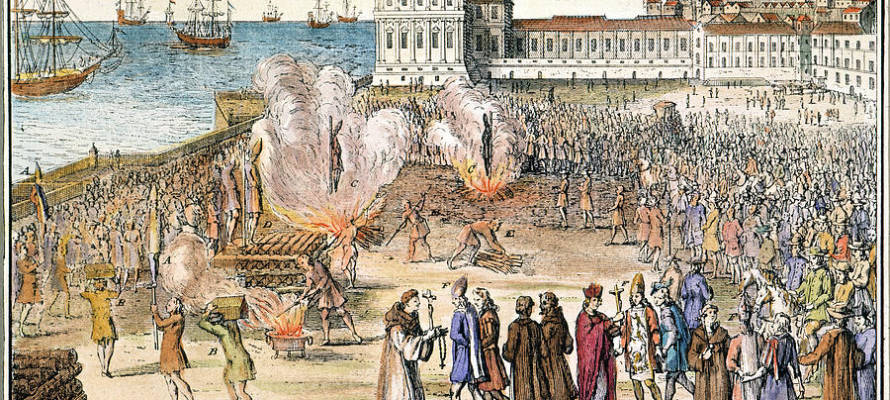
The deeper question is, if you are correct that God abandoned the Jews and then chose YOU, why would you want a God that makes promises and then breaks them? Requiring the breaking or bending of the Divine covenant as the basis for a faith is a crippling spiritual flaw.

Shouldn’t God’s promises and covenants actually be eternal?  When someone claims to be is stepping into the shoes of the original rejected human party to the covenant, this is a tacit admission that God could change His mind again. Who is to say that God won’t get tired of his antics and chose a new group again?

To illustrate: Sally marries Joe. Eventually, Sally gets bored with Joe, and she feels he isn’t man enough, so she cheats on Joe with Jim. Jim feels great that Sally chose him so her marries her. He doesn’t see any problem, after all, he is way more of a man than old boring Joe with his backwards ways. Their marriage goes fine for a while.

Eventually, Sally gets bored and cheats on Jim with Johnny. Johnny feels great that Sally chose him so her marries her. He isn’t worried, he is secure in his masculinity and feels he is much more accomplished than old Joe and Jim ever were. Their marriage goes fine for a while. Sally starts eyeing Javier…

Let’s think. If she broke her first marital covenant, why won’t she break the second?
Would any man with any sense marry such a branch swinging woman? Would you place an incorrigible cheater on your personal pedestal?

Would you deify a deity that acts like that?

This is the problem for piggyback faiths. If they say God chose them, that means God (in their eyes) is like a cheater who breaks sacred promises. It also means that for them, a lot of verses in the Bible are not true or eternal. It smacks of theological desperation.

Listen, you can believe whatever you want. You can still enjoy Jewish wisdom and insight without believing in anything. Jews are not out to convert anyone. We don’t have a monopoly on God or on heaven (yes, you can have eternal reward without being Jewish).

If you don’t think the Bible is true, then it doesn’t matter if Jews were or are chosen. But it is dishonest for people to claim that they believe that the Bible is true, but that they also believe God is faithless and the verses in Bechukotai are not eternal. Those people need to be honest about the serious theological conundrums they are causing themselves.