Korach: conspiracy, leadership, and female influence

This week we study the section of Korach, Numbers 16:1–18:32.  Korach, a cousin to Moses and Aaron, is an enigmatic figure. He objected to Moses choosing his brother Aaron as High Priest (Cohen Gadol) and then picking a different cousin to be head of the tribe of Levi.  Korach felt he was better qualified for these jobs, but that Moses had played favorites.

Korach organized a revolt of 250 men, promising them that they would all share the high priesthood (Kehunah) under his leadership:

Korach the son of Yitzhar, the son of Kehat, the son of Levi rebelled, along with Datan and Aviram, the sons of Eliav, and On the son of Pelet, descendants of Reuben.  They confronted Moses with two hundred and fifty men from the children of Israel, chieftains of the congregation, representatives of the assembly, men of repute.

They assembled against Moses and Aaron, and said to them: “You take too much (power) for yourselves, for the entire congregation are all holy, and God is in their midst. So why do you raise yourselves above God’s assembly?”
Numbers 16:1–3

Korach promised his faction that they would all be equal, taking turns serving as High Priest in the Tabernacle.  His intent was to use his followers to seize power for himself alone.  In a sense, he was the first communist.

Communism is not a Jewish concept, as we will explain below. The men who invented and imposed modern communism were not basing it on anything remotely Jewish.

Moses tries to talk them down. When they refuse, Moses challenges Korach and his aspiring priests to a spiritual showdown: they will all offer burnt incense to God and God will pick the man He wants to serve (16:7).  This setup was to prove that it was in fact God and not Moses who had chosen Aaron.

In front of everyone, the earth opens and swallows Korach’s household and his co-conspirators Datan and Aviram (16:32), while a fire from above consumes the men offering incense, leaving only Aaron alive (16:35).

The people, seemingly unimpressed by the miracles, complain that Moses had Korach’s supporters killed just to validate his personal appointments to leadership (17:6).  Subsequently there is a plague, which Aaron is able to stop by burning incense among the sick (17:12-15).

Then God commands a test, a staff is brought from each tribe.  Aaron’s priesthood is proven through his staff blossoming overnight through a Divine miracle (17:17-24).  God commands that Aaron and the Levites take responsibility to safeguarding the Tabernacle (18).

Interestingly, the conclusion of the portion reveals that the priests (Cohanim) and Levites will not receive ancestral land in Israel like the other tribes.  Their inheritance is the Divine service they are responsible for.  Instead they will receive a tithe of 10% of crops, and certain other gifts, in exchange for their service (18:20-32).

Who is holy?

Let’s take a look at the complaint of the rebels, that Moses was playing favorites by installing his brother as sole high priest when they were all qualified:  “The entire congregation is holy, and the Lord is in their midst. So why do you raise yourselves above God’s assembly?” 16:3.  They are technically correct, every man, woman, and child is holy in God’s eyes.

Moses points out the Levites already have a great position and honor among the Jews (16:7).  They were charged with assembling, disassembling, and transporting the Tabernacle, the portable sanctuary.  They were honored as teachers and spiritual leaders among the Jews.

As a Levi, Korach’s job was to carry the sacred vessels of the Tabernacle.  This was an important position reserved for his family.  However, Korach felt that he was on a higher spiritual level and deserved not just honor, but the highest honor.

While there are no limits to a man’s spiritual growth, a man must grow in the area that is appropriate for him, not in the domain of different people.  God gives a man specific tools that each of us must develop and apply to our chosen mission.  Jealousy for a different man’s toolkit results in a lack of focus on your own main task in life.

There is an ongoing tension in modern Judaism that reminds of this.  Some conventional (Orthodox, Hasidic, etc.) Jews lean towards taking on more stringencies and holding themselves to higher standards in Jewish law.  There are sometimes valid reasons to be more stringent than the letter of the law requires.

However, some people trying to do more than others may also desire to appear more religious.  Some undertake extra religious practices to differentiate themselves from others or to gain more respect in the eyes of their friends.

Jews already have a multitude of commandments and laws that guide our every detail of our lives.  It may be wiser to perform the basic level of spiritual requirements with more passion and care, rather than to take on new practices or higher standards.

Our sages say “better a little bit with pure intent than more without intent” and “whether one brings a great amount or a small amount, as long as he intends his offering to God”.

A man who wants to enhance his greater spiritual level through undertaking more stringencies must carefully examine his motivations [“koach dhetera adif].  I do not pretend to understand your heart, but you may be pretending to!  Be meticulous and thoughtful before beginning a spiritual mission or accepting a higher standard.

Female expertise

This reading focuses on the actions of the men in leadership positions.  What about the women?  What were they doing during these dramatic confrontations?

First, we should keep in mind that women naturally prefer (and are better at) communicating and operating covertly, while men default to interacting overtly.  This has been proven with studies showing women are more attuned to nonverbal communications and better able to pick up the implied intent and emotional content of verbal exchanges.

Men are typically focused on the obvious level, the content of the words, and are often not even aware when communication is also happening on a covert or non verbal level.  Humans have been created by God with innate gendered differences in brain function that drive these distinctions.  Our sages (Niddah 45b) teach that the Holy One, Blessed be He, granted women a greater understanding [bina] than that of a men.  Binah is the form in intelligence associated with communication, insight, and subtle details.

Men are more associated with Hochma, intelligence related to clear, direct insights.  In recent deacdes, women in mainstream society have been pushed and manipulated to act in the same way that how men naturally behave.  Nowadays some women are overt and aggressive.  Of course, they also still engage in covert communication as well.  You will see women employ nonverbal signals, in addition to words, to express their preferences.

This is common when meeting new people and dating.  A man should know to look for subtle cues of female interest and disinterest rather.  A woman who makes eye contact and smiles at you is sending a strong message, and it is up to you to get it.  Actions are always the best measure of intent, not words.  She may tell you she is interested, but if she avoids you or does not return your communications, that is the message, as “the medium is the message”.

However, many women, due to being pressured to act like men, rely on using overt communication to get what they want, not just in the public sphere but at home as well.  [There is also a recent trend of men in modern secular society relying on the implied quid pro quo of “covert contracts” in relationships.  We endorsed the book “No More Mr. Nice Guy” by Dr. Robert Glover which explains this concept].

Just a few of generations ago, and for the vast majority of human history, women exercised power and influence in a covert manner.  In most societies they could not openly wield power to challenge men, unless they were a queen.  Women would resort to behind the scenes persuasion and manipulation to further their own interests.  As we learn in Korach, that women were very good at this.

We must note that I am not making a moral judgment about manipulation, every human being employs some form of manipulation as a tool for living.  A baby crying is a form of manipulation; one that is absolutely necessary to sustain his life.  When used for good, manipulation is good.

With these gender differences in mind, let us explore what Jewish tradition teaches about the women in Korach.

The Medrash* (Medrash Hagadol, Bamidbar 18:1) describes how Korach’s ambitious wife subtly inflamed his feelings of jealousy for Aaron’s selection as High Priest.  The Medrash teaches that Mrs. Korach wanted her husband to have the highest, most respected role in her society.  Obviously this would improve her own standing.
[*Medrash fill in the backstories to the Bible, they oral history statements that were passed down by generations from the Jews who were on the scene and eventually written].

She brought up the idea of challenging Moses’ authority through attacking the law of “techeilet”, the one blue string in the tzitzit tied into the corner of a prayer shawl.  She proposed making a shawl entirely of techeilet, and asking Moses why would a garment that is entirely blue need another blue string in the corner?  She was telling Korach that he should argue to Moses that the entire congregation is holy, so they don’t need one man to serve as High priest.  That would be like adding the one special blue string to a garment that is already blue.

Mrs. Korach was hinting to him that he should use this approach to challenge Moses and Aaron and argue that all Jews can be spiritual leaders.  She was upset he had been passed over for the job; she felt she was on such a high level that she deserved to be the wife of the high priest.  With her behind the scenes instigation and inspiration, Korach went ahead and made the blue shawls for his rebels as a visual aid to his vendetta on Moses and Aaron.

Korach was already rich and respected, a heavy hitter in the big leagues.  He was able to convince Datan and Aviram and 250 important men to go up against Moses.  He used his position to invite the nobility and high ranking Jews to fabulous meals, where which he would complain about Moses’ leadership.  These complaints found traction after the episode of the spies.  Korach was way up on the pyramid of power, wealth, and influence.

Mrs. Korach wanted her husband to be the not just high, but the highest spiritual leader, so she would be elevated to the top of her society as well.  She employed manipulation, in the private sphere of her own tent, to induce her husband to adopt her own goal as his own.  She even gave him the shrewd idea of the blue shawls as a visual challenge to Moses.

We recently mentioned the power of the original snake, the spiritual source of the jealousy a man can nurture in his heart for another man.  This venom is not limited to men, a woman can also want what someone else has, or simply a better lot for herself.  Women are created with the desire to mate with the best man they can get.  In modern culture this can manifest as (God forbid) disloyal behaviors.

In ancient times, when adultery brought the death penalty, a woman who wanted more status for herself would try to get her husband to become more than he was already.  As he improved she would then be raised up with him.  This could certainly be beneficial, motivating him to pursue spiritual or financial growth.  A woman who wisely incentivized her husband to improve his lot would find herself elevated along with him.

However, this could also bring disaster, as a woman jealous of others might drag her husband into challenging them and losing his own position.  In Korach’s case, he and his wife were dragged down to hell.  This is also a major theme in Macbeth.

There was another woman operating behind the scenes in this episode: the wife of On (pronounced own) the son of Pelet.  On was mentioned as part of the conspiracy when Korach began the revolt (16:1) but then does not appear again.  It seems he dropped out of the revolt.

The Medrash (Medrash Hagadol, Bamidbar 16:32) fills in what the Bible hints to.  On, a noble in the tribe of Reuven and neighbor to Korach, had attended Korach’s parties and agreed to join the revolt.  When he returned home and bragged about his upcoming promotion, his wife asked him what he would gain from joining Korach.  After all, since he was not a Levi he could not become a priest or the high priest, that was God’s rule.  She told him it was foolish to risk his own life and position to help another man win greatness for himself.

Like Mrs. Korach, she exercised influence on her husband within her own tent.  She did not oppose or challenge On, but got him to see that he had nothing to gain and a lot to lose.  Unlike Mrs. Korach, her eyes were not clouded by jealousy and self aggrandizement, so she was able to recognize the danger for her husband.  She felt that she was fine being the wife of On, a nobleman; she didn’t need her man to try to become a bigger leader at the expense of others.  Mrs. On persuaded her husband to see that he had no upside in joining the revolt.

Unfortunately, he had already sworn an oath to join Korach.  His wife said she would take care of that.  She mixed him a strong cup a wine and put him to sleep.  When Korach sent his messengers to summon On for the rebellion, she came to entrance of the tent with her hair uncovered.  Jewish women are accustomed to cover their hair after marriage.  This custom is so strong that if a wife refuses to cover her hair, the husband can divorce her and she forfeits her alimony.  Now, this requirement is only in public.  A woman inside her own tent or home can have her hair uncovered.  The most stringent and pious women would go beyond the letter of the law and cover their hair inside too, and certainly when answering the door.

The men of Korach’s conspiracy were holding themselves out as being on a high level of holiness, all fit to be High Priest.  They expected the wife of their collaborator On to cover her hair even inside her tent.  When she came to the entrance uncovered they turned back at the immodest sight, and decided that On himself was not good enough to join their revolt.

This is really interesting.  They assumed On was not fit to join them in fighting to be a potential high priest because his wife came to the entrance of the tent with her hair uncovered.  They could draw conclusions about a man based on the behavior of his wife.

3400 years ago you could draw very accurate inferences about a man from his wife’s behavior.  The husband was the man of the house, responsible for the material and spiritual wellbeing of his whole family.  If he wanted his wife to cover her hair even inside then she would listen.  Typical women spent most of their time inside the house, with their family.  Their husband was the greatest they saw on a regular basis.

A man, be default, had what moderns call “headship” of his family.  This was not just authority, but responsibility.  The buck stopped with the husband and father.  This is why Korach’s men assumed that if Mrs. On would come to the door with her hair uncovered, this reflected On’s personal policy.  Since he was lax about spiritual stringencies in his own tent, then he wasn’t fit to join their holy revolt.

Today, outside of a tiny minority of households, this cannot be assumed.  Women are exposed to all sorts of influences and ideas.  They expect and demand freedom to make their own decisions, even about spiritual matters.  We can no longer really tell the level of a man based on his wife’s behavior.  Yes, a man has influence, but must take care when guiding his wife.  In our generation this is best accomplished in a gentle and subtle manner, by giving approval for desired behaviors and reducing his attention and affection when she is acting out.  But nowadays a man does not normally exercise direct overt control over his wife.

This example shows us that in the biblical society the relationship between man and wife was quite different.  The wives of Korach and On teach us how women could indeed wield significant influence from behind the scenes, through their husbands and family.  As they used to say, behind every successful man is a supportive woman.  A woman used to cultivate this influence and excelled at employing covert power to guide their husbands towards the outcome she wanted.

For the vast majority of human history, women focused inward at their own families and husbands, while men focused outwards on their business, society, and politics.  A woman was the head of her household but would defer to her husband’s opinions regarding matters outside her own tent.  However, for external matters she would use her influence and persuasion to help her husband understand which choice was best for the family (and her).

Nowadays, women are being conditioned to operate overtly in the public sphere, and without regard for the opinions of the men in their life.  Women are manipulated to prioritize advancing their careers and egos more than starting their families.  This often leads to misery, when a working woman cannot find a suitable mate and ends up alone.  She never gets the same satisfaction from a career as she would have from a family.

More than that, in the public sphere she must employ outward communication.  Without a family she has little chance to use her subtle powers of influence.  Acting in accordance with the new feminist script has resulted in an atrophy in the innate female ability to exert covert power in a private sphere.  Many women have lost their skills at influencing their own families through traditional feminine power, even as they throw their weight around more and more in public.  This has serious consequences for their own relationships and ability to achieve what they want.

Some women will brag about their business or career, as if that is what makes her attractive to men.  This is actually a projection: women desire a man who is successful and confident.  A woman who has focused on her developing her personal power and influence in the public sphere may be less able to wield power privately in a productive manner.  After all, she has grown used to being overt, and will default to that under stress.

A wise man will notice which women in his life have an outward focus, and compare them to the women who are more restrained in public, and instead focused on family.  He will also take heed when a woman expresses her desires subtly and with polite persuasion, instead of overtly demanding what she wants.  A man who knows what he needs out of life  for his own mission will select accordingly.


Chosen man, chosen people

Korach made a sensible claim, asking how it can be fair that one man was elevated over the rest when everyone is holy.  Interestingly, the same argument could be made against God Himself:  why pick one nation from all the rest to be the “chosen people”?

After all, human beings are all made in the Divine image (Genesis 1:27) and have innate holiness.  Of course we know God has no body or image, this means every single man has a spark of Divine power to achieve amazing things in this world.  Isn’t the concept of some people being different or “chosen” bizarre when God made us all “in the Divine image”?  This is a radical question to ask in the modern age.

The answer is given by God, is that Jews must work to become a kingdom of priests and a holy nation, a small group engaged in spirituality and holding themselves to a higher standard.  This is the mission God asked of us in Exodus 19:6, before giving the Bible.

We have to serve the world as teachers and priests, not as monarchs or rulers.  To be a “Chosen People” means greater responsibility, not greater power and privilege.  (This is the reason why Jews get blamed for everything).

God didn’t tell the Jews they are better than everyone else, but that they will have to work harder, bear more responsibilities, and take more blame.  We have to be “a light for the nations”, and everyone looks at the lights, seeing both merits and flaws.

Jews don’t proselytize, we don’t try to make other people into Jews.  God’s command for us to be on a high standard to inspire others would make no sense if everyone became Jewish.  Besides, God told us we would always be a tiny nation among humanity.

We believe that you don’t have to be Jewish to go to heaven, our sages say “the righteous of all nations have a share in the world to come”.  Our role is to only to teach and inspire through our own loyalty to God’s will, not to change and control others.

Humans needs hierarchy, that is how we were created.  If every man is a priest, then no one is a priest.  If every group is holy, then no one is holy.  If every man is an inspiration, no one is an inspiration; every man will look only to himself instead of looking for leadership.

Without a sense of leadership, then every group, nation, tribe, and man would look only inward, not to others who may be able to inspire them to improve in certain areas.  Men are created to look up to other men who attain something more, be it in athletics, business, academics, or even spiritual growth.

Men grow through competition, looking to high achievers for inspiration and guidance.  Leaders, ranks, and distinctions are a necessary reality of life as a man.  To want to level the playing field ignores human nature – the nature that God put into us.

Korach proposed flattening our the power hierarchy, opening up leadership positions to any worthy men (those chosen as worthy by Korach).

He proposed to his conspirators that they would share power since they were all on a high spiritual level.  He was espousing what me might call spiritual democracy, letting any man serve in the Tabernacle.

This sounds so appealing, but he was wrong.  The ancient ritual service required a single focus, one man elevated above his brothers, as we have described.  The high priest has to be the holiest man in Israel, he cannot attend funerals, he can only marry a virgin, and he atones for the whole nation.

If 250+ men were all on this highest spiritual level, it would no longer be a unique level.  When everyone is special, no one is special.  Per Divine command, the high priest himself performs a service once a year on Yom Kippur, the day of atonement.  There is no way it can be shared or divided.


Better to rule in hell…

Leadership is not simply an opportunity to exercise power and inspire others, but a serious responsibility.  Korach proposed to take turns as spiritual leader. Everyone that Korach felt qualified for the role would get a chance to serve in the Tabernacle and lead.  But this ignores the aspect of assuming full responsibility.

God tells Aaron that he is personally responsible for ensuring the sanctity of the Tabernacle and service (18:1).  To ensure the task is properly performed, one man must be in charge, exercising sole authority and having full responsibility.

Our sages teach that “A pot belonging to partners never gets fully cooked”.  This means when no single man has full responsibility for the cooking, no one man will wholeheartedly put in the firewood or effort.  If 250 plus men would share the job of high priest, no one man would feel obligated to put in his heart and soul.  When something went wrong they would pass the buck to the others.  If there was a mess, one man could simply leave it for the next guy.

No one would put all his energy and spiritual heat into to ritual service.   This would cool off enthusiasm the service.  Indeed the name Korach is cognate to the word for ice.  Democratizing the position of high priest would have effected a cooling off and degrading of the spiritual heat of the Jewish people.  Korach was a great man, but perhaps subconsciously he felt it would be better to be in power himself, even over a lower and less respected institution, then be out of power with the fire of the Jewish ritual service intact.

An extreme example of this mindset is put: better to rule in hell than serve in heaven.  The Torah makes us aware that some men have this motivation.  They may be a part of your business, sports team, religious, or social group.  When they cannot be in power they may undermine those who are leading, or the institution itself.  They may propose opening membership to a broader group of people, even though that would water down the mission of the institution or require lowering your high standards.

This is something to look out for, especially if you are currently leading the group.  Much of the book of Genesis taught us about the importance of men being aware of power hierarchies, and a man using power and leadership responsibly for his own family or tribe.  The lesson of Korach continues this theme.

Daily dose of wisdom, Shabbat 112: sandal straps and historical relativism

In Today’s learning we examine tying knots on Shabbat, including on shoes and sandal straps. Permanent knots are forbidden while temporary knots are allowed, for example shoe laces that are regularly untied.

Our sages point out that if the sandal strap holder on the outside edge broke, the sandal is no longer considered a useful utensil and cannot be moved on Shabbat.  The sandal could be repaired after Shabbat, but would need to be switched to the other foot.  They explain that a man would not wear a sandal where the repair was readily visible, so he would switch sides.  If the repaired strap holder was on the inside of his legs it would be less apparent he was wearing repaired sandals.  If you don’t think people notice little things like shoe straps, ask women, they always notice shoes.

The wisdom here is when you have weaknesses in your persona, areas that need work, you should not flaunt these. You should work to repair them, but also to keep out of sight. Put the best foot forward, in this case put the best sandal outward.

Today our sages also note a deep concept about how modern men view history:

Rabbi Zeira said that Rava bar Zimuna said:  If we view the early generations are as sons of angels, we are the sons of men. And we view early generations are as the sons of men, we are akin to donkeys.  And I do not mean that we are akin to either the donkey of Rabbi Ḥanina ben Dosa or the donkey of Rabbi Pinḥas ben Yair, (who were both extraordinarily intelligent donkeys) rather, we are akin to other typical donkeys.

Donkey is usually an epithet an any language, so you get the picture.

In conventional Judaism, we respect the greatness of prior generations.  They were closer to Sinai, they had deeper spiritual understanding and strength of character than we do.  Some critique prior generations as lacking a scientific understanding of natural phenomena, but they often had a better understanding of human nature and relationships.

When modern people compare ourselves to the past, it is tempting to say that they were less civilized.  But they were men just like us, doing the best they could with what they knew about the world.  To look down on them is your own judgment, but if you base your own identity on disparaging the past, how will future generations view you?

If you look at your ancestors as if they were barbarians, what are you?

Daily dose of wisdom, Shabbat 111: cocks, castration, and baby rabies

Today’s learning is not for a squeamish man.


The Gemara (starting bottom of 110) mentions that cutting off the crest from the head of a rooster effectively emasculates it, even without touching the reproductive organs. The rooster relies on the crest for it’s sense of manliness. We can learn from the cock. Don’t rely on just one thing to feel that you are a man. You are a man without a sports car or gold watch. Don’t be a one trick wonder.


The Talmud discusses potions that cure jaundice and other issues, but have a potential side effect of causing impotence or sterility. The Torah commands us not to cause sterility in humans or animals (Lev. 22:24).  See our hearty discussion of Noah’s ark, abortion and castration.


The Gemara suggests that perhaps taking the potion is allowed for a sterile or older man. Our sages reject this answer, noting that an action that furthers sterility after the animal is already castrated is forbidden. For example, the testicles were already cut but were still present in the sack. Even though the animal already is sterile, a man who cuts off the testicles entirely is punished. Therefore, taking a medication that causes sterility would be forbidden even for an old man.


A lesson here is that medications have side effects. Even over-the-counter pills like Ibuprofen can cause issues, especially when used regularly. When possible it is better to avoid dependence on medications. Many modern “diseases of civilization” can be militated through diet and exercise. Many psychological issues can be managed, God willing, through changing your situation, relationships, and attitudes about life. When you need medical help do get it, our sages record many medications and cures in the Talmud and many famous rabbis were also doctors. But be aware of the side effects.


During this discussion our sages note that the onus of the Divine command to “be fruitful and multiply” is on men, not women.  This is a complex issue; we will be brief now.  A wise man realizes that woman (normal ones) have a built in biological urge to bear children with the best man she can get with.  God gives them this hormonal reality to offset the pain of childbirth.

Healthy men have healthy urges, but not necessarily for children per se.  You may not even be thinking of that possibility.  Since men are the ones commanded to “be fruitful and multiply”, you should be aware that her motivation with you may include pregnancy, and be mindful of your plans in that area.  Men do have an innate desire to build a legacy, you must decide if children are a part of your mission and enforce your decision.

Daily dose of wisdom, Shabbat 110: snakes and jealousy

Today’s learning includes practical advice on how to avoid snakes.  Now, 2000 years ago snakes were more common and were greater danger to men.  Understand that there is a natural animosity between snakes and men.  The folklore of many cultures puts wings on the snakes and makes them into dragons.  Man’s enmity with serpents goes back to Genesis, when the snake wanted to entrap Adam and Eve to kill Adam so the snake could seduce her.


The Talmud warns a woman how to avoid a snake that wants to violate her, apparently there was an actual instance of a woman being raped by a snake which entered her (when she was sleeping).  One of the proposed methods to repel the arduous snake is to have intimate relations with her husband in front of the snake.  However, the Gemara notes that this might arouse the snake’s desire further and gives other advice.

This is a very interesting piece of Gemara from a red pill lens.  The pursuing “snake” that our sages discuss could easily be a fixated and desperate man.  Some men want what they cannot have, such as another man’s woman.  Seeing that the woman has a mate already will sometimes dissuade a man from approaching this woman.  However, for some men having a rival is a welcome challenge; he will continue to pursue the woman and cunningly try to split her off the man.


This was the mindset of the original snake in the garden of Eden, he wanted to take Adam’s place as the crown jewel of creation, and take his wife.  The snake’s mission was not improving itself, but removing the man and taking over what he had.  He wanted to depose Adam, who had been appointed king over the animals, and steal his queen.  Thus, the snake looked for a way to damage Adam and instigate conflict between him and Eve.


We see this today: some men in their jealousy fixate on the accomplishments of other men instead of working on their own mission or status.  When they see a man with a beautiful woman, they will obsess about the man, and ruminate “what does he have that I don’t?”  This chews them up inside as jealousy builds and poisons the psyche.  The obvious example is “incels” complaining that “chads” get all the girls instead of going to the gym or building a business (if you are not familiar with those terms, you are blessed).  This process is rooted in the first snake, which brought the power of jealousy into the world.  Our sages note that the snake with serpent tongue is also related to speaking ill of others, which is a terrible offense in Judaism and compared to bloodshed.  Many people are said to die because of the spiritual damage done by jealously talk about them.

Daily dose of wisdom, Shabbat 109: health and normalcy

Today’s learning discusses practicing medicine on Shabbat.  In the absence of actual danger, most types of medicine are forbidden, since we are concerned that a man will come to grind herbs to prepare medicines.  When there is danger to life or limb, we are commanded to break Sabbath law to maintain human life (Lev 18:5, Gemara Yoma 85).

The Mishnah examines practices that have medicinal value, such as bathing in certain water sources or eating specific foods.  The Gemara explains that is healthy people bathe in the same waters or eat the same items, there is no issue with using them on Shabbat, even when a man is visibly ill.


For us, there is a lesson that many things we do normally can also enhance our health.  Jews love chicken soup, it’s good medicine.  Many of the traditional remedies were food, Maimonides lists many beneficial foods and also touts regular exercise.  You may take walks already, do it with the awareness that you are restoring your body and soul.  Try to walk in the woods or near water and internalize the tranquility you experience to reinvigorate yourself.


Also, there is a larger message: try to appear normal.  You don’t want people to perceive that you are acting extreme, this can undermine your ability to relate to people.  Our sages say to act pleasantly and be accepted by other men (Avot 3:10, Talmud Ketuvot 20).

Naturally, in this generation even many extreme things are becoming normalized, but we still sense when someone is trying too hard, acting out, or being flamboyant.  Don’t look like you are trying too hard.  You want to be the man doing your thing because you enjoy it, not to get attention from others.  If you dye your hair and play bass in a punk band fine, but do it because it’s you, not to make a statement to people.  If you dress nicely it is because you respect yourself and your station in life, not to show off to others that you can afford tailored suits and gold watches.  Do what you do because it reflects who you are, not to get attention.

Daily dose of wisdom, Shabbat 108: The cure isn’t worse than the disease

Gentlemen, there is an amazing story in today’s learning…

Shmuel and Karna were sitting on the bank of the Malka River (in Bavel). They saw that the water was rising and was turbulent.  Shmuel said to Karna:  A great man is coming from the West, Israel, and his intestines are aching, and the water is rising to greet him.

Shmuel, the head of the academy, sent Karna to check if this man was a learned sage.  Karna met Rav (real name Abba) and started asking questions in Jewish law.  Then:

Since Rav understood that Karna came to test him, he said to him:  What is your name? He told him: Karna.  He said to him: May it be the will of God that a horn [karna] will emerge in his eyes.  (Some explain Karna got a cataract or a wart)

Ultimately, Shmuel brought him into his house.  He fed him barley bread and small fried fish, and gave him beer to drink, and he did not show him the lavatory so the food would stay in his intestines.  Shmuel was a doctor and he wanted to relieve Rav’s intestinal suffering by feeding him food that would relieve him.

Since Rav was unaware of Shmuel’s intention, he became angry at him.  Rav cursed him and said: Whoever causes me suffering, let his sons not survive.  Although Rav eventually discovered Shmuel’s good intentions, his curse was fulfilled, and so it was that Shmuel’s children did not survive long.

Rav thought he was simply being tortured for no purpose. If he had known that this painful remedy would actually cure his intestinal disease, he would have been able to tolerate it.  This is a lesson for us in forbearance.  Many times in life we need to take the pain for a good result. Think of a flu shot or heavy leg day.  More than there is emotional and psychological pain, and intellectual pain of not understanding what you are learning.

If you just suffer the pain, you have not gained.  If you take the message behind the pain and think about what is causing it, then you may cure the source.  Perhaps the relationships is in trouble, or she is simply the wrong person.  Just tolerating the pain and staying the course won’t help, you need to feel it and then think about what is causing this and how to fix it.

The other lesson here is don’t take curses lightly.  The curses uttered by our ancient sages had real power, but even our words today at our lower spiritual level do affect people.  If you curse yourself, call yourself good for nothing, you will fulfill your own curse.  The contrary is also true, when you bless yourself with success and aim high you achieve more.

Daily dose of wisdom, Shabbat 107: giving credit

Today the Talmud continues teaching about trapping on Shabbat, and begins discussing wounding or bruising animals.


If a deer walks into the house (not everyone had doors 2000 years ago) and you sit down blocking the doorway, you have actually trapped the deer inside.  However, if you already contained the animal by sitting in the doorway, then a second man sits next to you, then the second man is not really accomplishing anything.  Even if you get up and walk away and the second man is still sitting there, the law is that you already did the forbidden labor of trapping and the second did not.


This is a useful concept to understand.  Be aware when one man is doing the major part of the work and others are coming along after on to get credit.  In recent years, we see men trying to reinvent someone else’s content as their own, especially online.  This is not creative work. Yes, they may be accomplishing something if they expose more people to the ideas, such as the second man sitting in the doorway with a deer inside.  But they did not create the situation or put these ideas into words.  If some people are taking credit for the work of others’ they are shirking their own responsibility of creating useful and original content.  Give credit where credit is due, and put in your own work to improve and spread valid life concepts.  If the first man is no longer teaching important lessons, carry the torch, but do not forget the men who put in the work to test and explain their ideas.

Daily dose of wisdom, Shabbat 106: narrow it down to capture it

Today’s Talmud learning discusses trapping animals, which on Shabbat is a forbidden labor. However, chasing a bird into a house does not necessarily trap it. The bird can still flitter from corner to corner alluding the man trying to grab it. The bird is still not trapped until it is in within a smaller enclosure. The Gemara points out that a lion is not truly trapped until it is within the reinforced cage used for lions, as it can break out of a normal enclosure.


This reality alludes to our intellectual and psychological development. As we begin to improve ourselves, we place limits on certain aspects of our personality. For example, we work to limit our anger. But then we get into a situation that still triggers anger, and realize that the anger needs to be better caged. The same concept applies to our intellectual learning: we think we know something until we are challenged and we have to review and refine our understanding.

This process needs our close attention as we largely grow through trial and error. Many men don’t take the lesson from the trial and keep making the same errors.  King Solomon in Mishlei says that the righteous man falls seven times and gets up, meaning he learns and grows from every fall.  The wicked man falls once and doesn’t get up.  Success is not avoidance of failure, but resiliency.  When you fail, do you stay down or do you get up, learn from it, and grow.


Take the time to figure out where you are going wrong, or where your intellectual understanding needs more work, so you can narrow it down.

Daily dose of wisdom, Shabbat 105: burying emotions and releasing anger

Today’s page of Talmud discusses ripping items on Shabbat, which is normally forbidden when it is needed for a constructive purpose, as to rip apart a crooked seam and resew it properly.  However, the Mishnah states that ripping your clothing in grief over a death or in anger is liable.


The Gemara debates which over death it is constructive to express grief, noting that it is appropriate to mourn over any upstanding person.  This discussion shows that our ancient sages had a deep understanding of human emotions, and knew that feelings should be expressed. While Judaism is a highly intellectual faith, we respect the power of emotions and teach how to work through them. Burying your emotions deep inside is unhealthy.  A modern day explication of this danger is found in “No More Mr. Nice Guy” by Robert Glover.  Highly recommended.


So too, tearing in anger is constructive as a release valve for emotions.  However, our sages warn that breaking things in anger and losing self-control is a gateway to worse problems, and you will end up in idolatry.  (Modern day idolatrous practices include putting a woman on a pedestal, worshipping money, idolizing celebrities, and believing politicians).  Allowing anger to run you creates impulsivity in a man.  The loss of self-discipline will eventually cause a man to follow extremely negative impulses.


The Gemara concludes that the expression of anger which is constructive is when the man himself is not angry, but is merely displaying anger to cause better behavior in other people in his household.  This is a difficult level to achieve, to only act angry outwardly without being the slightest bit angry inside.  We see that God Himself is able to do this.  That is why such a display is called “putting the fear of God into him”.


In this generation, when respect and reverence for authority has been largely eroded, anger is not a useful method of inspiring others.  Our Rabbis today say do not try this at home (even 2000 years ago our sages warned about being intimidating).  One of my own Rabbis taught us “you never see a man get angry, and then say afterwards that was a good idea”.

Instead, showing subtle, stoic displeasure or calmly removing yourself from the person wronging you may be effective.  When people value your presence, taking that away is more powerful than rage.   Showing anger can lead people to think you are being oversensitive and weak, and they may push your buttons further instead of changing their behavior towards you.

Shelach: spies, avoidance, growing up, and 40 years dead time in the desert

Gentlemen, we have an amazing opportunity to learn a wise approach to living.  This week we study Numbers 13:1–15:41, the portion called “Shelach” meaning Send, as in “Send spies to scout the Holy Land”.

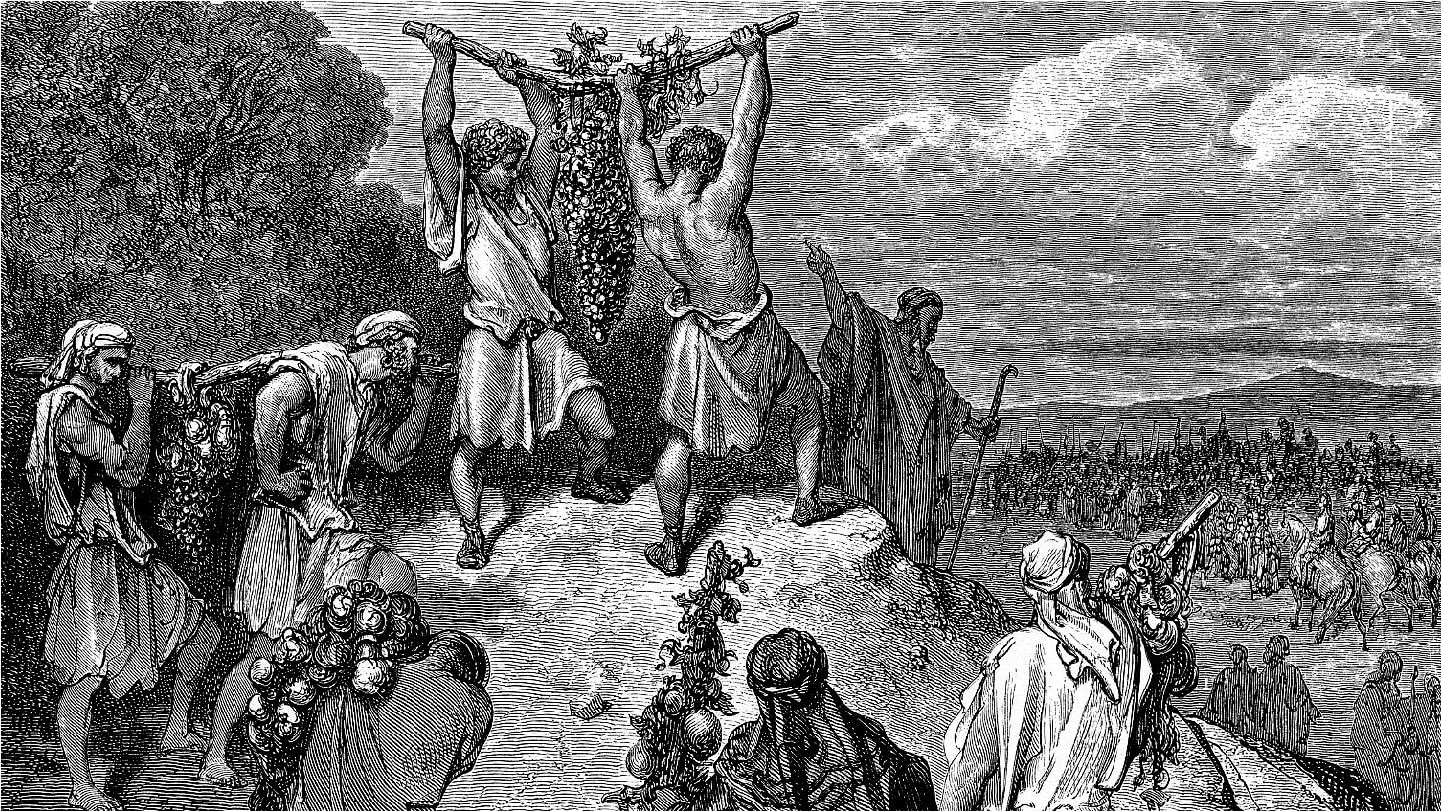
This is a famous story, you probably already know the basics: the ancient Jews, concerned about their upcoming invasion of the promised land, send 12 men into Israel.  When the spies return, they all tell about how amazing the land is, and show the gigantic fruits they gathered.

But then ten of the spies say that the tribes living there are too mighty and will be impossible for the Jews to conquer.  They spread slander about the promised land and demoralize the Jewish nation.  The people believe the spies, and in fear and doubt cry over their misfortune.  God tells them they cannot enter Israel now, even after the men realize their error.

The fallout from this episode was 40 years of wandering in the wilderness until that entire generation of men died and a new cadre of men with a new mentality was ready to enter the promised land.  This sin created a deep spiritual vulnerability that generations later allowed enemies to invade Israel, burn the Holy Temple, and send most of the Jews into exile.  Not once, but twice; on the exact same date.  Our sages explain:

And it is further written, “And the entire congregation lifted up their voice, and cried; and the people wept that night.” (Numbers 14:1).  Rabbah said in the name of Rabbi Yochanan: That night was the night of the Ninth of Av.  The Holy One, blessed be He, said to them: “You have wept today without cause, therefore I will set this day aside for weeping throughout the generations to come.” (Talmud Bavli Ta’anit 29a)

We are still living among the ashes of the spiritual inferno caused by the mistake of these spies.  This is a powerful story that punches us in the gut.

There is a useful psychological tactic that we learn from the report of the spies. When Moses sent them out, he instructed them to find out about the people living in the promised land, if they were strong or weak. Then he told them, inspect the land and see if it is fertile.

However, when the spies share their report, they first state that the land is very good and fertile, then immediately add that the current inhabitants are very strong and powerful, and cannot be conquered.

They reversed the order that Moses had told them. Why?

If you offer a man a business deal, and first tell him the potential profit he can make, but then inform him of the significant risks and pitfalls, he will be reluctant to go ahead with the deal.

But if you would offer the same man an identical deal, by first explaining that while there are some risks, then describing how the potential profits are enormous, he is much more likely to accept. He is thinking about the upside, despite the risks.

The idea is to phrase a decision as a challenge to overcome, by focusing on getting the gain despite the pain. You can do this to yourself. Be aware of how you think and make decisions. If you ponder the benefits first but then focus your attention on the risks, you are less likely to take action. Instead, acknowledge the dangers but then focus on the gains you will make and go ahead.

Back to the result of the spies’ report.

There are many deep lessons here, aside from the obvious one:  Don’t doubt God. Yes, know that when something (or someone) seems too good be true, you need to check it out. We should all be aware the humans never live up to 100% of expectations, especially if you place one on a pedestal. Don’t do that. Never idealize people, they can’t maintain your ideals.

But when it is God who is giving you something, something your ancestors already possessed a few generations back, then you should not feel a need to look that horse in the mouth.  This was the promised land!  The land of Abraham, Isaac, Jacob!  Yet our ancestors demanded to send the spies and check, showing that in some way they considered God’s promise on the same level as we would consider a human promise.  This sounds incredible coming from this generation that witnessed the miraculous Exodus from Egypt and the overwhelming Divine revelation at Mt. Sinai.  Why would they doubt God?

It was deeper than that.  They doubted themselves. Let’s explain: At this time, the ancient Jews were wandering around the wilderness between Egypt and present day Israel. This is not an inhabitable area, it is dry and empty, but they had all their needs supplied through Divine miracles.  The clouds of glory protected them from the harsh weather and terrain, they had Manna from heaven, and even meat after they complained.  They had water, food, clothing given by God.  They also had received massive wealth from Egypt and at the shore of the sea.  They were taken care of physically, they only had to walk outside to gather the Manna.

More than that, this generation did not have to choose for themselves what to do.  When God wanted them to pick up and move, God would signal them to go where He wanted.  They did not have to plan their lives or chart their route, the Divine clouds of glory showed the way.  They did not need to exercise independent initiative, leadership, or resolve doubts about the Law.  They had Moses as their teacher and leader who could ask God their questions directly.

Once they reached Israel, the promised land, this vacation from normal life would be over.  They would have to fight for the land.  The men would need to plan, attack, lead, strategize, struggle, fight, bleed, and die for their land.  While there would be Divine assistance and prophetic information helping in the war, their success would hinge on their human efforts.

Then, after the conquest and distribution of the land of Israel, the ancient Jews would lead a fairly mundane life, farming, shepherding, building.  Starting families, teaching, tending to crops and cattle.  Nothing visibly miraculous.  No more clouds of glory showing the way.  A man would need to think for himself and pick his own focus, his own career.  While the Bible provides guidance for every man, it does not micro manage your life.  You have to decide for yourself what to do and work for every step of personal growth.


Leadership is dangerous to leaders

For the men sent as spies, there was another danger.  The Bible points out that they were respected, distinguished men 13:3.  They were at the highest levels of leadership in the wilderness.  But in Israel itself, where the Jews would need a hands on style of leadership, including military leadership, their positions would be in jeopardy. The leaders thought that reporting that the people in the promised land would be impossible to conquer would keep the Jews in the desert and themselves in power.

Men in power will interpret situations in the way that justifies maintaining or enhancing their own power.  Our sages warn us about the corrupting nature of power (Pirke Avot 2:3), but also the need for men to fill a power vacuum (Pirke Avot 2:6).  Human are naturally hierarchical; we are created this way.

If you are in a position of authority, be aware that it will change the way you perceive events.  When in power, your actions may be subconsciously designed to keep you in power. Be mindful of your motivations and the power of power to corrupt your intellect.

A leader who truly represents the people uses authority for the benefit of the whole nation, while a corrupt ruler uses it to enrich himself or expand his own power. We see over and over that totalitarian governments become inept at basic functions that the people need, while at the same time becoming experts at embezzling the wealth of the nation and protecting themselves.

Dead time and Alive time

Our sages were familiar with the concept of alive time and dead time.  A large part of your life is already taken up with basic needs, sleeping, and working.  Very little of your time is truly your own.  Alive time is when you choose exactly what to do with yourself.

But for our ancestors of the famous generation of the Exodus and sojourn in the wilderness, practically 100% of their time was “dead time”.  The idea of needing to make the vital choice of what to do in their alive time was truly frightening.  This may have spurred the people to believe the opinion of the 10 spies that they could not conquer Israel.

To elaborate, in Egypt the Jews had been enslaved by Pharaoh, obviously not working for themselves.  Not only that, their work for Egypt was largely pointless.  They were forced to build “miserable cities” (Exodus 1:11) which our sages understand as hinting that they were built on quicksand or without solid foundations, and often collapsed.  Even their slave labor was not being used efficiently, it was meant just to keep them busy, not to give any satisfaction.

The Medrashim also teach that the Egyptians would wake Jews at any hour of the night to do random tasks, or simply abuse them.  None of their time was actually their own, they were not living for their own chosen purpose.  [With the limited exception of their wives bringing them food and seducing them].

israel+in+egypt,+sir+edward+john+poynter,+1867+-+israel_in_egypt-huge

During the first phase of the Exodus, the Jewish people were indeed free, but were also focused on fleeing the pursuing Egyptians, then on gathering their treasure after the splitting of the sea, finding water, and preparing for the Divine revelation at Mt. Sinai. They were constantly busy.

The experience at Sinai was so profound that their souls left their bodies and they had to be resurrected.  Needless to say, after Sinai the main focus of the Jews was learning Torah and fulfilling the commandments, including building the Tabernacle.  There simply was not much time for a man to feel bored or even need to choose what to do with himself.

There was no “free time” as we understand it, since they had accepted the yoke of God on them to do and learn (Exodus 24:7).  Not only that, they were surrounded by reminders of the Divine, providing protection against pursuing other distractions. There was a society wide push for Jews to learn, and any free time was invested in the Word.

This would certainly fade as the Jews settled throughout Israel, separated, and turned to mundane tasks.  The Jewish camp was like an army camp, united in a singular consuming purpose.  This is why veterans often feel something missing once back in civilian life.  Civilians lack such a strong unity and focus, which reinforces the importance of the mission.  Our ancient ancestors had that in the wilderness.

Naturally we are beginning to understand that our ancestors were scared and anxious to enter Israel and totally change their way of life.  The direct Divine assistance would be over, at least massively decreased.  They would need to hold spears and swords and risk their lives in physical combat.  They would need to plan, lead, act, and do, and would be responsible when their initiatives failed.  Other men would blame the officers when their relatives fell in the war.

And that was just the physical level.  For spiritual affairs the Jews would need to debate and decide laws and policy for themselves.  It would be up to each man to choose his path, to direct his time.  He would now have the challenge of using his “alive time” to build his life and the life of the Jewish people in Israel.  Now you can understand the reluctance, which manifested as the doubt in God’s promise of a successful invasion.

Keep in mind, this generation of men had known only slavery up until the Exodus just a few months prior.  We see this by their plan to return to Egypt, to “Dead time”:

And the entire congregation lifted up their voice, and cried; and the people wept that night. And all the People of Israel murmured against Moshe and against Aharon; and the whole congregation said to them, “Would God that we had died in the land of Egypt! or would God we had died in this wilderness!  And why has God brought us to this Land, to fall by the sword, that our wives and our children should be prey?  Would it not be better for us to return to Egypt?” And they said one to another, “Let us choose a chief, and let us return to Egypt.” (Bamidbar 14:1-4)


Avoidance

Avoiding responsibility and independence is safe, but has a cost: you also avoid accomplishment.  We had a great talk about MGTOW.  We discussed the reasons, many valid, that some men choose to avoid marriage.  However, focusing on avoidance gets you nowhere.  The question to ask is not what are you avoiding, but what are you actively doing instead?

If you are avoiding some dangers great; you should take care of yourself.  But what are you going out and actually doing?  If your mental focus is on what to avoid you are wasting your ability.  Instead focus on what you can accomplish.

Our holy ancestors in the wilderness wanted to avoid doing, to stay in the mode of passively learning and avoiding the danger of war.  It was safer within the Divine clouds, with the Manna from heaven.  It was easier to be righteous with miraculous reminders of Divine power all around.  Better to avoid putting yourself in a situation where you could fail horribly, costing men their lives.  The problem is focusing on avoidance costs you the ability to grow, mature, and develop your own skills and personality traits.

Children of God growing up

On a spiritual level this is also true.  Jews are called sons of God (Deut. 14:1).  It’s relatively easy to be children to God.  The benefits flow one way for parent to child.  Of course, the child needs to be obedient and learn from his parents, but the onus is on the parent to make the education and growth happen.

In Jewish tradition we are also compared to servants or slaves to God, and on the highest level as a wife to God.  Obviously God has no body, this is a metaphor for us to better understand.  [It is telling that in Biblical times marriage was considered the model of the closest possible relationship; this highlights how much real marriage has been defiled and depreciated in modern society].  In a healthy husband-wife relationship, each partner tries to anticipate what the other wants and go ahead and provide it.

Ideally, we try to think about what God wants from us and go ahead and do it.  Knowing what God has taught us in the Torah as outline, we should use our intellect to plan our behavior in all areas to live in a way that would be pleasing to God.  This is the opposite of a passive child being given all he needs by his parents.

If the child never grows up into an adult who makes his own plans, goals, and mission, then he can never enjoy the relationship on the deeper reciprocal level.  He is always a taker, never a giver.  Always passive, never the planning and initiating party in the relationship.  It was the dynamic tension between growing up and remaining a child that our ancestors in the wilderness did not want to resolve.

I don’t want to grow up…

This idea applies in modern times, and not just to men.  There are women who never grow up, never achieve full emotional independence.  They depend on others to bolster their self esteem.  It does not flow naturally from within, so she seeks it from outside.  This woman is an opportunity and a danger.

When you are the one giving her emotional energy, enhancing her positive self image, she loves you and can even be obsessed with you.  But if you slow down or stop, or if her demands are too great for you to continue this burden, then she flips and considers you evil.  After all, you cut off her supply, which is life to her.  We touched on this regarding humility and narcissism.

In modern times, many men also have become more passive in relationships as well as passive in life generally.  They let the woman set the pace, make the plans.  This is not in accordance with the mystical nature of man as a giver, a leader, a source of drive and energy.  However, secular society has instructed men that they should behave more like women.  Part of this is pushing men to conform, starting in schools where boys are taught they should sit still and act like girls, and continuing throughout life.

There is a great push towards conformity in our generation, which I view as a backlash to our increased ability to express individuality through technology.  This is part of the ongoing tension between individualism and central power.  That struggle itself is linked to the friction between growing up and remaining a child.

We even see this urge to conform in popular ideas among young people.  Every man needs a mission, but many young men gather under the banner of certain select missions that are approved by elites instead of finding their own mission in life.  Pursuing “social justice” is popular, when the cause is on the right list anyway.  To many college age American the idea of not supporting certain flavors of “social justice” is anathema, so great is the push to fit in with everyone else.

Those already in power find it easier to govern when men are docile and accept whatever is pushed upon them, and can be saddled as plow horses for various agenda.  Corporations too have an easier job selling things to women and to men who think like women, who want to follow the pack and buy into the latest fad or fashion.  It’s easier for the powers that be when men are more like women and women more like men.

But it’s not easier for you; passivity ruins your growth into a man ready and able to plan and act in accordance with your own life mission and your own chosen priorities.  It keeps you down, on a more childish and less capable level than you could otherwise be.  But having self actualized men pursuing their self interest is scary, unprofitable, and a little dangerous.

Forty years of wandering

The verdict on the men aged 20 to 60, the men of the Exodus who had been counted in the census, was to wander in the wilderness until that entire generation died (14:29) and a new generation with a new mentality could enter the promised land (14:31).  Not only that, but every year on the same day the spies returned (Tisha b’Av), the men would dig their own graves and go to sleep in them.  The ones who were fated to die that year would never wake up.  You can imagine the catastrophic psychological and spiritual consequences of this sin, this refusal to exercise independence, chart your own course in life, and simply grow up.

If your mentality is passivity, defeat, or to avoid the tough decision, you have to make a drastic change.  You have to kill the part of you that is holding you back.  Cross over and burn your boats.  The passive, childish generation of you needs to die so the new assertive generation can blossom.  This punishment may also have been appropriate since many men had a slave mentality from life in Egypt, while the new upcoming generation had known only freedom for their entire adult life.

A man who had lived his whole life as a slave could not be expected to exercise the independence and self direction to guide his alive time.  Indeed, the idea of having to make these choices was frightening for them.  But a critical part of Judaism, of humanity as a whole, is developing the capacity for self direction.  [We endorse “When I say no I feel guilty” by Manuel J. Smith as an intro to healthy self assertiveness.]

There is a very ancient story brought in our holy Talmud (Gemara) Bava Metzia 59b.  It seems unrelated but hold on to the end…

After failing to convince the Rabbis logically of his opinion, Rabbi Eliezer said to them: If the law is in accordance with my opinion, this carob tree will prove it. The carob tree was uprooted from its place one hundred cubits, and some say four hundred cubits. The Rabbis said to him: One does not cite proof from the carob tree.
Rabbi Eliezer then said to them: If the law is in accordance with my opinion, the stream will prove it. The water in the stream turned backward and began flowing in the opposite direction. They said to him: One does not cite proof from a stream.
Rabbi Eliezer then said to them: If the law is in accordance with my opinion, the walls of the study hall will prove it. The walls of the study hall leaned inward and began to fall.  Rabbi Yehoshua scolded the walls and said to them: If Torah scholars are contending with each other in matters of law, what is the nature of your involvement in this dispute?  The walls did not fall because of the deference due Rabbi Yehoshua, but they did not straighten because of the deference due Rabbi Eliezer, and they still remain leaning.
Rabbi Eliezer then said to them: If the law is in accordance with my opinion, Heaven will prove it.  A Divine Voice issued from Heaven and said:  Why are you arguing with Rabbi Eliezer, as the law is in accordance with his opinion in every place that he expresses an opinion?

Rabbi Yehoshua stood on his feet and said: It is written: “It is not in heaven” (Deuteronomy 30:12).  The Gemara asks: What is the relevance of the phrase “It is not in heaven” in this context?  Rabbi Yirmeya says: Since the Torah was already given at Mount Sinai, we do not follow a Divine Voice, since You already wrote at Mount Sinai, in the Torah: “After a majority decide” (Exodus 23:2).  (Since the majority of Rabbis disagreed with Rabbi Eliezer’s opinion, the law was not ruled in accordance with his opinion, despite the Divine interventions.)

The Gemara relates: Years after, Rabbi Natan encountered Elijah the prophet and said to him: What did the Holy One, Blessed be He, do at that time (when Rabbi Yehoshua issued his declaration)?
Elijah said to him:  The Holy One, Blessed be He, smiled and said: My children have triumphed over Me; My children have triumphed over Me!

Deuteronomy 30:12 reminds us that the Bible is not in Heaven anymore, it was given to man below.  God gave authority and initiative to men, to use, learn, and grow into adults.  This is the dynamic tension in Judaism (and in all men), between following and leading, between passivity and actively charting out own course through life.

We Jews are of course very rooted in the past, in tradition going back to Sinai and even before to Abraham.  But we were also given an area of independence and discretion that we exercise using the concepts from the Bible.  And not only that, God wants us to exercise independence and develop our own lives in the way we choose.  All men struggle between going with the flow and charting their own course, difficult as that is.

My own rabbi, decades ago, had a talk with some of us.  He was asking if we would succeed in some aspect, and one young man said “Yeah, we can do it, if God wants“.  This “if God wants” is a common phrase among conventional Jews.  Rabbi strongly said “Of course God wants!  But do YOU want?!  That is what makes the difference!”