This week Jews outside of Israel study the Bible in Numbers 19:1-25:9, the portions called “Hukat” and “Balak”. We read both sections this week to catch up with our brothers in Israel, as we had a two day holiday on a Sabbath and did not read the regular weekly portion then.
Hukat means decree, a law without a comprehensible basis. Hukat refers to one of the most enigmatic rules in the Bible: If a man becomes ritually contaminated through a corpse, he must be purified through being sprinkled with drops of a potion made of the ashes of a red heifer or Parah Adumah and other ingredients. However, the man doing the sprinkling also becomes contaminated (to a lesser degree).
The action in Hukat actually picks up 38 years after the last reading, with the death of Miriam. Since the water supply was in the merit of Mirian, this led to the famous episode of Moses striking a rock to bring water. Aaron also passes and is replaced as high priest by his son. The Jewish people wage war on the Emorite kings Sichon and Og, who had come out to destroy the Jews as they approached Israel.

Let us learn from the red heifer. This is the ritual purification required when a man touches or is under the same roof as a corpse or parts of a dead body. A corpse is the highest level of contamination in Jewish law, which has a plethora of types and levels of purity and impurity. For a man to enter the Temple or eat from sacrifices or tithes he had to be ritually pure. Any loss of life or loss of potential life causes contamination, so does touching certain creeping animals. In Judaism, the highest priority is life, so death is the lowest spiritual level.
The priests prepare the red heifer ashes into a potion in an intricate ritual, and along the way some become themselves ritually impure on a lower level that from a corpse (19:7, 10). Then the priest who sprinkles the water becomes himself impure through the same action that is causing the contaminated man to become pure, and even someone touching the purifying waters becomes impure (19:21). I can’t pretend to comprehend this. Even King Solomon, the wisest of men, who could converse with animals and demons, admitted he could not fully understand the depths of the red heifer ritual. That is why this law is called a “Hok” decree, not a “Mishpat” rule with a clear rational basis.
The red heifer hints to us that we are not islands. No man can live alone. When we are down and falling into impurity, we need to reach out to others, to leaders, to those men who serve us as priests. We need help to attain purity and holiness. A man cannot remain alone, isolated, quarantined and sink further into decay.
Men need other men to help them when they are stuck in life, to give them an outside perspective. This is a concept our sages also explore in the Talmud. It is also a modern necessity; we all grow up seeing only a small part of the bigger picture, and other men help us fill in the whole picture. Men are especially subjective about their own situations, and often need an outside set of eyes to fully evaluate what is really going on in their relationships.
The actions of the priests remind men that when we are up, we must be willing to give to other men, even if we sacrifice some of our position to bring another man up with us. This sounds esoteric because this whole chapter is full of mystical hints and undercurrents. The priests give purity to the man who was near a corpse, even though they lose their own purity.
A lot of what we do for others is, on some level, self serving. Some men raise money for a cause or institution to get their names on buildings or plaques. In our relationships we often give in order to get. Sometimes this is subconscious and covert, see Dr. Robert Glover’s book No More Mr. Nice Guy. We help our friends to get help back, to be considered an upstanding guy.
The priests involved in the red heifer would become ritually contaminated, not on the same high level as the man who touched the corpse, but impure enough that the priests could no longer eat from sacrifices or from the special portions and tithes given to priests. They had to immerse themselves and wait until nightfall to regain their purity even from merely touching the special water (17:21). The priests were willing to take a hit and reduce their own status for a man who had contact with a corpse, probably a man who was at a funeral or helped to bury a deceased. A man they didn’t necessarily even know.
Interestingly, priests themselves are not allowed to attend funerals or enter graveyards, except for close relatives. The high priests cannot attend any funerals whatsoever, as he has to remain pure to serve the entire Jewish nation. It is possible that the priests were willing and eager to help another man since they realized that this man had assisted in a funeral, something they could not do. This attitude requires seeing the big picture: not every man can do every job in society. In ancient Biblical society (and modern Jewish culture), the Cohanim and Levites have a special role. We all need a role, a mission.
In modern society, it can be hard to find your own mission. A lot of the problems men have in this area are due to the reality that other people and organizations, and society as a whole, are pushing their missions on to men. Men want to help, to stand up and contribute. This is how we are created as men and is a strength and key aspect of our masculinity.
But when a man does not have his own chosen mission to which he is dedicated, it is very easy for him to pick up tasks that are actually for the benefit of others. Women, corporations, organizations, and political groups will task men with working for the agenda that they want, knowing that men want to feel useful.
Men are socialized into carrying water for certain causes, for women generally, or for a specific woman in exchange for access. But many men feel that however much they do, they are not truly appreciated and valued, and are missing something. This something might be working on their own personal mission. Sometimes men are manipulated into making someone else’s dreams come true at the expense of their own.
Without the guidance of an outside source of wisdom and perspective it is hard for a man to know if what he is doing is for his own mission or for someone else’s benefit. The Bible outlines many ways a man can contribute to society and benefit himself at the same time. In modern secular life there are so many conflicting messages. Young men are told they are not a man unless they make women their focus and mission, and this is terrible advice in the long run.
A man needs to work out for himself how he wants to live and make his mark on the world. The key question to ask yourself is “what am I living for?” Then you explore how to go about it. While you examine this, ask if you are doing what you do for yourself or for the benefit of others. It’s fine to help other people, but when that becomes your focus in life and you give up what you wanted out of life, you are going to have problems.

With the above concepts in mind, we can draw a comparison to Bilaam (aka Balaam), the main character in the portion of Balak. Balak was the king of Moav and hired Bilaam, a powerful sorcerer and prophet on the level of Moses, to curse the Jews. This is the only section of the Torah that switches the narrative’s point of view from Moses and the Jewish people to the enemies of the Jews. This was obviously a critical turning point in Jewish history, even though the Jews were not even aware what was happening at the time.
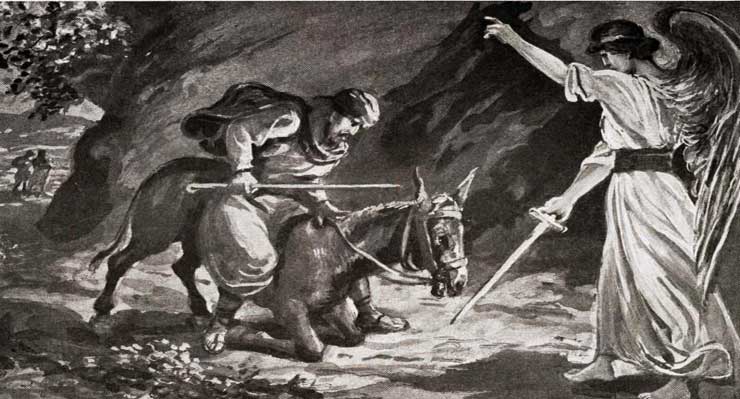
Bilaam at first refuses to go with Balak’s messengers, they offer him more riches as reward and send higher ranking officers and nobles to plead with him and honor him (22:15). Bilaam refuses until he gets prophetic dream stating if these men have come for your own benefit, you can go with them (22:20). Then, even with seeming divine permission, there is trouble on the road.
Bilaam’s mule sees an angel with a sword and tries to divert from the road (22:23-27). Bilaam beats the donkey until finally God open the mouth of the animal and it tells Bilaam that these impediments came since it was not appropriate to go and curse the Jews. Bilaam finally sees the angel who wants him from his mission. Bilaam insists on going, and the angel tells him “you will only be able to say what God lets you” (22:35).
Bilaam was inherently selfish, acting for his own gain, and his own hatred of the Jewish nation, which was even greater than Balak’s hatred. But even hating Jews was not enough until he would also gain honor and money from Balak. He acted only for himself even when agreeing to perform the mission for Moav against the Jews. He stubbornly continued his chosen path despite clear divine omens that the mission would fail and was contrary to what God wanted.
In modern society there are psychological barriers to a man putting himself first, as we discussed. A man should be able to put his own needs and mission first to gain fulfilment in life. But this is not enough, you need another level of analysis: is what you are setting out to do truly good?
This requires wisdom and introspection. Maybe you are simply selfishly charging through life without contemplating your role in the world. Bilaam thought he was doing good by cursing the Jews. After all, Moses and God had taken the stubborn Jews to task many times. Many people doing what we would call evil are utterly convinced they are doing the right thing, standing up for justice, against imperialism, etc. As we noted, Hitler thought he was doing good.
You want to decide and pursue your mission for your own benefit. But you do want to accomplish something that will bring you respect from decent people. This is another level of wisdom. You don’t want to be stuck as a people pleaser and compromise your own mission, but you don’t want to walk over other people for your holy crusade either. Many self proclaimed righteous people leave a lot of broken, traumatized victims in their wake.
These days it may be hard to find the right people to serve as your guidepost. You must work to know yourself first and learn how to interact with other men for mutual benefit. This takes work and it is hard to generalize. I can suggest that when men are willing to take criticism and examine their own actions and motivations, they usually end up doing the right thing. It’s the men who don’t doubt themselves who justify the evil they do.
Another way to put it is like this: an evil man will tell you with great certainty that he is a good, righteous, upstanding man. And how dare you questions his motivations! While a truly good, introspective man actually will doubt if he is as good as he could be. He knows he can improve, he does not identify as purely righteous. He thinks he is a work in progress, and he should be willing to work with you to help himself and you to improve in life.
A related issue is having a victim mentality. A man who blames others, or society, or women for his woes has externalized his own issues and removed his internal impetus to improve. Balak blamed the Jews and sought to destroy them with a curse, instead of negotiating or strengthening the defenses around Moab.
The victim card is also the get out of self improvement free card. If you gauge your own development against people who self identify as a victim, you will never improve. They will wiggle out of their responsibility to work on themselves you will not improve.
I will give you another indicator of upstanding men you want around you. Good men are interested in building up themselves and others. Evil men undermine others. The Bible hints to this in Balak’s message to Bilaam: “So now, please come and curse this people for me, for they are too powerful for me. Perhaps I will be able to wage war against them and drive them out of the land, for I know that whomever you bless is blessed and whomever you curse is cursed” (22:6).
Balak knew Bilaam had the power to bestow effective blessings, but hired him to curse. Imagine if Balak had asked for blessings on Moav instead of a curse on the Jews! But his focus was on harming the rival rather than improving his own kingdom. If the men around you are spending their time and energy tearing other people down, they are not worth keeping around. Our sages in the Talmud Brakhot 28 discuss this concept as well:
Defending your idea is a higher level of intellectual achievement than attacking someone else’s opinion. Anyone can attack an idea, it takes much more skill to develop your own positions based on all the evidence and be able to defend them from attacks. Therefore the advanced scholars were known as shield bearers and not sword wielders.
Finding the right group of men to help you improve yourself is an important job. Now, you may assume that the ultimate level would be to not care at all what other men think of you. Our scriptures and ancient sages point out that this is a bad idea, see Proverbs 3:4 and 1 Samuel 2:26, where Samuel found favor with the Lord and also with men.
You do need to think about what people will think about you – provided they are the right kind of people. A man who considers himself totally independent from what other men think will come to make terrible mistakes. There are advantages to this outlook, but in the long run it creates a lot of angry enemies.
In a sense, God has provided us with other men as a way to provide outside evaluation on our own lives. Contrast Genesis 6:8, where Noah found favor with the Lord, but not with other men. In his generation that was actually appropriate, as the men of that generation brought about the massive flood through their debauchery. You don’t want to find favor in the eyes of men who are evil, manipulative, and self destructive. This a serious challenge for men in our generation.
May you be blessed to find a proper group of men to help your growth.
The scandalous final section of this week’s reading (Number 25) features a sexual attack on the Jewish men, causing a plague until Pinhas murders a Jewish prince and the Midianite woman he was sinning with. After Bilaam failed to curse the Jews and actually blessed them by divine order, Balak was understandably disappointed.
As a parting gift, Bilaam advised the Moavites and Midianites that although he could not curse the Jews, there was another avenue open to harm them. Since God punishes harlotry, they should seduce the Jews to cause God to be angry at them. By causing Jews to sin, they will become vulnerable and perhaps die.
Understand that God does not actually become angry, nothing human do can change God at all. God does express what humans consider anger in this world so we can learn to behave better.
The Moavites and Midianites sent their most beautiful women, including daughters of nobility, decked out in their most seductive outfits and ornaments, to entice the Jews. The Medrashim (backstories to the Bible passed down from the people who were there) and the Talmud explain that these women set up trading posts and offered the Jews merchandise on sale, with an older woman outside a tent offering a higher price, and a younger woman inside the tent offering a lower price.
Jewish men went inside to strike a deal, and met a gorgeous woman dressed like a harlot and ready to please. The Talmud details that they wore golden lingerie to emphasize their bodily assets. In those days, a woman in any sort of revealing clothing was out of the ordinary.
As thousands of Jewish men got seduced, the Midianite women also convinced them to engage in idolatry (25:1-3). The pagan woman would get the Jews aroused and then demand he worship her idol before they went to bed.
God tells Moses to take the judges and sentence these men to death and execute them (25:4-5). In response one of the princes of a Jewish tribe brought a Midianite princess back to the camp, and brought her before Moses, a public outrage (25:6).
He intended not only to engage in promiscuity with her, but to do this in front of the whole camp, giving an official imprimatur to this harlotry. The Jewish leadership was paralyzed from shock at this desecration. Only one man, Pinhas (also spelled Pinchas or Phinehas) took action against the prince. He was a grandson of Aaron the high priest.
Pinhas spears the Jewish man and the harlot through their reproductive organs, then carries them outside on his spear. The camp witnessed his zealous vengeance on the prince and stopped pursuing the foreign women. Unfortunately, 24,000 Jewish men perished through this sexual warfare.

The obvious wisdom we can take is that men will follow their physical urges even into situations they should intellectually know are wrong. Holy Jews who heard from God not to worship idols were doing exactly that in order to get sexual access to harlots. It sounds amazing, but the Bible points out that men are men. We are the same today as we were 3300 years ago.
We will discuss more amazing lessons from this episode, God willing, next week.

 Red Pill Rabbi