This week Jews around the world study the portion of the Bible called “Pinhas”, Numbers 25:10–30:1. This loaded section concludes the scandalous episode of the sexual attack by Moavite and Midianite women against the Jews. This took place at the end of last week’s Bible study:
The Moavites and Midianites sent their most beautiful women, including daughters of nobility, decked out in their most seductive outfits and ornaments, to entice the Jews. The Medrashim (backstories to the Bible passed down from the people who were there) and the Talmud explain that these women set up trading posts and offered the Jews merchandise on sale, with an older woman outside a tent offering a higher price, and a younger woman inside the tent offering a lower price.
Jewish men went inside to strike a deal, and met a gorgeous woman dressed like a harlot and ready to please. The Talmud details that they wore golden lingerie to emphasize their bodily assets. In those days, a woman in any sort of revealing clothing was out of the ordinary.
As thousands of Jewish men got seduced, the Midianite women also convinced them to engage in idolatry (25:1-3). The pagan woman would get the Jews aroused and then demand he worship her idol before they went to bed.
God tells Moses to take the judges and sentence these men to death and execute them (25:4-5). In response one of the princes of a Jewish tribe brought a Midianite princess back to the camp, and brought her before Moses, a public outrage (25:6).
He intended not only to engage in promiscuity with her, but to do this in front of the whole camp, giving an official imprimatur to this harlotry. The Jewish leadership was paralyzed from shock at this desecration. Only one man, Pinhas (also spelled Pinchas or Phinehas) took action against the prince. He was a grandson of Aaron the high priest.
Pinhas spears the Jewish man and the harlot through their reproductive organs, then carries them outside on his spear. The camp witnessed his zealous vengeance on the prince and stopped pursuing the foreign women. Unfortunately, 24,000 Jewish men perished through this sexual warfare.

This week the Torah ties up the loose ends: Pinhas the son of Eleazar the son of Aaron the priest has turned My anger away from the children of Israel by his zealously avenging Me among them, so that I did not destroy the children of Israel because of My zeal. Therefore, say, “I hereby give him My covenant of peace. It shall be for him and for his descendants after him an eternal covenant of priesthood, because he was zealous for his God and atoned for the children of Israel.” Numbers 25:10-13.
You may find it mind boggling that an act of violence earns a covenant of peace and priesthood. All the contrary, sometimes a brave action against a corrupt status quo is just what is needed to restore balance and peace. Bad situations often get worse and worse gradually, and most people put up with it until some get fed up enough to takes action to undo decades of corruption.
The Bible also names the anonymous Jewish man publicly sinning as Zimri, Prince of the tribe of Simon, and the woman as Cozbi daughter of Tzur, a royal princess of Midian. This highlights the fact that the harlotry involved the highest levels of both nations.
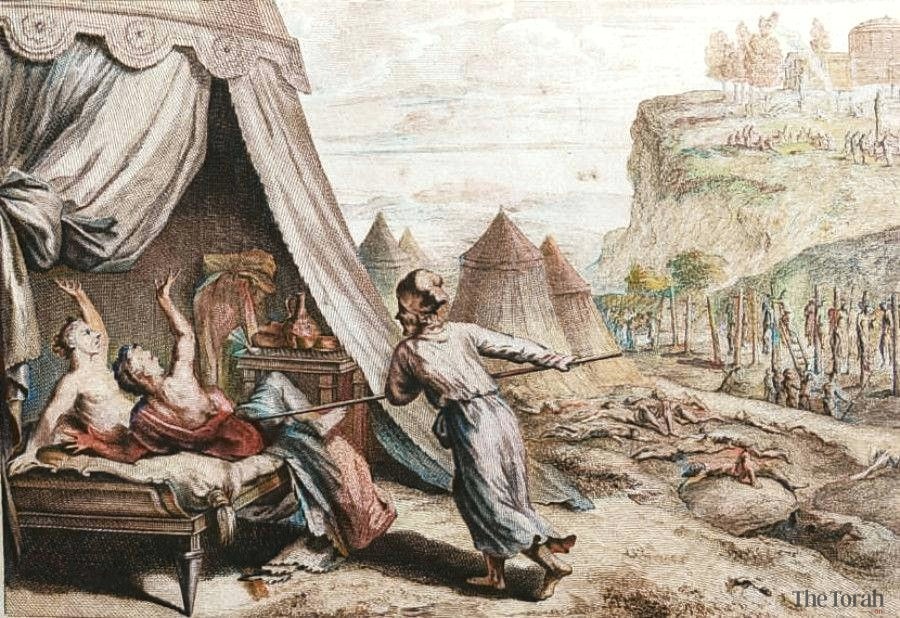
What exactly did Pinhas accomplish with his zeal and spear? First, the women of Moav and Midian began to seduce Jewish men and get them to engage in idolatry (25:1-3). God tells Moses to take the judges and sentence these men to death and execute them (25:4-5). The Jewish courts begin judging the sinners. Men from the tribe of Simon complain to their prince that they were being sentenced to death and ask for protection. The prince responds by bringing 24,000 of his warriors and a Midianite princess in front of Moses (25:6).
Our sages teach that he was making a legal argument against Moses: if you, Moses were allowed to marry a Midianite woman, then why can’t we do so now? (Sanhedrin 82). Moses had married before the Divine revelation at Sinai and the giving of the Torah, and obviously Moses had converted his wife to Judaism. Here the Jewish men were being seduced by lust and idolatry.
However, the gall of this prince, chutzpah as we say in Yiddish, shocked the Jews and they were not able to respond. Perhaps the leadership was trying to argue against the prince that these women could not be sincerely converted since they were steeped in idolatry and corrupting the men. There was also an implied threat of civil war as Zimri brought men with him.
Zimri, in front of everyone, took the foreign girl to his royal tent to seal the deal. Only Pinhas had the peace of mind to remember that there is a law that if a Jew cohabits with an Aramean (any idolatrous) woman, zealots have permission to strike him down. However, this act of zealotry is extra-judicial and the sinning man is allowed to defend himself with deadly force.

Pinhas put himself into danger, but employed wisdom and received Divine assistance. Our ancient sources explain that Pinhas hid the tip of his spear in his clothing and approached the prince’s guarded tent with just his walking stick, which was really his spear shaft. He asked for a turn with the Midianite girl, and the guards let him in, thinking it would be even better for their side to have a man related to the high priest ratify their harlotry.
Once in the tent, Pinhas rebuilt his concealed spear and stabbed Zimri and Cozbi through their reproductive organs, which were joined in copulation. He carried them outside on his spear, proving to the Jews that the zealous killing was legal as Zimri was actually sinning at the time. The nation was shocked into abandoning harlotry with foreign women. The guards from the tribe Simon were so shocked at the assassination that Pinhas was able to escape.
Zealot is hard to translate to English, and the entire concept is rarely mentioned in modern America. The same Hebrew letters “kanai” also connote jealousy. Pinhas acted out of jealousy in a certain sense, but not his own jealousy of Zimri’s escapades. It wasn’t anything personal to Pinhas, he had no grudge against Zimri. It was outrageous to Pinhas that Jewish men would go after foreign women and their idols, and that a prince would endorse and protect that behavior.
Pinhas was acting out of God’s jealousy. Understand, God does not have human emotions. God never gets actually jealous, the Bible uses such terminology so humans can understand the message and draw lessons on proper behavior. Pinhas understood that the rampant promiscuity was an affront to God, and to the honor of the Jewish people. He was jealously avenging the honor of others, not himself.
Pinhas was concerned with fulfilling God’s mission in this physical world, which requires the Jewish people to maintain their personal purity. He identified himself as an agent for God’s objectives, making His Divine goal into a personal human mission. This allows a high level of leadership.
When a leader takes things personally, holds himself as more important than the group, then he cannot be fully devoted to the mission. Others can drive a wedge between him and his goals by attacking him personally. He pays close attention to public opinion of his performance, instead of his actual job.
When you put your mission over your own pride, you can become more effective, because your actions are not about you. You have a greater cause in life, something you can be zealous and jealous for. Something you can put first, above other people and your own laziness. You don’t have to make excuses, since your mission demands certain actions, not yourself.
Again, it’s not your ego that drives you, but your mission. When someone gets in your way, you don’t take it to heart and get upset, you just go to work on removing the impediments to your mission. Nothing personal.
How low can we go?
When a Midianite woman seduced a Jewish man, she would ask him to join her in idol worship before giving up her body. One of the idols that the Midianite women brought to the Jews was the infamous Baal Peor, the lord of excrement (25:3). This idol was worshiped by defecating in front of it; the offering was the man’s excrement. The most pious Baal Peor fanatics would use the idol itself to wipe.
This is incredible. How could the holy Jews, the living banner of monotheism in a pagan world, be lured after the most pathetic and vile idol? And yet the Bible testifies that the seduced Jews were getting attached to this filth.

The Torah reveals a facet of human nature: When people reject holiness, they don’t just go to neutral, they go to the opposite extreme. We saw the same behavior by Ruth’s sister Orpah, who rejected Judaism for extreme harlotry, and mothered Goliath.
We also see another critical element of human psychology at play here: When men think they are fallen they throw themselves deeper into the pit. The Jewish men who were seduced by the Midianite girls felt that since they were already giving in to their physical urges by sinning, they might as well give in to join them in idolatry too. After all, they were already sinners in their own eyes.
This shows the power of a negative self-concept. The idea is actually against ancient Jewish wisdom: Our sages teach that however low a man has fallen, he can stop and turn his life around.
A man can change his life in a moment of repentance and resolve to change. Our sages bring stories of men steeped in hedonism and harlotry who turned their lives around in an instant of resisting temptation, even though they had given in to that temptation before.
This is a powerful idea that you can use. No matter where you are in life now, you can change it. The real change that matters is your perception of yourself. You are not a sinner, you are a normal human being who has made some mistakes and has some issues to work on. We all are, now get to work.
Our great sage the Baal Shem Tov taught: “More than the Evil inclination wants a person to sin, he wants us to feel guilty and depressed that we sinned”. When a man becomes paralyzed with guilt from self identifying as a “sinner” he will go and sin some more. Only when a man identifies himself as a good man who has work to do can he begin to improve.
Peer pressure
However, when many men are sinning together, it becomes much harder for one man to stop and turn around. Seeing thousands of men involved in harlotry and idolatry would have a tremendous influence on you. There can be positive peer pressure and God forbid negative too. Pinhas was not affected by the other men straying. His zeal was stronger than peer pressure, he was outraged at the affront to God’s honor.
God sent a plague to kill out the men who had sinned with foreign women and idols. The Bible makes clear that it was a minority of Jews engaging in harlotry, since 24,000 died from this encounter, out of over 600,000 men aged 20 through 60. But for that many holy men to give in to a sexual attack and abandon monotheism for copulation was shocking. Keep in mind the victims may include men who had seen miracles and God’s revelation at Sinai.
It is worth noting that the Egyptians enslaved and physically brutalized the Jews. Yet Egyptians can convert and join the Jewish people (Deuteronomy 23:8-9). However the Moavite men may not join the Jewish people, since they hired Balaam to spiritually damage the Jews and his advice led to temptation and sin (Deuteronomy 23:4-7). Attacking someone’s spirit is worse than punching him in the face.
However, usually spiritual damage takes place gradually and is harder to recognize than physical wounds. This sexual attack on the righteousness of the Jews was an exception. Pinhas realized this was an extreme change in the sexual-spiritual level of the Jewish men and took direct action.
When standards change slowly, most people don’t notice. If things get really bad quickly, some people begin to realize something is wrong. In mainstream society, the level of promiscuity and licentiousness has definitely been increasing, we know this. But for many it seems like a gradual process and it doesn’t really bother them.
When I was a kid, it was practically unheard of for a woman to have a tattoo. In college, it was still rare, and a girl with ink was considered trashy by most people. Now, if you are around young secular people, you will see many women with multiple tats, wearing clothing designed to show them off. The stigma has largely evaporated, at least in mainstream circles.
In fact, there is a race to the bottom: if one girl has one tat, eventually that becomes normal and boring, so the next girl wants two tats plus a body piercing and more revealing clothing so she can get more attention. There is such a pull to the extreme, to be more novel, more excited, more noticed by men, that soon what was outrageous seems pretty tame and normal.
When changes to what is acceptable are moving slowly they get brushed off. In modern America, changes to popular morality are purposefully introduced slowly, like slowly raising the heat to boil a lobster alive. If you are old enough you remember that there was a time when there was zero mention of certain sexual proclivities in the media. The media, by design, slowly added references and characters until it became normal and expected to have them on most mainstream programs.
In our generation debauchery has increased exponentially through technology. I am not simply referring to explicit images and videos. In the past, someone with a perversity kept it to himself. With the internet he or she can find others with the same fetish and link together, giving them the illusion that they are normal instead of sick.
Of course technology can bring benefits, helping men with personal growth, learning, and finding spiritual fellowship. We need to be cognizant too of the power for it to act as an amplifier for what were previously tiny signals of debauchery.
It takes a massive dose of perversity to shock this generation, at least in secular circles. And it’s hard to find such things today since we are being desensitized to it. Some of us religious fanatics still get worked up if a girl’s skirt it too short for her school uniform and her knee is showing. That’s a way of enforcing boundaries and social expectations.
In mainstream culture I have to wonder if there is still the capacity for real outrage. Compounding this is backlash to any expressions of outrage. If religious people refuse to decorate a cake for a certain “wedding”, they can be dragged through the mud and lose their business and reputation. It’s actually dangerous for religious people to express traditional religious ideas in public.

Proving Paternity
After the debacle of the girls from Moav and Midian sexually attacking the Jews, the Bible lists the families of the Jewish tribes, tracing their lineage back to the sons of Jacob (Numbers Chapter 26). Rashi (26:5) explains why this list is here: The nations were denigrating them and saying, “How can the Jews trace their lineage by their tribes? Do they think that the Egyptians did not exploit their mothers? If they mastered their bodies as slaves, all the more so the abused their wives. Therefore, the Holy One, blessed is he, appended His Name to them, the letter ‘hey’ to one side and the ‘yud’ to the other side, as if to say: I bear witness for them, that these are the sons of their fathers.
The names of the families listed in Numbers 26 have a letter Yod added to the end and a letter Hey added to the beginning. These letters form a name of God. The Torah is always referring to the same Almighty God, even when using different names. Human kings can also be called royal highness or exalted or majesty. The various appellation for God convey specific meanings as well. This addition of God’s name around the family names was the ancient equivalent of a paternity test. God himself was testifying that the sons were from the fathers, not any Egyptian or anyone else.
Conventional Judaism is tribal. Jews have been known as “the tribe”, though in fact they are 12 unique tribes from the 12 sons of Jacob. In modern times, most Jews do not know with certainty their ancestral tribe, except the Leviim and Cohanim (priests), who are from the tribe of Levi. Most men named Cohen or Katz (and a few other Cohanic names) descend from our ancient priests.
In fact, genetic testing of Cohanim has shown from common Y chromosome haplotypes that the overwhelming majority of present day Cohanim descend from a single man who lived 106 generations ago, about 3300 years ago. This was Aaron, brother of Moses, the first Cohen.
“For more than 90 percent of the Cohens to share the same genetic markers after such a period of time is a testament to the devotion of the wives of the Cohens over the years. Even a low rate of infidelity would have dramatically lowered the percentage.”
Dr. David Goldstein of Oxford University, Science News, October 3, 1998
Further testing on Jews generally, not just Cohanim, revealed similar results. Similarity testing was done on both Y-chromosome, passed from father to son, and mitochondrial DNA, which is passed to any child from mother (the mitochondria come with the egg cell). The results indicate a low level of admixture (intermarriage, conversion, rape, etc.) into the gene pool of various Jewish communities around the globe.
“Despite their long-term residence in different countries and isolation from one another, most Jewish populations were not significantly different from one another at the genetic level. The results support the hypothesis that the paternal gene pools of Jewish communities from Europe, North Africa and the Middle East descended from a common Middle Eastern ancestral population, and suggest that most Jewish communities have remained relatively isolated from neighboring non-Jewish communities during and after the Diaspora.”
(M.F. Hammer, Proc. Nat’l Academy of Science, May 9, 2000)
Of course there should be some degree of admixture, Jews do accept converts, though we do not encourage others to convert. And of course, through history there have been instances of, heaven forbid, rape and seduction. This goes all the way back to the abduction and rape of Dinah.
In Jewish law a child follows the status of the mother for religion, so the child of a Jewish mother is Jewish even when the father was not. However, tribal status goes after the father, and tribe determined inheritance and priesthood, so a man’s paternity was also vital to know.
The assumption that other nations made was that when one people subjugates another, the women from the weaker group are up for grabs. Now, witnessing 24,000 Jewish men go after foreign women, the other nations assumed that the Jewish women also had engaged in extracurricular activities back in Egypt, when powerful Egyptian men would appear more attractive than enslaved Jews.
We learned in Exodus that this was not the case by the Jews in Egypt, and further discussed the sexual loyalty of our ancient women. As we will explore, Jewish women took their job as caretaker of their family seriously.
Five Righteous Daughters
The daughters of Tzelafhad approach Moses to ask for their father’s inheritance in the holy land (Numbers 27). The Bible had instructed that the land would be divided among the men. However, Tzelafhad had died during the 40 years in the wilderness without leaving any sons. His family – the five girls – would be without an inheritance. God instructs Moses that in the absence of sons a man’s inheritance goes to his daughters 27:7.
If a man leaves sons and daughters, the sons provide for the girls from his estate until they get married. Those laws are discussing in detail in the Talmud in Ketuvot. However, the default situation was that a man’s sons inherit his estate, especially the land.
This is really interesting. You see, 3300 years ago it was extremely rare for a woman to own land. Based on ancient records, historians have determined that it was almost unheard of. In many ancient cultures it was outright illegal for women to truly own anything. Only men could own property, and men owned the women as well. In Jewish culture, it was not illegal for a woman to own land, but it was uncommon, we will see why.
If they merely wanted land, it would have been easy for the daughters of Tzelafhad to marry men and get the fruits of the land through their husbands. They would be attached to the holy land through their family. That was totally normal and expected. In addition, the ancient sources say that these women were all righteous and would be considered a good pick even without owning their own land. So why their obsession to get an inheritance in Israel for their father?
These righteous girls obviously respected the memory of their father. In conventional Jewish wisdom, a child is considered the legs of the parent: after a parent passes from this world, the actions of the children are still known to and bring merit to their parents who are in the world of souls. A parent in the next world can still take pride in deeds of their descendants in the physical world.
The daughters of Tzelafhad wanted to attach his name to an actual inheritance in the holy land. That would be a tremendous merit for their father. Even after the five girls would marry and be a part of a new family, they wanted their father’s family name to continue, because they identified with their father. He had lovingly raised them and taught them, he was the most important man in their life.

Not only ancient times, but even in recent generations, women found fulfillment in continuing their family legacy. Women were taught that they were the crucial element in family continuity. Women had the responsibility to take care of the home, and this was valued highly because the home is where the family comes together and educates and inspires the next generation.
Jewish women, compared to other groups, were typically more educated and more likely to be literate. They were the first teachers in the family, both by example and by literally teaching young children. They were the mainstay of the house, having the most influence over the children and the mood in the house. Women understood that their behavior and values set the tone for the home. They don’t just make children, they make the house a home, and continue the family for generations.
In Jewish mystical tradition, women have the power of development and incubation. They can take a raw material, protect and nurture it to ensure it continues. This obviously refers to pregnancy and child rearing, but also to nurturing the family generally. A man by contrast needs to go out of himself, strike off on his own, and make something of himself.
On a deeper level, remember the letters Yud and Hey we mentioned above, that are part of God’s name and were added to the family names as testimony of paternity. These letters are also the main part of the world for man and wife:
Rabbi Akiva taught (Sotah 17A): when a husband [איש] and wife [אשה] are worthy, the Divine Presence dwells with them and when they are not worthy, fire burns them. The Hebrew word for man is ish, spelled aleph, yud, shin. Remove the yud and you have aleph, shin or esh, meaning fire. The Hebrew word for woman is ishah, spelled aleph, shin heh. Remove the heh and only esh remains.
The idea here is without Divine assistance, man and woman create destructive fire. Without any higher goals in their life, man and woman burn out.
A woman’s real work is to continue her family, both her father’s legacy, and her own family with her husband. This is why our ancient women valued the land so highly. When the Jews would enter the holy land, Israel, their family would be attached to the land. The Jewish women identified as the pillars of their families, and a family on their ancestral land also works for continuity and legacy. They felt that their love for the land would reinforce the strength of their families on the promised land.
Nowadays a young woman is told repeatedly that she will only find real meaning outside of the house, by becoming something in the public sphere. She needs to be a “Strong independent woman” and become an influencer, a doctor or lawyer or politician and make her own personal impact on the world. She is manipulated by the “village” to believe that she will not find meaning inside her family, as the central figure of her own household and the one responsible for her legacy.
Traditional societies have continued to give women the message that they can find purpose and fulfillment in their own family. In recent times we see many women in mainstream culture reject feminist conditioning and start families, but the messages from the media do have a serious impact. Modern life emphasizing career over family seems to be detrimental for women, as noted in “The Paradox of Declining Female Happiness”.
However, many women in America avoid or delay marriage while they are buying into the feminist brainwashing, only to realize that they truly wanted a family when it is already quite late. Many women don’t realize that they will find more meaning as a mother than as an employee until family is difficult or impossible to accomplish. The conditioning impacts even traditional families, women in religious circles are much more likely to work outside the house than in prior generations.
Women are told (indoctrinated) that work and wealth, career and consumption, will bring them meaning. But they are often frustrated that their work takes them away from their homes and families, the very things that bring them a deeper, more lasting sense of well being and fulfillment.
I see a struggle in many a modern woman between finding her value outside of the house, where modern society told her it will be, and also having the time and resources to build her own home, where she has immensely more value and lasting impact.
Provisioning
There is another element at play among the daughters of Tzelafhad and their request for their father’s land. Without their own family plot of land, these girls would get suitors who would rely on their land to make a match. The suitors would know that these women had no land in their family, and would play up the advantage of marrying for land, for financial provisioning.
While in ancient times especially it was totally normal for the husband to provide for wife and family, the five daughters wanted future husbands who would not rely on their assets to prove their value as men.
I have a theory that the daughters of Tzelafhad knew that their own land, any man they would marry would have a subtle sense that some of their motivation to marry was for economic security. They wanted to marry the best suitor because he was the best man, not because he brought a valuable asset to the table. With their own family land, the daughters of Tzelafhad could choose the best husbands on the basis of other factors, not for provisioning.
This ancient wisdom from five women helps us understand a recent change in modern culture. Even 60 years ago it was rare for a woman to work outside the house, the husband was considered the main provider. Nowadays women are not only working, but attaining more college degrees than men, and often making more money than men. When economic troubles hit, men are more likely to lose their jobs.
Women with their own economic security are not impressed by a man’s ability to provision. However, some men don’t understand that fact and still rely on wealth and assets to impress. A man needs to work on himself in other areas and be a complete man, not a walking credit card. Of course, a man with wealth will get more attention from (certain) women, but he needs to ask if that is due to him or the money.
A woman must carefully consider the messages being pushed on her from modern society. For thousands of years, women developed the unique skills to be the central figure in building her home and family into a source of pride and accomplishment. Women were responsible and hard working and found fulfillment in family and building a legacy.
Today young women are being manipulated to devalue family. They are told to find themselves and become something. The reality is this something is often a depersonalized cog in the machine working for someone else’s profit margin. This, it turns out, is not good for women. We should be blessed with the wisdom to understand the messages and act for our ourselves and the interests of our families.


 Red Pill Rabbi