This week we study “Chaye Sarah” the life of Sarah, Genesis 23:1–25:18.
Abraham obtains a burial plot and lays to rest his beloved wife Sarah. He then sends his most trusted servant back to his homeland to find a wife for Isaac. Despite her family trying to delay their union, Rebecca agrees to return immediately to Israel to marry Isaac. Isaac is consoled after Sarah’s death, and Abraham marries again and has more children.
Taking the hint
Abraham comes to Hebron (Chevron) to bury Sarah, who had died there (Gen 23). He asks the local men to allow him to purchase a burial plot, but they insist on giving him one for free. Abraham continues to ask to purchase a specific cave owned by Ephron the Hittite, knowing that Adam and Eve were buried there.
Abraham was a war hero to the ancient Canaanites. With Divine assistance he had driven out the combined armies of four kings and returned the captured people of Sodom and Gomorrah (Gen 14). He was respected not just as a spiritual leader, but also for his military and political skill, and great wealth. However, he did not want to abuse his prestige to take a gift, but insisted that he pay for the land.
Ephron, wanting to appear friendly and generous, volunteers to give it for free: “No, my lord, listen to me. I have given you the field, and the cave that is in it, I have given it to you. Before the eyes of the sons of my people, I have given it to you; bury your dead.” 23:11. Abraham holds firm to his plan to pay for the land. Abraham knows that the cave is especially important since Adam and Eve are there, and that Ephron could retract his gift if it is not finalized with money.
Ephron replies: “My lord, listen to me; a piece of land worth four hundred shekels of silver, what is it between me and you? Bury your dead.” 23:15. Abraham listens to Ephron, meaning he understand the veiled implication that Ephron is really wants a huge amount of money. Abraham counts out 400 coins that are accepted everywhere – meaning the largest circulating coins of pure silver, today worth many millions of dollars (23:16).
The wisdom here is to pay attention to what people are implying, not just the simple meaning of the words. A man who wants to succeed in dealing with other people must work not only on the literal level of words themselves, but must observe the tone and body language of who he is dealing with. This is especially true when communicating with women, who more often employ non verbal cues that may not fully jibe with their words.
Men tend to be more direct, even Ephron who was trying to appear willing to give the land for free eventually revealed his true greed. Keep in mind that women tend to be less direct, and that she may say one thing to you while her body language and behavior give a different message. The medium of communication itself is a critical component of the message.
Another issue here is that Abraham was not willing to take a gift and capitalize on being a respected figure to the local men. Instead of coasting on his reputation, he is ready to shell out a huge fortune and write up a formal contract to seal the deal.
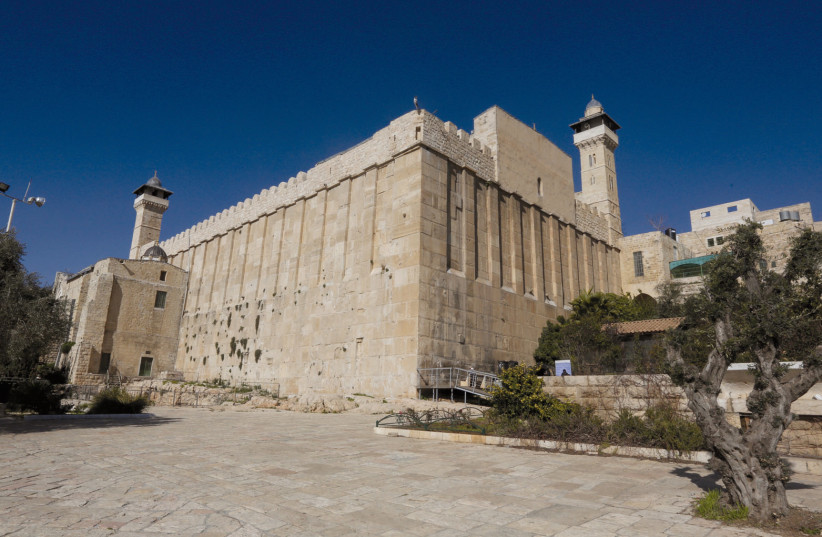
By the way, this field and cave that Abraham purchased about 3600 years ago is now underneath a large building in Hebron. All of our Patriarchs and most of our Matriarchs are buried there. Rachel was buried by Bethlehem, for special reasons we will learn later.
Every year when we study this section of the Bible, thousand of Jews make a pilgrimage to Hebron pray at the exact site our father Abraham purchased from the ancient Hittites. Muslims who respect our patriarchs also pray here. There is a rumor that decades ago some of them found a hidden passage into the caves underneath the building and sent a small child down there. He came back up, but in shock and never spoke again.

“The One”
Abraham sends his most trusted servant to find a wife for Isaac (Gen 24). Abraham’s life mission of bringing monotheism to the world will continue through Isaac, his heir. However, he is aware that Isaac marrying the wrong woman would impair or scuttle this vital task. He has his senior servant travel back to him own homeland to find a girl from his own family.
Remember that historically it was absolutely normal to marry relatives. Abraham himself married his half niece. Sarah, the granddaughter of Abraham’s father Terach. Her father Haran was Terach’s son from a different mother (Gen 20:12). Such marriages were made to keep women protected within the tribe, here this was needed since Abraham’s extended family were the only people around with leanings towards monotheism.
The trusted servant is not named in Chaye Sarah, we know from our sages that he is Eliezer, the chief of staff for Abraham’s household (15:2). Eliezer himself was a teacher, a great man and very pious. To find the right girl Eliezer turns to God in prayer and devises a test:
“Behold, I am standing by the water spring, and the daughters of the people of the city are coming out to draw water. And it will be, that the maiden to whom I will say, ‘Lower your pitcher and I will drink,’ and she will say, ‘Drink, and I will also water your camels,’ her have You designated for Your servant, for Isaac, and through her may I know that You have performed loving kindness with my master.” 24:14
The test works and it works immediately, a sign of divine endorsement:
Now he had not yet finished speaking, and behold, Rebecca came out, who had been born to Bethuel the son of Milcah, the wife of Nahor, Abraham’s brother, and her pitcher was on her shoulder.
Now the maiden was of very good appearance, a virgin, and no man had been intimate with her, and she went down to the fountain, and she filled her pitcher and went up. And the servant ran toward her, and he said, “Please let me sip a little water from your pitcher.” 24:15-17
Eliezer runs towards her and asks for water. He hopes that his prayer was answered, that she is the one. It turns out he was correct, but our sages in the Talmud actually fault him for making such a specific request and then assuming that the right girl had appeared:
With regard to Eliezer, servant of Abraham, he made an inappropriate request when he prayed beside the well, as it is written: “That the maiden to whom I shall say: Please let down your pitcher that I may drink; and she shall say: Drink, and I will also give your camels to drink; that she be the one whom you have appointed for your servant Isaac” (Genesis 24:14).
Eliezer entreated God unreasonably, as his request allowed for the possibility that the girl might be lame or blind, and yet he had already promised to take this one to Isaac. Nevertheless, God responded to him reasonably and caused the fitting Rebecca to come to him. (Talmud, Taanit 4a)
Our sages explain that Eliezer implies to God that the first girl to show up at the well and pass the test of giving him water will be the one bride for Isaac. Then Eliezer runs towards the first girl. It could have been anyone, a girl with a peg leg or a hidden health problem, or someone not from Abraham’s family. God, to reward the tremendous merit of Abraham, arranged it that she was Rebecca.
Keep in mind as well that Eliezer was a very righteous man who had witnessed actual miracles while living with Abraham and Sarah. He was one of the few men teaching monotheism in his generation. He had also bravely joined Abraham in battle against four armies.
Even though he was used to miracles, Eliezer comes up with a logical way to test the girl’s compassion, in addition to requesting Divine assistance. His prayers were answered immediately and directly. For modern men by contrast it would be foolish to rely on a prayer for a wife and run to the first decent girl who shows up.
Not only did Eliezer seem to rely on this girl being “the one”, but Rebecca’s family also states that the match was “made in heaven”. The Talmud (Moed Katan 18b) brings their reaction to Eliezer’s proposal as proof to the notion that a match can be fate:
Rav said in the name of Rabbi Reuven ben Itzterobili as follows: From the Torah, and from the Prophets, and from the Writings; it is implied that there is a Divine decree that a specific woman is destined to be married to a specific man.
From where is this derived? It is from the Torah, as it is written: “Then Laban and Bethuel answered and said: The thing comes from the Lord, we cannot speak to you either bad or good” (Genesis 24:50). From the Prophets, as it is written: “But his father and his mother knew not that it was of the Lord” (Judges 14:4). From the Writings, as it is written: “House and riches are the inheritance of fathers; but a prudent woman is from the Lord” (Proverbs 19:14).
This is seemingly a proof of Divine providence in bringing a man and a woman together. We might assume that the Bible and conventional Judaism endorses the notion of “the one”, or “soulmates”. This concept is called “zivug” meaning match or pair in Hebrew and “bashert” (or beshert) in Yiddush.
It appears Jewish tradition endorses soulmates. But digging deeper into ancient Jewish sources we find this concept is not cut and dry.
The Gemara cites a famous statement of our ancient sage Shmuel: “Every day a Divine Voice issues forth and says: The daughter of so-and-so is destined to be the wife of so-and-so; the field of so-and-so will belong to so-and-so.”
It sounds like fate controls our future mate and even our real estate dealings. However, Shmuel also allows a man to engage a woman for marriage during a festival, which would otherwise be forbidden. He explains that if you don’t do so now, another man might step in and betroth her first. The Gemara reconciles the apparent contradiction with Shmuel’s other statement by noting that another man may pray for this woman and change her destiny.
So while there is fate, we are also beings with free will, with some power to modify our fate through our actions, attitudes, and prayers.
The Talmud in Moed Katan 18b relates an ancient true story illustrating this possibility:
There was this incident, in which Rava heard a certain man asking God for mercy, (praying), who said: Grant me so-and-so (a specific woman) as a wife.
Rava said to him: Do not ask for mercy in this specific way. If she is fit to be your wife, she will not go away from you. And if she is not destined to be your wife, you will come to reject the Lord (when you see that your prayer is not answered).
Later, Rava heard him say in prayer: Please either let him (referring to himself) die or let her die.
Rava said to him: Did I not tell you not to pray for this woman?
There are actually two ways to understand this Gemara that each teach a valuable lesson. According to Rashi (a major figure who explained the Bible and Talmud, 1040-1105) this man continued to fixate on this woman and pray to have her. He was now adding to his prayers that he should die before her if she was going to marry a different man, or that she should die before she married a different man. The prayer became so obsessed that he would rather die than see this woman, his “one”, wed another man.
However, the other version of the Talmud does not read “you will come to reject the Lord” but “you will come to reject her”. The difference in the text is tiny: A Hebrew letter Hey with an apostrophe after it is an abbreviation for God, so we can avoid writing His name without a real need. However, the letter Hey without any apostrophe means her.
So instead of the danger being rejecting God due to his prayers being unanswered, the man will come to reject the woman herself. In this version of the text, the obsessed man actually married this woman, but then came to hate her and prayed that one of them would die.
His prayers for a specific woman were answered. It is interesting that Rava, a great wise man, thought this man would be disappointed when God did not give him this particular woman. He counseled him not to pray for her since he may be disappointed in God when he doesn’t get her.
Instead, God gave him what he wanted, even though she was not a good fit for him. Sometimes the most painful punishment a person can receive is to get exactly what he asked for.
This man had a knack for prayers, normally a sign of righteousness. However, he probably became so obsessed with this specific girl that he focused all his energy and devotion into requesting that God have them marry. Being obsessed with one woman can corrupt even a pure man’s prayers.
Naturally, if this man entered the marriage after a long period of being fixated on this woman, he may have unrealistic expectations of how their relationship would go. He had put her up on a pedestal in his mind, and the reality of living with her did not match his fantasy of how thing would go. He was in so much pain that he began to pray that one of them would die.
Naturally, both versions of the Talmud teach that a man might alter his ‘intended’ mate through prayer. The Rambam (Maimonides) writes in Shmoneh Prakim, section 8 (his introduction to Pirke Avot) that while a man may be drawn to a certain woman or type of women, it is a complete mistake to think that there is one predestined match that a man will end up with. Humans were given free will and can make the choice to marry another.
The Talmud reveals other elements of this concept that deepen our understanding of matchmaking.
Matchmaker, Matchmaker
The Talmud on Sotah Daf 2 explains another aspect of “the one”, or the match made in heaven. Namely, this heaven decreed soulmate only applies to a “zivug rishon” or the first match. Some explain this means a match made when the couple is still young. But “zivug sheni”, a match made later on in life, is actually made according to the man’s deeds and accomplishments.
Rashi explains that a first match is made according to the man’s Mazal (also spelled Mazel). Mazal is usually translated as luck or fate, as in the common phrase used to wish congratulations: “Mazal tov” typically translated as good fortune.
But Mazal has another, deeper meaning. Mazal also connotes intelligence and social acuity.
Mazal is understood as intellectual wherewithal, in the Talmud in Bava Kama 2b which rules that human beings are always liable to pay for damages they cause because unlike animals they have “Mazal”.
Rashi (אדם דאית ליה מזלא) defines this Mazal as the intellect to guard himself to prevent damage to himself and others. The Mishnah on 26a states that human beings are liable even for damage caused during sleep. The Talmud explains this is because he should be aware of his surroundings and check for breakable items nearby before he falls asleep.
So this Mazal is not merely paying attention and being aware, but is also the ability to plan ahead and understand the consequences of your actions.
Naturally, we can conclude that there are two types of Mazal. The common understanding of Mazal as fate and fortune is incomplete, as there is also an aspect of Mazal which is how a human being chooses to interact with the world.
We can understand that both aspects of Mazal are needed. A young man can be have excellent luck, and be from the best family. The girl he is taking out can be a perfect match, as if made in heaven. But if he has spinach stuck in his teeth during the date, she is not going to want to go on a second date.
It’s hard to make a match
The Talmud (Sotah 2a) states that God is involved in making matches and this is as difficult as splitting the sea. The Gemara notes this is for the second match, made through the man’s actions. The implication here is that many or even the vast majority of couples are considered a second match, so God has to consider not merely their mazal, but also their deeds.
Naturally, for most people today, the person they will marry should be considered a “zivug sheni”, and not the result of pure heavenly matchmaking.
Keep in mind that in ancient times a couple would engage and marry at a very young age, at ages we moderns are still in high school. In the Talmud in Kidushin 29b, Rav Ḥisda said: The fact that I am superior to my colleagues is because I married at the age of sixteen, and if I would have married at the age of fourteen I would say to the Satan: An arrow in your eye! (Implying if he would have married before experiencing any sexual lust he would be a greater sage).
Now, at such a young age, the personalities and proclivities of both the boy and girl are not entirely set. We simply have not accomplished much at age 16. They most likely don’t know what they want out of life and a spouse, and they grow and learn together. Therefore the match for such a “zivug rishon” relies more on fate. It would be fair to say that for them the match was made on the basis of destiny or fate or a Divine voice. Of course the parents and society of the couple are also involved as agents of destiny.
(Yes, there are some still couples that marry quite young in our circles, under the guidance of their parents and rabbis. More often both have considerable education and life experience and exercise independent judgment).
But once a man develops himself, the match he gets is based not only on his Mazal, but also his accomplishments. In modern mainstream America people get married, if they ever get married, around age 30 on average. Yes, some marry right out of high school but this has become rare, and often doesn’t last. In addition, religious subcultures like conventional Jews drive down that average by marrying around age 21. In our circles most people are married by age 25, and almost everyone before 30.
But for average Americans it is around age 30. Realize that a boy and girl with about three decades of life, sixty years of combined experience, are much more set in their ways. They are no longer young and influenced by parents and teachers. They have already developed their personal goals and patterns living long before getting married.
Each has his and her separate aspirations, developed independently. It isn’t fate that brings them together at last, but a knowledge base built over decades of what they want out of a relationship. In today’s mainstream society it would be very hard to say that the concept of a match made in heaven still applies at all.
The Zohar, the primary text of mysticism (Vayechi 229a), states “According to their deeds God matches couples. If a man perverted his ways, his zivug is given to another, until he rectifies his ways. If he rectifies his ways and his time has come, the other man [who was not her true zivug and has married her in the interim] is pushed aside and he comes to takes what is his. This is the most difficult task for the Holy One, blessed be He, to banish one man because of another”.
This mystical approach is in line with “mazal” and also what we call “middos”. “Middos” means measures as in “the measure of the man” and refers to a man’s choices, behaviors and approach to life. These elements, under his rational control, are the major force in determining his mate. The mystical sources also remind us of the rationalist Rambam cited above, that free will requires that a man’s match is actually his personal decision.
Our actions, behaviors, and prayers can change whatever was our decreed fate. We now understand that the notion of there being “the one” out there for you is not such a sure thing. Gentlemen, imagine this: what if your own “match made in heaven” went and prayed for the big biker guy with tattoos. It worked, she rode his bike and got her own tattoos and she is no longer a woman you would even consider marrying. The reality that out free will decisions change who we are and who we become makes holding out for that one person seem foolish.
A worse problem would be a man obsessing with the woman he thinks is “the one”. This disease of “one-itis” can lead to disaster, as the Talmud in Moed Katan teaches. Even if that woman had been appropriate for the praying man, he ruined his chance of building a stable relationship with her by putting her on a psychological pedestal and overlooking any possible faults. No wonder he ended up praying that one of them die.
Instead of fate, we have Mazal and accomplishments. Mazal in the sense our sages use it in the Talmud: wherewithal, intelligence, and social acuity. This includes the ability to introspect and decide what you want out of life and relationships. This is a vital skill to develop.
A man’s personal accomplishments also change his outlook. A man who puts in constant work and becomes successful in business may not consider marrying certain women who he feels will undermine his dedication to what he has built. She may have been fitting for him before he created his business, but not anymore.
Many men go through life without ever stopping to think what kind of woman they should partner up with. When an attractive woman is available, that it enough and they fall into relationships and even marry without really determining if she is proper for his life. Even ancient Eliezer at least devised a plan to test the girl for kindness and compassion.
Draw and water
There is a potential problem for men of taking the wisdom of the Bible and thinking it applies to their life directly. The wisdom is still true and accurate, but our modern context is wildly different that ancient Israel and Padan Aram. Even at a fairly young age of 20, modern women can have more life experience, for better or worse, than ancient women had in a lifetime.
A great man takes wisdom and grows wiser from it, meaning he considers how it applies to his own circumstances. Eliezer himself is described as the teacher who would draw water and pour water (Rashi on 15:2). He absorbed the wisdom in Abraham’s teaching and then gave it over to new converts to monotheism. We need to draw lessons from our Holy Books and then use them to water modern ground.
Abraham the Elder
“And Abraham was old, coming with his days, and God blessed Abraham with everything” (24:1). Abraham came with his days meaning all his days. He did not take even one day for granted or let if be wasted. So what did Abraham do now that his beloved wife Sarah was buried?
Our sages explain 24:62 “Isaac came from having gone to Beer-lahai-roi…” as meaning that Isaac, after his mother died, went to bring Hagar, the former concubine, back to Abraham. Beer-lahai-roi is the spring where Hagar saw the angel and then settled. Obviously this was done with Abraham’s approval. Our ancient sages state that Abraham now married her, based on 25:1, identifying Keturah with Hagar.
Previously Hagar had been only a concubine. 25:6 implies Abraham took other concubines as well, this is debated by our sages. Rashi notes that the word concubines “pilagshim” is spelled missing a letter since if refers to just Hagar. Other authorities explain that Rashi’s Bible was missing a letter, but the mainstream text has all the letters. (See Beit Yosef YD 275 from the Rashba).
Anyway, the simple meaning of 25:6 is that Abraham took multiple concubines. It could be that Hagar was the only one he took as a full wife. In Jewish law, that means with a marriage contract. Concubines do not have the guarantee of a marriage contract, but must be loyal and exclusive to their man. If the concubinage ends she cannot join another man for three months – so that if she was pregnant or becomes pregnant later we can be sure who the father is. The Bible reflects a man’s natural desire for knowing paternity, knowing exactly which children are his responsibility.
Abraham, already an elder, marries again and has more children. Keep in mind he has already passed the torch of his mission for monotheism to Isaac and Rebecca. Our sages state that continuing to try to have children and build society is the message of Ecclesiastes 11:6 “Sow your seed in the morning, and don’t hold back your hand in the evening, since you don’t know which is going to succeed, the one or the other, or if both”. Children of a man’s youth can be quite different from children he has after he is wiser and more accomplished.
As a man ages, his focus should change. His physical power may wane but he should replace this with wisdom and intellectual pursuits. However, a normal healthy man still has God given physical desires, and should not pretend that they evaporate with age. Abraham reminds us that a man can still accomplish more as an elder in all areas of life.
While the narrative of the Bible shifts to focus on Isaac, Abraham was still in the picture and involved in educating Isaac’s twin boys as well as Ishmael and Abraham’s other sons from his concubines. While the monotheistic mission continued only through Isaac, Abraham gave his other sons “gifts”.
Our sages say this alludes to wisdom and spiritual powers. There is speculation that when Abraham sent these sons East some ended up in India where they became religious leaders and priests. The priest caste in India is call Brahmins, a cognate of Abraham. These may have been his sons. Some of the sons may have gone even to ancient China, bringing a version of Abraham’s philosophy.
As we see later through Jacob, a man continues his legacy through his children. If you are not blessed with actual children, keep in mind another lesson from Abraham: teaching a man is like making them. Abraham and Sarah were credited for “making souls” by opening their eyes to the truth of monotheism (Genesis 12:5).
If you have special wisdom, insight, or technical skills, you can share them with other men. You will be credited with making these people into better men. Of course, your students must be motivated to learn as well, but you as their teacher can join them in forging their own souls.


 Red Pill Rabbi