This week we study Genesis 12:1-17:27, called “Lech Lecha” meaning go for yourself. That was God’s command to our first patriarch Abram to leave his homeland and travel to a new place and become great. For our convenience we will call Abram and Sarai by their ultimate names, Abraham and Sarah (see Gen 17:5, 15).

First of all, pay attention to God’s language: “go for yourself” implying for your own benefit. Our sages explain this means go in order to become greater than you are now.
God could simply give orders, He doesn’t. Instead Abraham is told that by undertaking the difficult step of moving away from his homeland and family he will become something greater, so the whole mission is ultimately for his benefit. God wants us to become better than we are, and puts us into situations where we have to improve to pass the test.
We discussed this test last time we studied Lech Lecha:
He takes the leap of faith to Israel, only to be tested again and again with difficulties such as famine, war, enemies, family strife, and abductions of his wife. Abraham is not made into a great nation, he doesn’t even have children. Again, God repeats that Abraham’s offspring will inherit the land (Genesis 12:7, 13:15, 15:18), and that descendants will become a large nation and become countless in number (Genesis 12:1, 13:16). When Abraham reminds God that he has no genetic heir, God explicitly states: “the child who will issue from your loins will inherit you” 15:4.
We focused on Sarah (then named Sarai), Abraham’s wife and her internal struggle with victory over hypergamy. This enabled her to give her handmaid over as a concubine to father children. This time we will discuss some couple key details about Abraham and Sarah that allowed them to succeed and for Sarah to overcome self interest to nurture the first Jewish family.
The first rational man
We know from our ancient Medrashim (traditions passed down from ancient times that fill in the back story to the Bible) that there were other tests before Abraham left his homeland. The Medrash explains how Abraham became the first monotheist. While he was born into a completely idolatrous context, Abraham used rationality to determine that it was better to believe in just One God.
Abraham considered the sun, which many worshiped, and observed that when night fell it’s power was gone. Likewise the idolized moon, which waxed and waned.
Abraham thought perhaps the great mountains are appropriate to worship, but the wind, rain, and earthquakes wear down and destroy them. Maybe men should worship the wind and rain? The wind stops and the sun dries out the water. Some worship powerful beasts like the lion, but a mere stick can kill it.
Abraham used intellectual and philosophical inquiry to reach the conclusion that monotheism was the only valid faith. He reasoned out there there was no single physical thing that was permanent and independent, but that all things were interdependent and vulnerable to something else. Therefore, none of them were worthy of worship.
He logically concluded that there must be one master creator for all these creations. The Medrash states that Abraham saw the natural forces of the world interacting with purpose, and asked “where is the One Master to this?”
Then God finally appeared to him. Using his rational forces to come to belief gave him an advantage over simply being told by God “I am God”. Abraham did not rely on miracles or prophecy, but on his own mind, his internal intellectual and philosophical power.
The pagan religions of Abraham’s time were not rational but emotional. If a man wanted a good harvest he went and served the harvest idol or donated to the harvest shamans. When a kingdom felt they needed success in war they brought sacrifices to the war deity. If a man felt lonely he could bring gifts to the fertility goddess in order to sleep with one of her temple prostitutes. Religious practice was all about fulfilling emotional needs.
Idolaters preyed on emotion to manipulate people to bring offerings. Many societies were shamanistic, with religious and political leaders portraying themselves as representatives of the deities. They demanded allegiance from regular people and used feelings of religious obligation in their grift. If a man wanted permission to start a business, he had to bring an offering to the gods, which went into the pockets of the elites.
Various idols were used to make money from the gullible believers, under the illusion that the idols had the power to help them. Some cults regularly sacrificed men on the bottom rungs of society to “appease the Gods”. They were really removing disenfranchised or discontented people who might rebel against the social order.
Shamanism and magical thinking was the way they ran society and grifted the people. Abraham took a rational hammer to this emotionally manipulative culture.

Abraham used his intellect to reason that idols were false. Then he went a step further to debate with idolaters and convince them their emotional attachment to idols was illogical.
Abraham was the son of Terah, who built and sold idols for worship. Having an idol for various deities in the home was normal in the ancient world. More affluent people would buy larger and more ornate idols to show their devotion to their deities, and as a status symbol.
Abraham would employ logic to convince his father’s customers not to buy and serve idols, arguing that it was inane for them to serve an object that was itself just made and younger than the people themselves.
Once when Terah was gone, Abraham smashed almost all the idols in the shop and placed the hammer on the largest idol, claiming the biggest idol had been jealous and broken the others. His father and the people of Ur Kasdim replied that it was impossible, an idol can’t break another. Abraham asked them: if they are powerless then why do you pray to them ?

His rational thinking was undermining the emotional idolatrous culture. If the people stopped feeling idols could help them, the bribes and offerings to the elite would stop. The unquestioning allegiance to the shamans, priests, and politicians would wane. They couldn’t use fear to grift people who developed an intellectual realization of an all powerful One God.
Nimrod arrested Abraham and threw him into a burning furnace. Miraculously, Abraham was saved. After seeing the miracle, his brother Haran said he was with Abraham died in that furnace (11:28).
Abraham began to preach that rational people should serve the One God who created everything else. Abraham has already shown he is not swayed by public opinion or the prevailing cultural values. He has a rational basis for his faith and preaching, he has evidence. This gives him a special certainty and makes him dangerous to the idolatrous society.
Abraham’s family, including Terah, leaves Ur Kasdim, under threat from the pagans (11:31). In Haran, Abraham and Sarah are able to preach monotheism and “make souls” (12:5). This means by teaching people about monotheism and bringing them to see the reality that One God made everything else, they were credited as if they had created new people. This is the origin of the term “born again”.
Our sages in the the Talmud (Avodah Zara 9a) explain that the outreach and teaching done by Abraham and Sarah marked the beginning of the era of Torah in this world. Rashi comments on this verse that Abraham taught the men while Sarah taught the women.
In any area of teaching and inspiring others, and especially in personal and spiritual matters, men are better able to connect to other men while women are the same way.
The importance of pitching a tent
Genesis 12:8 “From there he relocated to the mountain east of Bethel and pitched his tent…”
The word tent “ohel” here is written with an ending letter Hey, the feminine possessive suffix, meaning “her tent”. But the word is pronounced as if it ended in Vav, the masculine suffix for “his tent”. No, this was not an ancient spelling mistake, there are no mistakes in the Bible. Rashi explains based on the ancient Medrash Rabbah (39:15) that this change hints to us that Abraham first pitched her tent and afterwards his own.
Some versions of the Rashi add “because a man should honor his wife more than himself”. We have mentioned that on a practical level women are more attached their home than a man is. They see it as their nest, their place. There is more wisdom here than a simple lesson in being a nice husband.

Remember: Abraham and Sarah had travelled before and set up their tents before. Why does the Bible insinuate that Abraham gave extra respect to his wife at this juncture?
There are no accidents or coincidences in the Bible. Abraham now sets up Sarah’s tent first because God has just informed Abram that they will have children (12:7). Our ancient sages tell us that Sarah was born infertile. She certainly prayed for children, but never seriously thought she would give birth since she had not conceived after many years of marriage.
Instead of fixating on a family she would never naturally have, Sarah’s focus was teaching others about God and monotheism. Abraham would teach the men and she would teach the women (Rashi on Gen 12:5). She had the statute and gravitas of a tenured professor and the acumen of a popular preacher. She made a name for herself in public by inspiring her students. She was running a seminary with thousands of women as her students and protégés.
But her own home, her personal tent, was not important to her. Sarah got her sense of accomplishment outside the home, by interacting with others. She felt important because of her public persona, her success in “making souls” by bringing them into God’s light. Now, when God reveals that she will have children, Abraham sets up her tent first.
Abraham is showing Sarah that she needs to change life focus and understand the importance of her personal tent, her own family. She must refocus on her private home life in preparation for becoming a mother. When she will have a child, her main accomplishments and source of personal pride will be inside her own home, with her own family. With the simple act of setting up her tent, Abraham is showing Sarah that this private mission will become more important than her public life as a teacher and leader.
Gentlemen, there is a huge life lesson here. The things a man tells his woman are important she will feel are truly important. If a man tells his wife over and over that he loves her cooking, she will dedicate more energy to cooking. When a man tells a girl he likes it when she does her hair and makeup so perfectly, she spends more time doing her hair and makeup.
Likewise, if a wife works and the husband goes out of his way to praise her for bringing home the bacon, then she feels that her job is what makes her important. She starts to identify as a working woman, since that is what earns her praise.
The same concept applies to men as well, if you praise a man for his work then he begins to think his work is what makes him a man, and puts more energy into that. But women are especially conscious of how others perceive them, and more apt to change their focus based on the praise they get from the important people in their lives.

Realize that in modern mainstream society this innate responsiveness of women to male praise has been somewhat mitigated. One of the main concepts of modern feminist ideology is to indoctrinate women that they should never do anything for the pleasure of men.
Obviously this indoctrination is not entirely successful, women still do their hair and makeup to attract attention from men. However, as a sop to feminism she might say she is doing it for herself “to look pretty” or “feel good about herself”. Okay, but it still gets attention from men, that is why it feels good to her.
Be aware of how feminist thought impacts modern women. If you tell a woman you want her to do a certain something or wear a specific outfit, she may reject this suggestion. After all, she has been told by our feminist society to be her own independent woman, not to take orders from a man! (The irony that she is expected to take marching orders from radical feminists is lost on most people). You were too direct, and it triggered resistance programmed into her by mainstream society.
When you are important in her life, then her biology and innate programming tells her that she should try to please you. We see this in young women who start to become interested in a certain genre of music, sports team, or style due to being around a strong male figure with that interest.
A woman naturally wants to get along with and please the powerful men in her life. She will eventually adopt hobbies and interests from those men. If a man pushes her into those things, she will resist. If they are simply interests the man has and she sees the man as her best option in life, she will get into them simply by following this man.
Giving praise to certain activities or efforts a woman makes is much more effective than telling her to change her focus. This is what our patriarch Abraham accomplished by setting up Sarah’s tent in the Holy Land thousands of years ago.
Until that point Sarah had thought her worth in life was only through publicly teaching about God. No doubt Abraham had praised her for that and celebrated her accomplishments. Now God had informed them she would have children, a private mission. In order to get Sarah psychologically ready to change her focus in life, Abraham began to show her the importance of her private life as well.
Beauty and the beast

One of the greatest tests for both Abraham and Sarah was her capture by Pharaoh, the king of Egypt. A famine in the holy land forced them to travel to Egypt. The lead up to this event is very interesting from a gender dynamics perspective:
“As he approached to enter Egypt, he said to Sarai “Behold, now I have known you are a woman with a beautiful appearance. It may be, when the Egyptians see you, they will say this is his wife, and kill me…” (12:11-12)
The word “now” is not extra. The Medrash explains that Abraham and Sarah were very modest and did not show off their bodies, not even to each other. Abraham, on an extremely high level of holiness, was not accustomed to looking at his wife, even though she was a looker.
When they arrived at the Nile, Abraham realized that compared to Egyptian women she was extremely attractive. Rashi also explains the simple reading of the verse: Abraham knew already his wife was beautiful, but did not mention this until they came to Egypt since it was not yet relevant. Abraham was obviously not in the habit of talking about his wife’s physical beauty.
But now it could lead to conflict. Abraham knew the reputation of Egyptian men, that they were willing to murder a man to steal his wife. He suggests that Sarah claim she was his sister instead, to protect his life. This ruse works and Sarah is taken by Pharaoh and Abraham given riches in return.
There is also an Roman history book by Josephus that cites a more ancient history by Berossus the Akkadian reporting that while Abraham was in Egypt he taught mathematics and astronomy to the Egyptian priests. This could be another cause of Abraham gaining wealth there.

Both the Medrash and Rashi’s simple explanation to 12:11 tell us that Abraham was not used to mentioning Sarah’s beauty, maybe not even consciously aware of it. This is a very high level of holiness, a man is certainly allowed to look at his own wife and enjoy her beauty. We should be aware that a normal woman enjoys being praised for her appearance. Keep in mind that Sarah and Abraham were outliers, on a very high level of spiritual development. They held physical appearance in less esteem than modern people do.
Rashi (on 12:15) explains that the Egyptian customs agents praised Sarah amongst themselves saying she was fit for the king. They were likely aware that if they took this beauty for themselves, the king would find out and kill them to get her. So Sarah was taken directly to the king. We can only imagine how lustful Pharaoh praised and complimented Sarah for her beauty.
This was a test for Sarah. Pharaoh was the most powerful man in Egypt, possibly in the ancient world, and he was practically drooling over her beauty! What an ego boost! Her own husband did not seem to appreciate her body until he realizes it may get him murdered. It must have been tempting for her to give in, to be seduced by Pharaoh’s praises.
Sarah instead prays for salvation and God sends an angel to strike Pharaoh whenever he came near her(12:17). Sarah shows that she is not seduced by flattery but understands the value of beauty. Jews appreciate beauty, we even have a blessing to recite upon seeing an especially beautiful person. The words of the blessing reveal how Jewish wisdom relates to physical beauty: “Blessed are You, God, who has such (a beauty) in His world”.
The praise is not to the woman for her beauty, but to God for putting beauty into our world for us to enjoy. Sarah knew that her beauty was not truly her own, but merely on loan from above. It was a gift from God, a tool to use for Divine service, not something to take personal pride in. Not a reason to give in to the animalistic Pharaoh.
This humility is hard to find in modern people. We do take pride in aspects of ourselves that are really gifts given from God. Realize that God gives each of us certain strengths or abilities, and also gives us the choice of how to use them. A naturally large and strong man could bully others, or develop his strength further become an Olympic champion, or use it as a lifeguard. A cunning man could use his mind to cheat people, or to help them.
So too a beautiful woman, she could use her looks to seduce men and get attention from thousands, or keep them under modest clothing and save them for her own husband, to inspire him to love her even more for her modesty.
A wise man does not praise others for their inherent attributes, but for what they do with those gifts. It is especially important to praise your woman for the effort she makes to look good for you and appeal to you. As we explained above, specific praise from a strong man encourages women to put more work in that area.
When Pharaoh returns Sarah to Abraham, Pharaoh takes him to task for being misleading. Pharaoh was aware that his country was the problem. They were known for murdering men to take their women. He knows this as Pharaoh kicks them out of the country to prevent further Divine wrath. Be aware that when they can, people will try to blame you for their own problems.
Abraham for his part has no question that Sarah was loyal. The Bible hints to this as well, in 12:4 the verse mentions Abram went, and Lot with him. Now in 13:1 it states Abram went up from Egypt, he with his wife, and all that he had, and Lot with him.
It appears Abraham was more attentive to his wife after the sojourn in Egypt where she had been praised for physical beauty. Remember that Abraham found monotheism by intellectual observation and questioning the physical world around him. He was also an astute observer of human interactions.
Naturally Abraham decided this test was a sign he should pay more heed to his wife’s beauty and spend more time with her. This order also highlights that his nephew Lot was poised to split off from Abraham.
The first world war
After Lot moves to the Sodom area, God appears to Abraham and promises the holy land to his offspring. However, Abraham is soon tested by war. Genesis chapter 14 describes how an alliance of four kings invaded and made war on a group of five kings in the holy land, and on other tribes in the area. One of the kings is identified as Nimrod, who has a vendetta against Abraham for undermining his idolatrous society. The four kings win the war and capture Abraham’s nephew Lot. They plan to lure Abraham and destroy him.
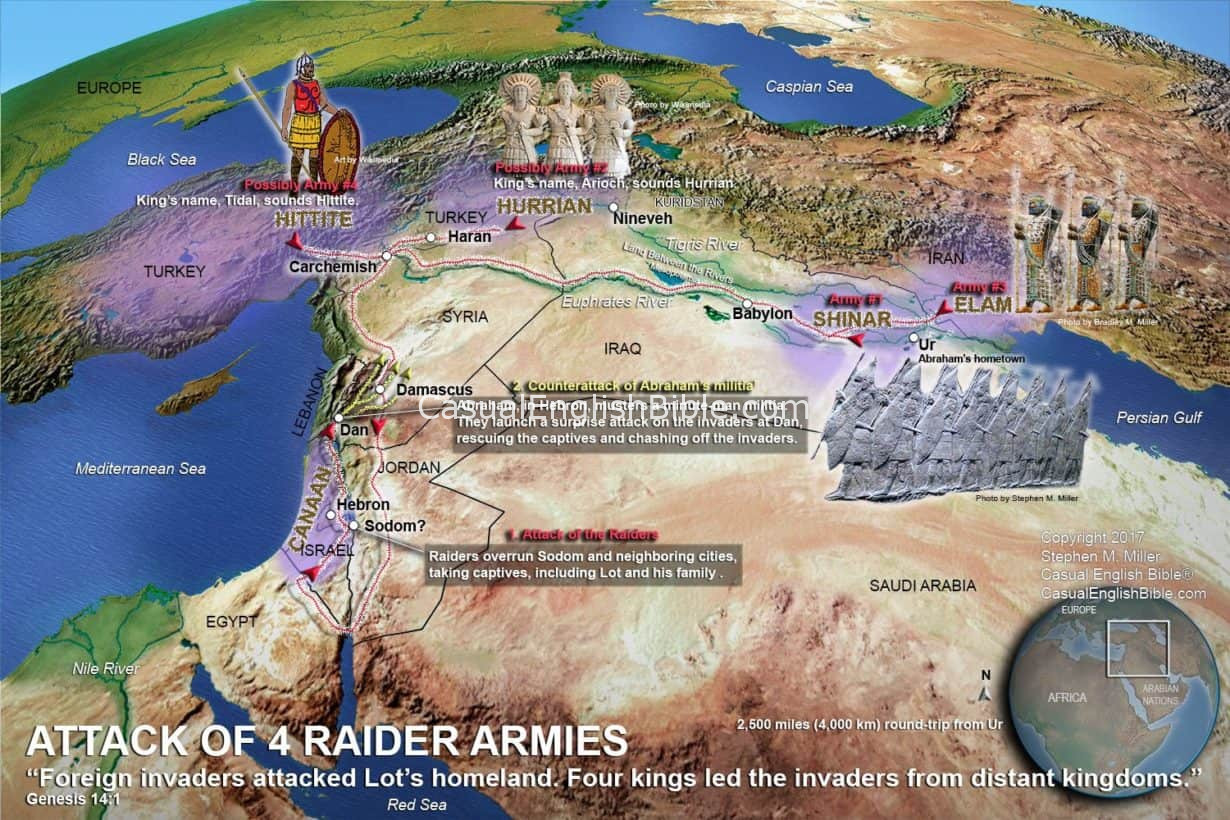
Abraham arms his men – 318 men – and goes up against the combined armies of four kings (13:14). Abraham splits his forces and attacks at night, pursues and prevails, returning Lot and the other captives and spoils from Sodom and the neighboring kingdoms. This sets up a powerful meeting. Abraham is greeted by Malkitzedek, king of Shalem. This is actually Shem the son of Noah, who had built the city of Shalem which would later become Jerusalem.
Our sages teach that God’s intent was for all of the descendants of Shem to become a holy nation. However, Malkitzedek greets Abraham with a blessing – and only after blessing the returning war hero does Malkitzedek bless God who gives victory. At this juncture God decides that only Abraham’s descendants will become the holy nation, since Abraham was always aware that it was God Himself who made this war happen and allowed Abraham to win (14:22).
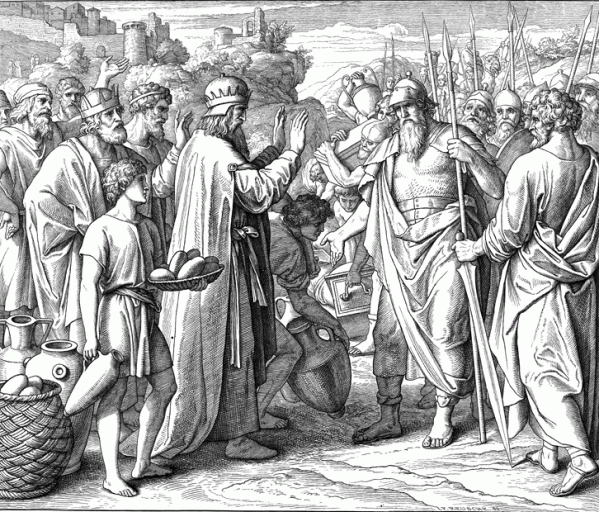
The king of Sodom asks Abraham to return the people, and offers that Abraham keep the wealth. Abraham refuses to take anything for himself, but does give shares in the treasure to his men 14:23. Abraham does not want anyone else to claim that he made Abraham rich. He does not want to be beholden to someone else.
This is an interesting concept to keep in mind. Abraham has already displayed independence from the mainstream idolatrous culture and willingness to challenge the status quo. Now he is a war hero to the nation, and could certainly claim the treasure as his own. But he does not want the king of Sodom to be able to say that Abraham’s wealth came from Sodom.
In today’s society it is possible but difficult to be independent of others. With modern technology some men, to some extent, can make a livelihood without being someone’s employee. This is a powerful step to make yourself free from the influence of others. Even if you are not able to do so, it is important to be independent by using your free time for your personal mission, not for someone else’s agenda.
Recognize that in modern culture the media is a huge influence over most people, and that the media creates a subtle push to consume more, be it physical items or entertainment. They are selling your eyeballs to advertisers. When you have a specific mission you want to accomplish in life, you need to be careful not to get wrapped up in the media.
Abraham shows us a prototype of a man who would not be beholden to other people. He had to be strong and independent since he was the only real monotheist in a sea of idolatry. Yes, Malkitzedek, king of Shalem was also a monotheist, but he was isolated in his holy city, not traveling throughout the world to open men’s eyes to the reality of God.
If you are a man with a mission, look for ways to gain independence from what other people think of you. This allows you more room to maneuver as you travel through life the way you want to.

 Red Pill Rabbi