We continue in Genesis with the reading of “Vayishlach”, meaning and he sent, Genesis 32:4-36:43. Our father Jacob is returning to the Holy Land after 20 years abroad, with his two wives, two concubines, eleven sons and at least one daughter. The last of his 12 sons, Benjamin, will be born on the road to Efrat (Bethlehem).

Jacob is returning home at last, but recall why he left: his twin brother Esav wanted to murder him after Jacob got Isaac into to give Jacob his first blessing. Esav had swapped his rights as firstborn to Jacob in exchange for food (25:43), but Esav was still angry over being tricked out of the blessing he had sold and wanted revenge.
Now, approaching the area where Esav lives, Jacob sends messengers to inform his brother of his arrival, telling them to call Esav the lord and Jacob his servant 32:2. The messengers report that Esav is coming out to meet Jacob – with an army of 400 armed men (32:7). Jacob has only his 11 sons, the oldest of whom is around 13. He has some servants and hired shepherds as well, but children and shepherds are no match for 400 warriors.
Jacob is afraid and “distressed” (32:8). Remember there are no extra words in the Torah, our sages explain he was afraid of being killed, and distressed over the thought he may need to kill his own brother. Jacob was willing to fight against all odds and psychologically prepared to kill.
However, he first send gifts from his flocks to Esav, instructing his shepherds to tell Esav that the animals were to “find favor in his eyes”. Jacob prepares his camp for battle if need be. Jacob also prays to God to save him. Then something bizarre happens. As Jacob is moving his family and possessions across the Jabbok river, he is left alone and an angel comes and attacks him 32:25.

Our sages explain this angel was the embodied spiritual force of his brother. Jacob prevails in the all night wrestling match but the angel dislocates his thigh. Jacob gets the angel pinned and demands a blessing from the angel before he is willing to release him.
The angel changes Jacob’s name to Israel, literally ruled over power, meaning he triumphed over an angel which had power “El”. That is one of the Divine names but also means power generally. Our sages explain that previously Jacob (Yaakov) got his father’s blessing through trickery, as Yaakov is cognate to trickery.
Now with this new name, Jacob’s blessing will be open and in full view. Even his brother Esav will admit to him that he was the worthy man for the first blessing.

Jacob first spent 14 years in the study hall of Ever (Malkitzedek) learning before he went to Haran. Jacob spent 20 years in Haran working for his wives, children, and flocks, under scrutiny from a hostile father in law. During this time he became a man who was not just a scholar, but a leader in all spheres of life.
He had to work on his marriages, his children, his dealings with Lavan and other idolaters, and shepherding his flocks despite thievery. He even dabbled in genetics to breed the best animals (30:41). He spent decades building himself up into a great man. Jacob has 34 years invested in becoming the leader of the monotheistic mission to the world. However, he still felt second to his older brother until his victory over the angel of Esav.
For modern men, realize that you may work on improving yourself for months and years and other people may not notice. It can take a long time, and even open conflict, for people to change their opinion of you. People get used to you behaving in one way and expect that to continue, even if you have changed course and started on another path in life. Most people don’t change much once they reach adulthood, so it can be surprising to others when you make radical changes in your character.
Part of this is setting goals and finding a mission. Jacob in his youth was involved in intellectual study, but with the blessing to lead the Jewish people he had to become a leader and a renaissance man capable of handling any situation. He made the mission of monotheism his personal mission, and developed himself to meet the challenges of being the leader of the only monotheistic tribe in a sea of idolatry.

Another thing you will notice is that when you make changes and improve, it may take a long time for people around you to get the hint that they should improve too. This can take months, even years.
If you start working out and look better and dress better, and become more confident and assertive, your woman may give mixed messages. She may say she dislikes these changes and wants the old (comfortable) you back. However, she may become more attracted to the new you, the man who takes care of himself, has goals, and gets things done.
Your self improvement causes anxiety in other people, because they want you to be predictable, and they worry they may need to improve themselves to stay with you. Eventually, if she has sense, she will start to work on herself to keep up with you. If not, you are already in a better position to find someone who will keep up with you.
This anxiety is important, but it must be subtle, never direct. You don’t tell your wife “I’m going to the gym to take care of myself, you should start taking care of yourself too”. You just work hard and let her see the results and figure it out herself.
We don’t rub our success in anyone’s face. Imagine if Jacob had simply gone to Esav’s home and announced “Brother! Here I am with my wives, sons, servants, and huge flocks! How did you like that soup I traded with you?” Esav may have drawn his sword immediately.
Instead Jacob sends a message of humility but also hints that he is no longer a mere academic. Jacob then sends gifts demonstrating, a little at a time, that he has acquired vast wealth and the aptitude to manage and grow more wealth (see Rashi on 32:15). He gradually reveals that he had developed into a leader and chief of his own tribe.
This process was meant to avoid a violent reaction by Esav. However, Jacob also had to be able to fight with Esav’s angel, representing his brother’s spiritual energy. It wasn’t enough to slowly improve himself into a leader for decades, he had to demonstrate the ability to use his strength.
While Esav and Jacob did embrace, Esav still resented his brother, even as Jacob was humbling himself, bowing and giving massive gifts. Brotherly love could not overcome Esav’s envy for Jacob and his success. Perhaps Esav realized that he had the same strength as Jacob to improve himself, but had wasted these decades while Jacob was away.
Be aware when you see another man’s competence and success and feel jealousy, anger, or resentment. These are destructive forces for your own soul. Instead when you look at an accomplished man you should realize that you can work hard and become better at life, more competent and more in control of yourself.
You may never have what the other man has, but you can work to attain what you need to get out of life for yourself. Jacob had total control over his emotions and was able to bow to his wicked twin, even though he knew he had put in the work to become the greater of the two.

Ovadiah the convert
We conventional Jews read a bit of the prophets or writing every Sabbath along with the weekly reading from the Five Books of Moses. This custom was instituted at a time when the ancient government banned Jews from reading from Torah scrolls. The portion of the prophets we read was picked to remind us of the actual Torah reading for that week.
With Vayishlach we read the entire short book of Ovadiah. This is interesting as the prophet Ovadiah was a convert to Judaism from Edom, which was Esav’s kingdom. Esav’s direct descendants were Edomites, which later were associated with Rome as well. Esav also gave rise to the tribe of Amalek, the ancient anti-Semitic enemy of the Jews. Unique in scripture, Ovadiah’s prophecy is geared not to Jews but towards Edomites.
Jacob had told Esav: Now, let my master go ahead before his servant, and I will move at my own slow pace, according to the pace of the work that is before me and according to the pace of the children, until I come to my master, to Mount Seir. Genesis 33:14
We never see in the Bible that Jacob or his children went to Seir, Esav’s mountain. Jacob’s statement is actually a hint to Ovadiah’s future prophecy about the ultimate punishment for Edom:
Ovadiah 18: And the house of Jacob shall be fire and the house of Joseph a flame, and the house of Esau shall become stubble, and they shall ignite them and consume them, and the house of Esau shall have no survivors, for the Lord has spoken… 21: And saviors shall ascend Mt. Zion to judge the mountain of Esau, and the Lord shall have the kingdom.
Ovadiah came from Esav but made himself into the opposite of Esav (Talmud Sanhedrin 39). Ovadiah had served as steward at the court of Ahab and Jezebel, who were extremely wicked [Jezebel deserves her own essay, she was the driving force behinds Ahab’s corruption and murder].
Yet despite living among amoral villains, Ovadiah remained righteous and even hid and protected the true prophets whom Jezebel was trying to murder. That is how Ovadiah merited prophecy himself.
Esav by contrast grew up with Isaac and Rebecca, the most righteous people of their time. And yet he was not influenced by them, but went out into the field and became a hunter, a murderer, and rapist. He was willing to sell his birthright, with his responsibilities to his family, for soup.
Be stubborn
We see from here that Esav had tremendous power, which he shared with his descendant Ovadiah, to resist outside influences. Jacob too has this strength, he lived with idolatrous Lavan for 20 years without becoming like him. Jewish wisdom identifies Rome with Esav/Edom as well. Rome was extremely powerful and proud, and influenced others with Roman culture and the Latin language.
Some modern sources speculate that perhaps America now has the mantle of Rome/Esav/Edom, with the same strength of resisting outside influences and instead dominating others. We see from the end Genesis chapter 36 that Esav/Edom give rise to multiple kings and kingdoms in various locations. Edom is not merely a geographical location, but a spiritual force.
Much of American politics and architecture takes cues from Rome: the eagle, arrows, and columns as symbols for example. Certainly there are other influences on modern America as well, including a Jewish component. Americans are known as stubborn, and accused by foreigners of being set in our ways and expecting them to go along with us.
As we see, this stubbornness can be both a good and bad quality depending how it is applied. We want to be open to positive influences but also remain steadfast in avoiding negative changes and maintain our distinct national character. Resisting outside influences can be a sign of inner strength and confidence. Be aware of your capacity for stubbornness and use this talent well.
Outgoing women
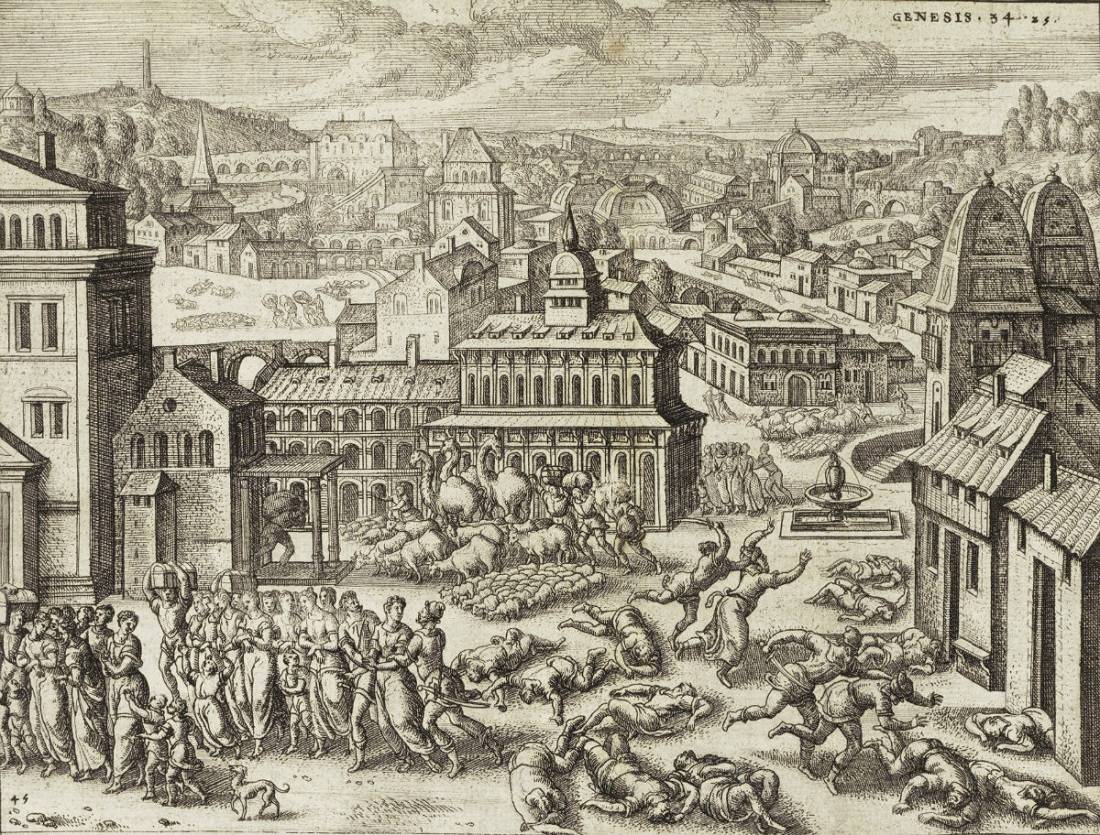
Last year we explored the abduction and rape of Dinah, Jacob’s daughter, by Shechem, prince of the city Shechem. We focused on the actual episode and the consequences, including the psychological effects on Dinah herself. We mentioned one of the causes of this outrage:
In Genesis 32, Jacob finally returns home, only to have his estranged brother Esav come out towards him with an entourage of 400 armed men, seemingly to get revenge. In preparation for the encounter, Jacob sends gifts, prays, and prepares his family to fight if needed. When they finally encounter Esav and his soldiers, Jacob bows to his brother, they hug, and Esav cries, seemingly reconciled with his brother. Then Jacob introduces Esav to his wives and sons (Genesis 33). Missing from the list is Dinah, daughter of Leah.
In preparation for the meeting Jacob had hidden her, thinking that if Esav sees her beauty, he will become interested in taking her as a wife. As we have seen, marrying within the family was common in that time. Jacob is fully aware of the power of family and society over women, having successfully freed his wives from the influence of their idolatrous family and society.
Jacob wants to protect young Dinah from becoming corrupted by Esav, knowing that Esav is a strong and powerful man and power is attractive (Jacob himself calls Esav powerful, Targum to 33:10 “ravrevei”). Jacob understands that if Esav takes Dinah, she will be changed by his aggressive power and influence, he does not think that Dinah is able to change Esav. However, our sages teach that Jacob was mistaken, and Dinah’s ultimate fate will be worse…
From Shechem, Dinah becomes the first recorded Alpha Widow. I want to focus our attention on Jacob’s mindset in putting Dinah in a box so his brother would never see her. We concluded:
Jacob had thought that if his brother Esav saw and married Dinah, she would be totally lost to his power. Our sages in the Medrash (Genesis Rabbah 76:9) state that Jacob was mistaken, and the rape of Dinah was the consequence of his mistake. While Dinah was emotionally lost to Shechem as an Alpha Widow and victim of Stockholm Syndrome, she also tamed him.
Dinah was the first girl Shechem the rapist prince really wanted to settle down with. While Jacob was correct that Esav would have changed Dinah, he did not realize Dinah would have had power over Esav too. Our ancient sages, aware in retrospect of Dinah’s unique power, point out Jacob’s mistake.
I want to delve more into Jacob’s relationship with his daughter Dinah. While our ancient sources say Jacob had other daughters, Dinah is the only one named, showing that she was especially important. Hiding her in a box from his crooked brother was just one illustration of Jacob’s policy.
We can speculate that this was not an isolated event, but that Jacob typically tried to keep Dinah away from men, and keep her under close supervision. This may sound overprotective by modern standards, but was likely considered absolutely normal in ancient times.
Historically, parents tried to keep their daughters chaste and away from young men who could seduce them. While everyone has free will, the Bible teaches that the parents of a woman who commits adultery share somewhat in her guilt (Leviticus 21:9, Deuteronomy 22:21). We know that the way you grow up does influence the decisions you will make later in life.
In ancient times there was the added danger of young women being abducted by criminals or rival tribes, or even taken as a war brides never to be seen again. Women were tragically stolen, bought and sold as sex slaves. Responsible parents were very careful with their daughters.
The verse just before Dinah “going out” states that Jacob, having settled by Shechem, erected an altar for God 33:20. Immediately after that Dinah does out to look on the daughters of the land 34:1. In the times of Abraham and Isaac setting up an altar was a way of publicly proclaiming a site holy to God. Abraham used to set up an altar and “call in the name of God” meaning bring people there to teach them monotheism (Gen 13:4).
Jacob has just bought land near Shechem, and with his altar is now beginning to influence people around him to see the truth of One God. However, it seems that Dinah and the women were not involved in this outreach mission.
We can speculate that not only should Jacob allowed Dinah to meet and influence Esav, but realizing her outgoing nature Jacob should have involved her in outreach to local women in Shechem. Indeed, Dinah goes out to meet the local girls when she is abducted (34:1). She was trying to make connections, and felt that her outgoing nature could be used to serve God and increase monotheism in the world. That was the same work her father was starting at this time.
In the time of Abraham and Sarah he had taught the men while Sarah taught the women (Gen 12:5). Sarah had an outlet for her passions and beliefs. However, Jacob felt that Dinah and the women must be protected while Jacob went to work dealing with the local people. Jacob feels that a woman’s role was not to go out and influence others. He was correct that men are the leaders, the conquerors, the explorers.
However, his grandmother Sarah had converted thousands of women to monotheism (Gen 12:5). Sarah died before Jacob was born, so he never saw her in action. His model for women was Rebecca, who seems to be a modest and private figure, like Isaac. The most outgoing woman Jacob knows if Leah, Dinah’s mother, who approached him for intimacy, leading to Issachar (30:16).
:max_bytes(150000):strip_icc()/JacobAndRachel1500x1016-56a1464c3df78cf77269160f.jpg)
Jacob’s ideal of femininity is a private and modest. He felt that women should work on inner attributes and family and stay out of the public eye. His fear was letting Dinah and Esav meet would corrupt her. He likely feared letting her get involved with teaching monotheism would expose her to outside ideas and influences.
Now Jacob was not wrong to be careful, but he did not know Dinah’s true inner power. As we saw, Dinah was able to lock down Shechem, the rapist prince, and render him infatuated, willing to take a knife to his own foreskin to marry her (34:19). Dinah had deeply rooted spiritual power. A strong woman can engage with the outer world and keep her inner spiritual world intact.
Modern mainstream culture tells women they are strong for acting like men, and following a feminist script for their life. This requires her to go out into the world to make her mark, to break into the masculine areas of public life (not that there are any left). The modern feminist narrative is that women should prove that they are as good or better than men by becoming like men.
Ironically, women today are told to obey feminist ideologies or they are not strong independent women.
We learn from Dinah and Leah a different feminine strength. Leah shows that a woman can be more outgoing but still have her focus on her household and her family life. Leah, as we see from the names of her children, strongly valued her relationship with Jacob and wanted his attention and affection. Indeed, her act of going out to Jacob was to further cement her genuine desire for him 30:16.
Dinah wanted to go out to engage with local women and teach them about God, not for her own selfish reasons. She wanted to emulate her mother and use assertiveness and inquisitiveness for a holy cause. That was a valid reasons to get involved in the outside world.
Tragically, Dinah did not know that the local prince was a serial rapist that could abduct her without protest from the men of his city. Her earnest desire to use her God given talents may have made her less cautious than necessary in a place of idolaters. Perhaps if she had brought her protective brothers along she could have made real progress helping the women of Shechem.

A woman may have a genuine inclination to go outside her own home environment to influence the world. Dinah had her internal spiritual world in order and felt able to go out of the safe comfort of home to help other women. This is not to say that every woman could or should try to make an impact outside of her home.
A woman’s desire to accomplish something in the world not always a bad thing, it just needs to be done with proper caution and motivation.


 Red Pill Rabbi