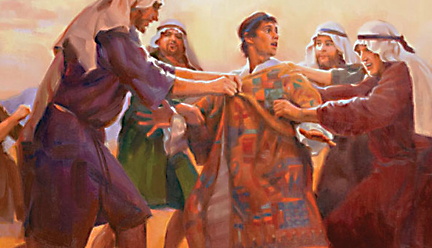
Miketz: political freedoms, beards, splitting the difference

We are studying Genesis 41:1–44:17, called “Miketz”.  Joseph is now a slave imprisoned in Egypt.  His father Jacob is convinced he was killed by a wild animal when in fact he was sold into slavery by ten of his own brothers.  We have examined how young Joseph was unaware of the power dynamics in his own family, leading to his brothers assuming the worst about him.

Miketz picks up two years since the last events described in the Bible, Joseph interpreting the dreams of Pharaoh’s baker and butler.  Now Pharaoh himself has a foreboding dream:  seven fat cows swallowed by seven gaunt cows, then seven laden stalks consumed by seven thin ones.  His wizards and wise men cannot give him a fitting interpretation.  The butler mentions the Hebrew slave who had interpreted dreams in prison.  Joseph is rushed out of the pit, cleaned up, and brought before Pharaoh, Genesis 41:14.

Last year we mentioned the first of the “48 Laws of Power” (from the book of that title by Robert Greene), and discussed how Joseph, who as a boy angered his brothers with a desire for power, is now sensitive to power dynamics:

The amazing thing is that he does not take credit for any special skill or ability to help.  Instead, he tells Pharaoh that the interpretation of dreams is from God (41:16).  This is an amazing statement. Joseph has his chance to shine in the limelight, to brag about his powers, and he humbly says that only God has the power, not himself…. The first law is Never outshine the master.  Joseph is doing that by humbly replying that he himself lacks the power to help Pharaoh.  He is a slave, clearly subject to Pharaoh’s whim.  He is not trying to upstage Pharaoh in his royal court…

Joseph, at age 17 was innocently sharing his dreams of power with his brothers, breaking Rule #1.  His childlike unawareness of the power dynamics at play, and the potential jealousy over his dreams contributed to a horrible schism in the Jewish family.  Now at age 30, he is appointed not only minister over the Egyptian economy, but prime minister over all of Egypt (Genesis 41:44).  This was only possible since he hid his dreams of ruling and his practical experience wielding power from Pharaoh, and also realized Pharaoh’s rabid sensitivity to his royal power.  Joseph has mastered himself and become master over his dreams, instead of letting his dreams master him.  This allowed him to achieve power when God put him in the right place as the right time.

Joseph had suggested that Pharaoh appoint a minister for the economy to collect and store grain.  Pharaoh goes beyond that advice and puts Joseph in charge of the entire country. 

43e390f61c831c8ce54cef8c9147c6db

I want to focus your attention on what Pharaoh tells Joseph, the newly appointed Prime Minister:  And Pharaoh said to Joseph, “I am Pharaoh, and besides you, no one may lift his hand or his foot in the entire land of Egypt.”  41:44

Pharaoh was giving him complete power over a nation.  So how does a government maintain complete power?  Rashi on this verse says see the Targum, the Aramaic translation.  The Targum was written by Onkelus, a Roman noble who converted to Judaism, and based on how our ancient sages understood the verses.

The Targum says this verse means “without your permission a man may not lift his hand to grip a weapon, or his feet to ride a horse…”

This is an eye opener.  Real power is access to your own weapons and transportation.

Pharaoh wields power by controlling his subject’s use of arms and ability to move around, so he emphasizes these tools to Joseph as the two main factors in political control.  Ancient Egypt was the regional power of the time, with a tremendous military and economic advantage over her neighbors.  Historians will tell you that part of this supremacy was due to Egyptian chariots and horses, allowing decisive mobility in battle.

To maintain these advantages, Egyptian citizens were allowed to keep their own weapons, horses and chariots.  We see this in the book of Exodus (Chapter 14) when Pharaoh is able to recruit an army of charioteers to pursue the Jews, even after a plague killed out Pharaoh’s own horses.  

File:Bridgman Pharaoh's Army Engulfed by the Red Sea.jpg

Interestingly, citizens owning their weapons and enjoying the ability to travel are freedoms identified with the United States of America.  There are parallels between modern America and ancient Egypt, both are acknowledged as the powerhouse of their day.  American men being proficient with weapons and transportation was a major factor in America prevailing in armed conflicts since the revolution.


However, later on, when the Egyptians are reeling from the famine, Pharaoh tells them to go to Joseph and do whatever he says (Genesis 41:55).  Part of Joseph’s economic plan involved moving the people to new cities.  The Egyptian citizens were not concerned with their classic rights as a citizen to free travel, they just wanted to eat. 

This is an important fact to be aware of.  When men are struggling to feed their families, they lose interest in their traditional freedoms.

On a practical level, you should be aware when the powers that be are implementing policies that cause men to become dependent on the government for basis needs.  This will, as history shows, allow the government to take more rights from the citizenry, who will gladly exchange freedom for food.

A modern man may not always have ready access to weapons, but your greatest weapon is already with you if you are trained in a martial art.  Know that simply being awake and aware of who is around you can prevent you from being a victim.

Likewise, a man may not have his own car, but be able to make use of whatever transportation is available, and get himself where he needs to be.  This brings him confidence and options. 

Finally, a man cannot guarantee his financial situation, but must take logical steps to try to provide for himself and avoid relying on others.  Charity is an important virtue, but the highest level of charity is allowing a man to earn his own keep.  The Messianic age is characterized by “each man tending his own vineyard“.  Grand schemes to make each man a dependent or a cog in the machine are doomed to fail as they are out of sync with human nature.


A man and his beard

When Joseph’s ten brother arrive in Egypt to buy grain, they also search for their lost brother.  When they encounter him, they do not recognize Joseph.  Our sages explain that at age 17 he had been without a beard, and now he was fully bearded (Genesis 42:8).  

This sounds odd, many of us have seen a man to grow facial hair or shave off his beard, and had no trouble recognizing him despite the change.  There is something deeper here.  The beard, which was nearly universal in ancient societies, is a sign of maturity.  But if Joseph had merely grown a beard, his brothers would surely have realized it was still him. 

With the beard came responsibility and authority.  A grown man, in ancient times at least, was expected to be the competent master of his own family, affairs, and estate.  He had to start interacting with other men with confidence, giving orders, negotiating as an equal with adults and leaders.

It was not just that Joseph had grown a beard, he had grown into a man.  He had years of experience managing the estate of Potiphar, then managing the royal prison, with great success.  Now he was running the entire economy of Egypt, the most powerful nation in the ancient world.  Joseph was not a 17 year old youth with a beard, he had developed himself into a man used to wielding authority.  His entire way of dealing with other men and his environment was radically altered.

The brothers were looking for the Joseph they thought they knew, who had acted like an irresponsible youth (Genesis 37:2).  Obviously they understood that their younger brother may have grown a full beard.  They were not looking for a man wielding authority with confidence and composure.


Gentlemen, the most important markers of your maturity are not physical.  Rather, they are seen in how you act and interact with your world and other men.

We also see men who make an effort at the gym to build muscles and an imposing figure, but do not develop the social acumen to lead others.


Split the difference

We conventional Jews have an ancient tradition, dating back to the Greek occupation about 2200 years ago, to read a section of the prophets or writing each week after the reading from the Torah scroll itself.  The Greeks, and some say Persians as well, banned reading from the Torah, so Jews read from the other parts as a workaround.  This is known as “haftarah” meaning addition, and the reading alludes to themes in the regular Bible portion.

This week is a special treat since Miketz, which usually falls during Chanukah, is just after Chanukah ends.  So instead of a haftarah about Chanukah, we read I Kings 3:15-4:1.  This section first mentions that young King Solomon had a prophetic dream, similar to Pharaoh.  In Solomon’s dream, he asked God to grant him wisdom.

Then the haftarah brings the famous story of two women (one may have been a demon, possibly Lilith) who came before King Solomon for judgment.  One said that she gave birth to a boy, then a short while later the other woman also gave birth to a boy.  The other mother had lain on her child and it suffocated, then she switched the babies while the first slept.  The first mother realized that it wasn’t her son and understood the switch, and came for judgment.

Solomon already knew through prophecy who the real mother was, but he wanted to show with logical proof that she was the mother.  He came up with a wise solution.

Solomon said: “This one says, ‘My son is the live one, and the dead one is your son,’ and this one says, ‘Not so; your son is the dead one and my son is the live one.’

Then he said: “Bring me a sword”, and they brought a sword. He said: “Divide the live boy in two; give one half to one and the other half to the other.”

The first mother immediately screamed out “My lord, give the baby to her, just don’t put him to death.” Then the other one said: “Let him be neither mine nor yours; divide him.”

The king spoke up and said: “Give the first woman the living child, and don’t put him to death.”


Solomon teaches us an important concept.  You may feel or subconsciously “know” something is correct.  There are many times you should “trust your gut”.  However, when you can use wisdom to find a logical and rational proof for your feelings, that is more appropriate. 

When debating issues, many people will tell you “I just know”.  You should be ready to challenge this and ask them how they know.  Did they do the research and consider both points of view?  Did they write down and calculate the potential gains and losses of their favored approach?

God created us with a fantastic mind and expects us to use it.  Yes, God also gives us information through certain senses that we cannot put into words.  But often the only way to demonstrate our choices being correct is to offer rational evidence which other men can easily understand.  This is the way to influence and lead men, through showing then on an intellectual level that your path is best.
Daily dose of wisdom, Pesachim 27: pure fuel

The Talmud is debating what happens in Jewish law if someone heated up an oven with forbidden fuel sources.  Some sages argue that bread baked with this girl is forbidden to eat.  We also examine the disagreement over if using two sources, one permitted and the other forbidden, can render the result forbidden.

The wisdom here is to be aware of your own personal fuel sources.  Obviously this applies to food, our ancient sages stress the value of quality foods and their medical value and the Rambam Maimonides codifies this as law.

Your fuel is also what ideas and words you choose to read, the actions you perform, and the people you spend time with.  Choose these wisely.  Keeping a friend around who is degrading your performance in life is going to impact the results you get.

Daily dose of wisdom, Pesachim 26: taking advantage

Today the Talmud debates if you can derive enjoyment from something forbidden when you the enjoyment is unavoidable.  One example is Rabbi Yohanon ben Zakkai who taught publicly in the shade of the Temple (which is forbidden to benefit from), since the space outside the Temple could hold the crowd.  The Gemara explains that since the building was made for the interior and not the shade it provides, this benefit was allowed since it was not truly deriving benefit.

We see from here that we can make use of aspects of certain items in our life, be they buildings, institutions, businesses.  Even when someone does not intend to help you, they may set up a situation that ends up for your benefit.  Be on the lookout to step up and take advantage of this.

Another example is a man who is holding on to a lost object until the owner comes to claim it.  He can hang up the item (eg a tapestry or blanket) to air it out, but not for his own benefit.  Even when the guardian is hanging out the item for it’s own sake, he cannot do so when guests are there, since this can actually damage the lost item.  The guests could become envious of the nice item (which invites damage) or plan to steal it.

When you have something nice, be wary of showing it off and inviting envy or resentment that you have it.  This is especially true when it truly belongs to someone else.  In Jewish wisdom we remember that all we have is a gift from God, we are temporary custodians only.

Daily dose of wisdom, Pesachim 25: clarify your own mission

Today the Talmud has a discussion regarding using a tree of idolatry for healing a dangerous illness.  Jews cannot derive benefit from idolatry; if the only way to be cured was to engage in idolatry, the Jew would have to lay down his soul instead (see Tosafot regarding using the tree itself as bandages).

The Gemara brings an amazing psychological insight in the Bible that applies to modern men:

Rabbi Eliezer says:  If it is stated: “And you shall love the Lord your God with all your heart, and with all your soul,” why is it then stated: “And with all your might (wealth)” (Deuteronomy 6:5)? And if it is stated: “With all your might,” why is it also stated: “With all your soul”?

This verse teaches you that there is a man whose body is more beloved to him than his property, therefore it is stated: “With all your soul.”  The verse teaches that one must be willing to sacrifice his life to sanctify God’s name.  And there is also a man whose wealth is more beloved to him than his body, therefore it is stated: “With all your might.”  We must also give up our property to serve God.

God, in the Bible, explains that men can have different priorities in life.  That is why even though if God tells us to be willing to give up our life, He must also tell us to be willing to give up our wealth.

To each man his own chosen values are true and completely compelling.  He will lay down his life or make other sacrifices for what he made into his mission.  Another man with different priorities may not be able to understand why he would do that.

One of the key tasks in your life is to sit down and figure out exactly what your key priorities are.  What are you willing to die for?  Then what are you willing to live for?  What do you need to accomplish in this life?
After that you ask yourself how to go about this, and you start to plan the specifics.  But first you must decide, for yourself, what your own life is going to be about.

When you have clarity about your personal mission, you have power.  No one can convince you to change your priorities and die (or waste your time and energy) for their cause, you already have your own.  It is the men who are not clear about what they are doing in life that are easily manipulated to give up their money, energy, time and even lives for nonsense in the service of others.

Daily dose of wisdom, Pesachim 24: know the risks

The Talmud continues to debate if items forbidden by the Bible to eat are forbidden to have any other benefit from as well.  Some of the derivations are based on if the Bible adds an extra phrase “it shall not  be eaten”.  However, our sages note that this phrase can sometimes serve to add on prohibitions to something already forbidden.  For example, eating a bug living in the water racks up four sins – earning four sets of lashes since there are four separate problems  (Leviticus 11:43, Leviticus 11:10–11 and Deuteronomy 14:10).  A land bug has five verses, and a flying bug has six.

When you are undertaking something new or risky, know the dangers.  Keep in mind what is at stake.  When you value you time, you are less ready to lose it on activities or relationships that have more risks than potential gains.

We also see from here that our sages carefully analyzed the Bible and figured out which prohibitions were worse risks to spiritual gain than others.  Not all mistakes cause equal damage.  When you focus on your mission in life, analyze and compute what things can detract from your goals.  Know what to avoid and what issues you may face.

Daily dose of wisdom, Pesachim 23: trees and social media

Today the Talmud discusses various items which are forbidden by the Bible to eat, and debates when that prohibition also includes other benefits (such as selling the item).  One of these items is “Orlah” the fruits that grow from a new tree for the first three years.

Our sages disagree if the Orlah prohibition applies to a public tree.  Rashi says this tree is planted in the public domain.  Tosafot (medieval comments on the Talmud) state based on the Mishnah in Orlah that the tree under debate is actually planted in a private domain but for the needs of the public, ie for shade or fruit for all passerby in the public area.

In our generation there is a pervasive breakdown in the boundaries between your public life and private life.  Many people are regularly sharing their private life with the entire world on social media, and working to present themselves as a good brand in order to win attention.  In ancient society there was also a concept of a privately owned items shared with the public for general use.  You can use this idea to guide how you present yourself to the public.  You want to provide benefit, not detriment for others.  We also learn that even if our branches and fruits are shared with the public, we want to keep the tree itself protected in our own space.  Don’t put everything out there.

Daily dose of wisdom, Pesachim 22: turn your life around

The Talmud brings a famous event:

Shimon HaAmsoni, and some say that it was Neḥemya HaAmsoni, would interpret all occurrences of the word “et” in the Torah, deriving additional inclusions from the “Et” (which signifies the definite direct object in Hebrew grammar).  Once he reached: “You shall be in awe of [et] the Lord your God; you shall serve Him; and to Him you shall cleave, and by His name you shall swear” (Deuteronomy 10:20), he withdrew from his method of interpretation.  How could one add something to God Himself?

His students said to him: Rabbi, what will be with all the “etim” that you interpreted until now? He said to them: Just as I received reward for the “drisha” interpretation, so I shall receive reward for my “prisha” withdrawal.

The word “et” in this verse was not explained until Rabbi Akiva came and expounded: “You shall be in awe of [et] the Lord your God”: to include Torah scholars, and one is commanded to fear them as one fears God.

Understand, interpreting the “etim” was haAmsoni’s life work, his doctoral thesis.  He thought he had discovered a new pattern in the Bible, and spent years, maybe decades, working on his thesis.  But one verse stopped him.  Now, he could have come up with some creative interpretation or worked around it, as many modern people do with verses, but he was intellectually honest.  So he quit his life’s work and refuted it entirely.

When you have been working on a project or relationship for years, it can seem impossible to stop.  We are always most comfortable doing what we have been doing already.  Our ancient sages teach us to honestly evaluate what we are doing now and be open to changing if the situation calls for it.  Just because something has been working for years or decades does not mean it will always be the proper course of action in the future.

You may ask, how was Rabbi Akiva able to interpret the “Et”?  He had one thing haAmsoni never had.  He had haAmsoni as a Rabbi – Rabbi Akiva saw a man willing to disregard his life’s work in the Bible to be intellectually honest.  That was a man who could inspire awe and respect similar to God Himself.

Daily dose of wisdom, Pesachim 21: domestic and wild animals

The Talmud returns to the topic of leavened foods (hametz) on the eve of Passover.  The Mishnah rules that before the time to burn it, we can feed hametz to both domesticated and will animals.  The Gemara explains that the Mishnah had to tell us both types of animals, since we cannot assume one from the other.  Domestic animals may leave over some hametz food, and the owner might not notice.  The non domesticated animals are likely to hide the food without the owner seeing this, and the hametz will still be around during Passover.

When you have people depending on you, whether for financial support, emotional support, attention or affection, be aware that they may do different things with what you give them.  Some people will consume all the time and energy you give them.  Other hide it away and ask for more, as if they got nothing from you.  That can be frustrating.  Look for people who take what you give and use that energy properly, and give back in return.

Daily dose of wisdom, Pesachim 20: airspace contamination

We continue learning about ritual purity in the Talmud, and discuss food in an earthenware oven along with an impure creature, a “sheretz”.  The sheretz does not touch the food, but the Torah rules that the food still becomes impure.  The sheretz contaminates the airspace of the oven with first degree impurity, so the food baking in the oven gets a second degree contamination.

The practical wisdom here is that even if you are not in direct contact with negative influences, if you share the same space, you will be impacted.

Vayeshev: losing frame, putting her feelings first

Happy Chanukah!  Last year we developed the idea of how Chanukah is a holiday about frame:  the Jews fought the dominant Greeks in order to choose their ancient framework of life over the framework of modern Greek civilization.  The Hanukkah struggle was really over who would define the global assumptions of life for the Jews. 

We call this idea Frame, as in the framework through which a person views the world and their role in it.  The larger narrative that you are a part of, the basic assumptions that you live by and don’t think to question.  From Rollo’s classic essay on Frame:

In psych terms, frame is an often subconscious, mutually acknowledged personal narrative under which auspices people will be influenced. One’s capacity for personal decisions, choices for well-being, emotional investments, religious beliefs and political persuasions (amongst many others) are all influenced and biased by the psychological narrative ‘framework’ under which we are most apt to accept as normalcy.

This week we again study the reading of “Vayeshev”, and he settled, Genesis 37:1–40:23.  Jacob settled back into the Holy Land, after surviving 20 years with Lavan in Haran, meeting Esav and his army, the abduction and rape of Dinah, and losing his beloved wife Rachel during the birth of Benjamin. 

Vayeshev also centers around frame:  Joseph goes to check on his brothers, they judge him to death and ultimately sell him as a slave.  He blindly walked right into their framework and they had total power over him.  As we explained last year, the assertive women in this reading both teach us about frame between the genders. 

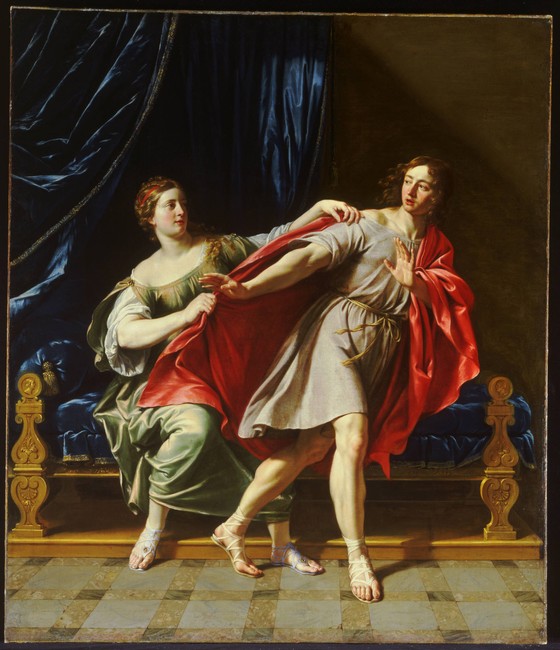
Tamar enters Judah’s frame completely, leaving it in his hands to acknowledge their relationship or leave her to execution.  Potiphar’s powerful Egyptian wife seduces Joseph into her dominant frame, he walks into her world and barely escapes.

Joseph and the Wife of Potiphar (y1987-68)

There is another issue with frame in our reading this week:  instead of setting the paradigm for his sons, Jacob abdicates control and takes a hands off approach to parenting.  He sits back and allows his children to work out their own system outside of his supervision. Indeed this reading begins “and Jacob sat” (37:1), as the word Vayeshev implies settle down or sit.

Jacob’s sons set up their own framework to understand their relationship, which focuses on the struggle for eventual power over the family between Joseph the son of Rachel and the sons of Leah.  They create a fearsome rift in the family, almost commit murder, and finally sell Joseph as a slave down to Egypt.

Jacob was a self made man who spend decades working on himself to become the heir to the mission of monotheism and overcoming obstacles.  Now back in the promised land, the holy land, he felt he could rest.  Our ancient sages point out that this attitude was a mistake (see Rashi 37:1).  Because our holy Patriarch Jacob wanted a break, God brought about all the trouble between his sons. 

If Jacob had been running on all cylinders, he could have realized the danger of the tension between Joseph and the sons of Leah and been able to intervene.  Jacob could have set the framework of interaction between his brothers by teaching Joseph to be patient in his aspirations for power, and teaching the other brothers that each of them was a critical part of the nascent Jewish nation.  Instead of vying for control, each would be dominant in his own area.

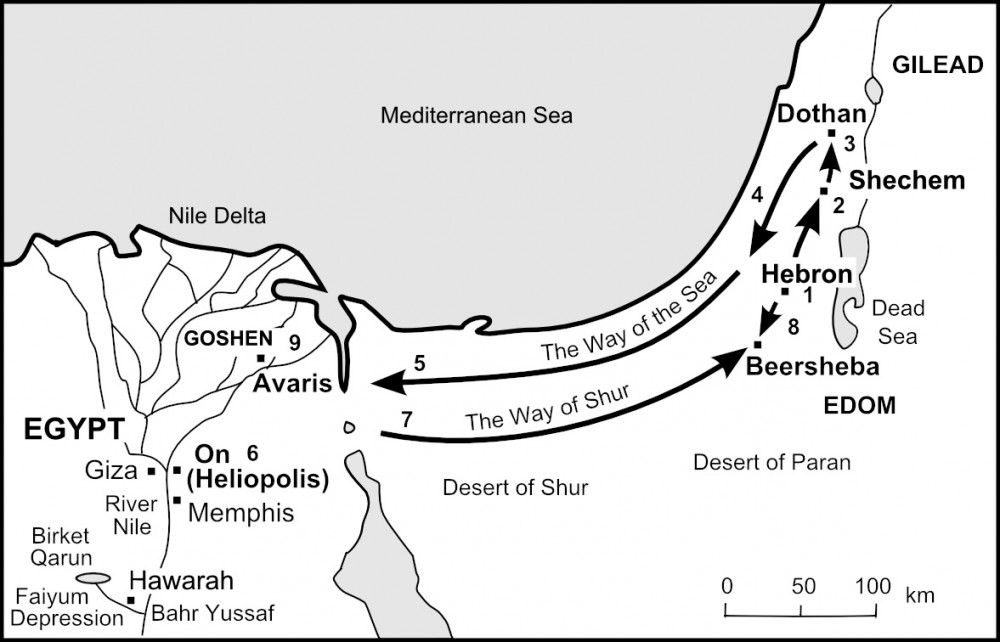
We see that Jacob is more passive, staying Hebron while his sons take the lead in the family, taking the flocks all the way up to Shechem (37:12).  He lets his sons set the framework for exercising power.  Jacob’s method of monitoring them is to appoint Joseph to go check on them and report back (37:14).  Joseph was already known to bring bad reports about his brothers (37:2).  Using one son to report on the others deepens their rivalry, and Jacob in the background does not realize the extent of this rift.

Relocation to Egypt

Jacob spent decades developing himself into a leader, a tribal chief.  But now he wanted a break.  You understand, Jacob’s break was no vacation, he was still learning Torah, teaching his family and others about monotheism, and managing his tribe (at least from the background).  But he wasn’t always there to actively guide his sons’ interactions.  When you develop your own personal power and abilities, it is not time to rest.  God wants you to use your strengths to accomplish more. 

This is not to say that taking a break is always problematic.  My own rabbis taught us to take a vacation, but to do so with purpose – to regain your strength for your real mission.  Relaxation is not the goal, but the means to an ends.  When you engage in leisure in order to be able to better face your challenges and work harder, it is not wasted time.  You can even sleep with purpose: realize you require sleep for proper functioning and sleep with the goal of becoming refreshed and able to accomplish.


Brother against Brother

And the man said, “They have traveled away from here, for I overheard them say, ‘Let us go to Dothan.’ ” So Joseph went after his brothers, and he found them in Dothan. And they saw him from afar, and when he had not yet drawn near to them, they plotted against him to put him to death.

So they said one to the other, “Behold, that dreamer is coming. So now, let us kill him, and we will cast him into one of the pits, and we will say, ‘A wild beast devoured him,’ and we will see what will become of his dreams.”  (37:17-20)

Shimon and Levi, the brothers who violently rescued Dinah from Shechem, share their plan to kill Joseph to prevent him from dominating the family and becoming their generation’s Esav or Ishmael.  As we explained, all the brothers (except Joseph’s full brother Benjamin) convened as a court and judged Joseph for his plan to gain control over the family.   It appears that they agreed, but then:

But Reuben heard, and he saved him from their hands, and he said, “Let us not deal him a deadly blow.” And Reuben said to them, “Do not shed blood! Cast him into this pit, which is in the desert, but do not lay a hand upon him,” in order to save him from their hands, to return him to his father. (37:21-22).

Our sages teach us that if Reuven had realized that his words in defense of his brother would be recorded for all time, he would instead have snatched Joseph away and ran him back to Jacob on his shoulders.  Reuven also distrusted Joseph and his dreams of power.  He also voted to condemn Joseph to death.  However, Reuven realized this was wrong and took action.  What was special about Reuven?


His mother’s son

Reuven was motivated by thinking about how his father would feel about Joseph’s death.  Recall what the Bible tells us about Reuven’s childhood.  When he was born Jacob had two wives, his mother Leah and Rachel.  Jacob loved Rachel more than Leah (29:30).  Leah, while obviously not despised, felt hated by her husband in comparison (29:31). 

Reuven was born while Jacob was working the second period of seven years for Lavan, as a reverse dowry for Rachel.  Jacob was out in the country with the flocks, and when he was home he focused his attention on Rachel.  Leah was blessed with sons and named them in a way to attract attention from Jacob to her, to remind him that she and her sons were deserving of his time.  Leah used her sons to find favor with Jacob and win more attention and affection from him:

God arranges for Leah to have children, and with each son Leah solidifies her role as Jacob’s wife.  We see this in the meaningful names she picks: Reuven “God has seen my lack and now my husband will love me” (29:32).  Shimon “God heard I was unloved” 29:33. Levi “now my husband will be attached to me” 29:34.  Judah “This time I thank God” 29:35.  It appears that now with four sons Leah felt Jacob was truly loving her, and likely Jacob spent the most time with her due to helping educate the boys.

Leah, one of our holy matriarchs and mother to half the tribes of Israel, was not a complainer.  She wasn’t moping around whining about how Jacob had more time for Rachel when he wasn’t with the flocks.  But she truly felt bad that Jacob showed more love for Rachel. 

Reuven was quite perceptive and realized that Leah was naming her sons in a way to inform Jacob that she was giving him an eternal gift of creating the Jewish tribes together.  This is why Reuven went out and picked the dudaim, the mandrakes, an herb which aided fertility (30:14).  He felt his mother would get her emotional needs better fulfilled if she had more sons.

This was the same episode where Leah trades the mandrakes to Rachel in return for Rachel’s turn with Jacob that night (30:15).  Reuven sees that his going out to pick the herbs combined with Leah’s action in going out to Jacob to seduce him paid off for Leah.  She had two more sons as a result.  No doubt Leah praised Reuven for his help, his picking herbs won her two sons and love from he husband!  Reuven has learned that helping his mother meet her emotional needs wins him approval.

His father’s concubine?

There is another infamous episode of Reuven standing up for Leah’s emotions:
While Israel stayed in that land, Reuben went and lay with Bilhah, his father’s concubine; and Israel heard. Now the sons of Jacob were twelve in number.  Genesis 35:22. 

This is an enigmatic verse, which implies Reuven actually had intimate relations with Bilhah.  However, the verse concludes Jacob had 12 sons.  The punishment for adultery or rape is death.  If actual adultery with Bilhah had taken place, Jacob would be down to 11 sons.  This family is into justice, they wiped out the men of an entire city for violating Dinah.  Since they did not execute Reuven, we know he didn’t literally violate Bilhah.

What the verse actually teaches, according to ancient sources passed down since the time of Jacob, is that Reuven moved his father’s bed from Bilhah’s tent to Leah’s.  Why would Reuven do such a thing?

To protect his mother’s feelings.
Jacob had taken turns with his wives and concubines (30:15), they got to have him in rotation.  It appears that Jacob spent the most time with Rachel.  After she passed away, the logical thing would be for Jacob to spend the most time with Leah, his first wife and mother to most of his children.  However, after Rachel died he moved in with Bilhah, the concubine given to him by Rachel. 

Leah must have felt slighted by this choice.  Reuven, already emotionally perceptive, sneaks into Bilhah’s tent and moves his father’s bed into Leah’s tent.  The intention was to remind Jacob that Leah was now his primary wife, and he should be with her most of the time, not with a mere concubine.

To modern ears this act may sound innocent, but interfering in your father’s intimate life is akin, in a certain sense, to violating his wife.  What son would dare to tell his own father which wife to sleep with?

Jacob certainly took Reuven to task, and we know that Reuven accepted his mistake, since “the sons of Jacob were 12”.  Reuven was restored to his status as one of the sons, since he repented his mistake to Jacob.  In this process, he learned to see not only his mother’s emotional state, but his father’s as well.  Our sages teach that to repent Reuven undertook fasting and serving his father.  He became especially attuned to his father’s feelings, because of the grief he had caused Jacob.

This, friends, is why Reuven is able to argue to his brothers not to murder Joseph.  He considered his father’s feelings and this motivated him to plan to return Joseph to Jacob.  We see that Reuven makes an emotional appeal to the brothers: “Do not shed blood! Cast him into this pit, which is in the desert, but do not lay a hand upon him,” 37:22.

Notice he does not say “don’t shed Joseph’s blood”.  Reuven is not arguing that Joseph is innocent, rather he is telling the other brothers:  Imagine how you will feel if you shed blood!  The Ishmaelites and Edomites are known to live by the sword and use violence, but we are the chosen sons of Abraham, Isaac, and Jacob, we are not killers. 

Reuven appealed to their emotions, and invoked how the brothers would feel about themselves if they went through with executing Joseph.  This fits his personality as having exceptional emotional sensitivity, developed during his childhood with Leah.


Emotional and Reason

The other brother to suggest an alternative to death is Judah:  And Judah said to his brothers, “What is the gain if we slay our brother and cover up his blood?  Come, let us sell him to the Ishmaelites, but our hand shall not be upon him, for he is our brother, our flesh.” And his brothers hearkened. (37:26-27)

Judah was contemplating the bottom line, how they could turn this situation into a profit for all the brothers.  Judah becomes the ancestor to King David, and the king is the man responsible for all of Israel.  He has to use reason and logic to figure out how to provide for the nation effectively, and take counsel from the sages (Talmud Brakhot 3b).

Judah seems to ignore emotions in favor of cold logic, employed for the benefit of all the other brothers.  This is the proper outlook of a king.  But where was Reuven when Judah convinced them to sell Joseph?

And Reuben returned to the pit, and behold, Joseph was not in the pit; so he rent his garments.  And he returned to his brothers and said, “The boy is gone! And I where will I go?”  (37:29-30).

Reuven had left to serve his father, or because he was fasting in atonement for moving Jacob’s bed.  He had left to take care of his emotional needs, at a time when reason should have dictated that Joseph needed Reuven to watch over him.  Reuven seems to realize his mistake, rending garments is a sign of mourning.

However, in the next verse we see the brothers, which includes Reuven, move on to phase two of the plan, covering up their sale: And they took Joseph’s coat, and they slaughtered a kid, and they dipped the coat in the blood.  37:31.  Once Joseph was gone, Reuven does rejoin his brothers in the plot.  They all swore an oath not to reveal the truth to Jacob.

With his sensitivity to Jacob’s feelings, Reuven tries to save Joseph, and uses the power of emotional appeal to spare his life, which results in Joseph being sold into slavery instead of executed or left to die.  However, Reuven was unable to fully rescue Joseph since at the critical moment he was still working through the emotions and repentance of his own mistake with Bilhah.

There is a verse in the Song of Songs 7:14: “The mandrakes yield their fragrance, At our doors are all choice fruits; Both freshly picked and long-stored Have I kept, my beloved, for you.”

This alludes to Reuven, who picked the mandrakes for Leah, saving Joseph, who stored fruits in Egypt to save them from famine.  What is more “at our doors” alludes to Chanukah: the custom is to place the Menorah by the front door were passerby can see it.  (When it is windy and in America the prevalent custom is to light indoors by the window).

Reuven, through growing up with Leah, developed a special emotional sensitivity.  This holds a power and a danger.  In modern America, many boys grow up with a strong mother figure but without a real father figure.  About half the children in American are born out of wedlock, and even if the father was present, often this situation ends.  Many boys grow up in a broken home, some never meet their father.  These young men learn to act out of emotion, but they don’t learn to harness their emotional energy with logic.

What of modern men

These days, boys are acting out to follow their emotions.  Emotionality is not always wrong, but must be tempered with rationality.  Boys who do not learn to work through their feelings and stay logical end up with significant dysfunction as adults.  This is even harder in modern America which celebrates emotional responses to events as the proper way to live.

 
The Bible shows that the brothers needed Reuven emotional sensitivity and Judah’s cold reason to deal with Joseph without killing him.  Both elements are needed in men.  Reuven shows us the power of appealing to emotions, but the danger this entails.  He was unable to save Joseph because he was dealing with the fallout from his own sin, which was to help his mother’s emotional state.  If he looked at the situation logically he could have stayed with Joseph and saved him from slavery.

Judah and the other brothers appear cold and unfeeling, focused on the bottom line.  They were also motivated by jealousy, but used logic and convened a court of justice to deal with their emotions.  Jacob for his part did not realize that he was allowing his sons to set the frame of their interactions.  He had underestimated the power of his sons’ emotions and did not see what they might do to Joseph.
 
 
Modern men need to understand that emotional responses have tremendous power, but learn to stay rational despite our strong feelings.  Working through emotions with logic is important for ourselves and especially when dealing with women.  Modern secular society now values emotional over reason, making our work much more difficult and all the more vital.