This week we wrap up our study of the first book of the Bible with the reading “Vayehi” meaning And he lived (Genesis 47:28 – 50:26) from the work Hai, famous for the toast “leHaim” to life.
Last year we focused on Jacob’s thoughts of his legacy and the prophetic blessings to his 12 sons, and mentioned parenting and vetting women for marriage. We discussed how Jacob makes an effort to ensure he will be buried in Israel – even though God had promised this:
For you, for all of us, Jacob is teaching that even when God promises, you still need to do your part. Jewish wisdom has a concept of predestination in tension with a competing concept of free will.
Our sages teach that even before you are born there is a field, a house, a woman (at least one) fated for you. But that this fate can change through prayer and actions. This friction is hard to understand at first, we live with this spiritual reality and we get used to it. A practical example my rabbi gave us:
A man can have a judgment in Heaven that he will live a healthy life to age 120, but if that man jumps off the roof he is still dead.
All humans tread a fine tightrope between fate and free will. We make our plans and put in our efforts, and we have to make reasonable efforts, but there are forces and energies out of our control and even beyond our imagination. You don’t have be a religious man to know this. The universe is out of your control.

Joseph and fatalism
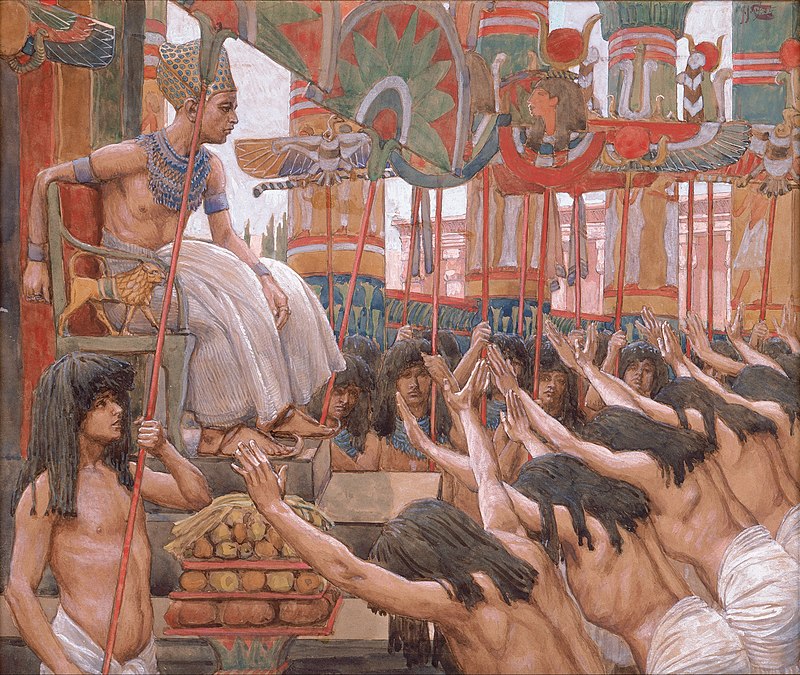
Joseph rose to power in Egypt and became the central figure in the last few sections of Genesis. We now see that Joseph had also internalized Jacob’s wisdom that some things are out of your control. At the conclusion of Genesis, after Jacob is buried, the brothers who sold Joseph approach him and ask forgiveness, and offer themselves as slaves in return for selling Joseph as a slave (50:16-18).
Joseph has an amazing response: “Do not fear, because am I in place of God? Although you planned to harm me, God planned for the best in order to do (His plan) to keep a great nation alive – this is clear as day” (50:19-20).
These verses are begging for analysis. The brothers did not merely plan to harm Joseph, they were about to execute him, left him in a pit to die, then sold him as a slave. He was definitely harmed!
Joseph doesn’t take these attacks personally, since he is focused on the big picture: all of this was necessary in order for him to come to Egypt, become the vizier, and save both Egypt and his own Jewish tribe from starvation. The pain, anguish, and years of slavery and confinement he went through were justified because God intended a greater good.
It appears that Joseph is tilting to the fatalistic side, absolving his brothers of personal responsibility and declining to blame them because in retrospect God had a greater plan. This is a powerful concept and must be used wisely.
If you can tolerate insults and damage from others by truly feeling that God has planned it all, you attain a high level of stoicism. You can become immune to nagging, ignoring the person saying the words and realizing that the message is really from above and for your ultimate benefit. (It is on you to analyze the messages and act on them).
This incredible power holds a tremendous danger. When you continue to tolerate insults from other people, you tend to get more insults. For a man, being passive invites aggression from others. Human beings do have free will and their own motivations. People can employ their free will to manipulate you to get what they want from you. While every person is on some level an agent of Divine fate, and actor in a vast play, they are also a free agent…
A wise man realizes that he must try to be objective. Yes, tolerating insults and nagging without reaction can give you certain power in a relationship. But if your current situation is damaging your health or reducing your ability to achieve your chosen mission, you must try to change it. Don’t let other people grind you down or use you as their tool or plow horse.
In the meantime, you can accept that this situation is, for the time being, exactly where God (or the universe, whatever you want to say) wants you to be. God has His own plans, and they often include items we don’t enjoy. Overcoming obstacles is what makes a man.
By cultivating the ability to not take insults and attacks personally, a man can stay objective and evaluate if it is worthwhile for him to remain in this situation or to seek new options. You want to be able to roll with life’s punches, but you don’t ignore them. After you get punched, change your strategy and stop getting punched. Employing stoicism gives you the peace of mind to decide what to do about it in the way that is best for you.
Joseph himself was on a very high level of spiritual development and dedication to God and God’s plan. He was able to see that his brothers’ very personal acts against him were in the end part of the grand plan. This doesn’t mean that Joseph did not protest and argue with his brothers at the time, indeed he had (Gen 42:21). It was only in retrospect that he fully understood that his suffering was part of the Divine plan for his family.

Modern men don’t have this luxury. I am not suggesting you become fatalistic and allow other people to walk all over you. Only that instead of reacting by becoming angry and losing your rationality, you step back and evaluate intellectually how to best deal with your situation. Sometimes the best response is no response, to simply walk away from this person so they cannot abuse you further.
Samson
Our Patriarch Jacob gives his sons individual blessings and words of guidance (Genesis 49). Many of the verses are prophetic. Jacob was on his death bed, part of his soul was already connecting to the next world, and he was able to reveal some of the future to his sons.

We see this especially by the blessing to Dan, which foretells the career of the famous Samson, a descendant of Dan:
Dan will avenge his people, like one the tribes of Israel (49:16).
Rashi (a great medieval commenter) brings an ancient explanation: “All Israel will be like one with him, and he will avenge them all. Concerning Samson he uttered this prophecy.”
Dan will be a serpent on the road, a viper on the path, which bites the horse’s heels, so its rider falls backwards. (49:17). Rashi explains: So is the habit of a snake. Jacob compares him (Dan) to a snake, which bites a horse’s heels, and its rider falls backwards, although it does not touch him. We find something similar by Samson: “And Samson grasped the two pillars of the center, etc.” (Judges 16:29), and those on the roof died. This means Samson was able to destroy his enemies indirectly, as the snake who bites the horse.

For Your salvation, I hope, O Lord! 49:18.
Rashi: Jacob prophesied that the Philistines would gouge out Samson’s eyes, and Samson would ultimately say, “O Lord God, remember me now and strengthen me now only this once, etc.” (Judges 16:28). Rashi’s comment are based on the ancient Medrash Numbers Rabbah 14:9.
You may be familiar with the epic story of Samson, also known as “Samson and Delilah”, emphasizing her role in his downfall. At this time in Jewish history there was no central monarchy. The tribes were self ruling, and when necessary joined into a confederacy united under a judge. This period spanned over 300 years and is covered in the Book of Judges.
In an illustration of the concept that history repeats, the Jewish confederacy suffered a terrible civil war that began over the rape of a concubine at Gibeah (Judges 19-20). The other tribes united to demand that the tribe of Benjamin extradite the rapists to be tried by a high court. Benjamin argued that they should be the only authority to bring their own citizens to trial. In the ensuing war the other tribes almost entirely wiped out the men of Benjamin.
Shortly after that, the tribes again united to vote on a king, despite the warnings of Samuel the prophet that the central government would be problematic. They selected Saul, the same man who would eventually vie with David for power and popularity. Samson’s time as judge was well before this consolidation of Jewish politics.
Before Samson’s career, the Philistines, a recurring enemy, had increased in power and moved inland to subjugate the Jews. This was possible because the Jews of the time were not united and had less devotion to God due to temptations of idolatry. A theme throughout Jewish history is that spiritual problems within the Jewish community invite enemies from outside, causing the Jews to unite and reevaluate their decisions.
Samson (Shimshon in Hebrew) was blessed with incredible strength, enough to tear apart a lion with his bare hands. He decided to use his blessing for the great good, by becoming judge over the Jewish tribes and fighting the oppressive Philistines (a tribe completely unrelated to any modern people).
The odd thing is that he did this by marrying a Philistine woman, after converting her to Judaism. This was not the infamous Delilah (we will get to her soon), but the first of three foreign women Samson chose to be with. One theory is that Samson sought out this marriage to be able to fight the Philistines as an insider, see the Radak’s commentary on Judges 13:4: ולא היו ישראל נלחמים בהם כי אם שמשון לבדו ולפיכך לא היה לפלשתים טענה להלחם בישראל מפני שמשון כי לא היה ברשותם והוא לבדו היה עושה הרעות בפלשתים ועם פלשתים היה שוכן בעוד שהיה מריע להם
So this marriage was at least in part a political and military move. After marrying a Philistine, when Samson fought other Philistines it would be a family feud. Therefore it would be considered mere infighting, and the Philistines would not take revenge against the other Jews.
When Samson went down to retrieve his wife, he was told by his Philistine father in law that in his absence she had been given to another man (15:2). This gave Samson an excuse to destroy the Philistines’ crops (15:3). Then they took revenge on the father in law and the woman, giving Samson a reason to attack them personally. He ends up killing a thousand Philistines with a jawbone of a donkey (15:15). With this victory, Samson is accepted as a judge over Israel, and frees them from Philistine domination for twenty years.

Delilah
The Philistines were not done. After 20 years, they took a different approach, designed to take advantage of his desire for foreign women. They promised Delilah, Samson’s new Philistine wife, a huge reward to find his weakness. Delilah was the third foreign woman Samson was with, after a woman in Gaza (16:1). Gaza was in Philistine territory.
It appears Samson truly loved and likely married her. “And it came to pass afterward, that he loved a woman in the valley of Sorek, whose name was Delilah” (Judges 16:4). The Talmud in Sotah 9b brings a quip: Rabbi Yehuda HaNasi says: Even if she had not been called by the name Delilah, it would have been fitting that she be called Delilah, for she weakened “dildela” his strength, she weakened his heart, and she weakened his deeds. This rabbinical comment shows us that instead of using her as a tool to get at the Philistines, Samson was actually infatuated with Delilah and changed his behavior to better appeal to her.
Delilah tries everything to get him to reveal the source of his strength. Over and over Samson gives her a false answer and prevails against Philistine ambushes. Finally he admits the truth: his strength is from his long hair which has never been cut, since he is a Nazirite to God (16:17). Understand that the hair itself did not give him physical strength, it was the fact that he was obedient to God’s command not to cut the hair.
Delilah invites the Philistines to come, lulls him to sleep, and has his hair cut off. Samson is now too weak to fight back, and likely shocked by the betrayal from his wife. The Philistines blind him and take him in chains to Gaza as a trophy.

There is a practical lesson here. Delilah kept striving to get Samson’s secret. Women take interest in a man with a mystery or secret. Women enjoy unraveling the secrets of a complex man.
Modern men should be aware of this. She wants to figure you out. Don’t tell her your whole life story in an effort to make her comfortable with you. Let her use her female intuition and imagination. This is more rewarding for her, and she is more likely to want your company so she has the chance to glean more insights and solve your mysteries.
Samson’s mistake was revealing his true power to a woman who was not loyal to him. While perhaps Delilah loved Samson or was attracted to his strength and fame, whatever feelings she had for him became valueless once he had no mystery, and she was able to betray him instantly.
Eventually, Samson is brought out during a pagan holiday, with countless idolaters chanting: “Our god has delivered into our hands our enemy Samson.” 16:23. He prays to God to give him strength one more time 16:28. God answers this request and Samson famously pushes the pillars that were holding up the roof of the pagan temple, burying himself and thousands of Philistines 16:29.
The lessons
Samson is a heroic but tragic figure. Our sages point out in the ancient Mishnah (Sotah 1:8): Samson followed his eyes, therefore he was punished measure for measure, as the Philistines gouged out his eyes, as it is stated: “And the Philistines laid hold on him, and put out his eyes” (Judges 16:21). The Talmud in Sotah elaborates that he lusted for foreign women:
Samson rebelled with his eyes, as it is stated: “Then his father and his mother said to him: Is there never a woman among the daughters of your brethren, or among all my people, that you go out to take a wife of the uncircumcised Philistines?
And Samson said to his father: Get her for me; for she is pleasant in my eyes” (Judges 14:3). Therefore, the Philistines gouged out his eyes, as it is stated: “And the Philistines laid hold on him, and put out his eyes” (Judges 16:21).
We have explained that at least at first marriage to a foreigner, Samson had a pure motive in mind. He married a Philistine so he would be able to attack the Philistines as one of their own, without them taking revenge on the other Jews. He thought his intentions were upright.
The problem may be that he continued to pursue and get with not just one but three foreign women. Even though he had converted them to Judaism, they would be a negative influence on his character. We find the same danger from King Solomon’s foreign wives. Delilah perhaps feigned a conversion as she was clearly still loyal to the Philistines.
One of the obvious lessons is the danger of foreign women. This is not merely outsiders but also women who are loyal to a cause that is at odds with your own mission. We discussed why our Patriarch Jacob spent decades weaning his wives away from their family and culture of origin. Samson is often invoked as a warning figure about marrying outside of your own faith or culture.
There is a deeper lesson hidden in the verses. When Samson finally reveals his secret, it is only after Delilah nags and presses him to the point of death 16:16. The word in the verse וַ֠יְהִי כִּֽי־הֵצִ֨יקָה לּ֧וֹ בִדְבָרֶ֛יהָ כָּל־הַיָּמִ֖ים וַתְּאַֽלֲצֵ֑הוּ for press also implies sexual contact. Our sages in the Talmud (Sotah 9b) bring an ancient tradition that Delilah used sex to manipulate Samson: What is the meaning of “and urged him”? How did she do so? Rabbi Yitzḥak of the school of Rabbi Ami says: At the moment immediately before his completion of the act of intercourse, she slipped away from beneath him.
Delilah left Samson without release for his masculine energy, in addition to verbally and physically abusing him. The Ben Yehoyada (Ben Ish Hai) explains that Samson was upset by spilling seed as a result of his wife slipping away just before they completed intercourse. He wanted a healthy outlet for his energy, and his wife was denying him.
Samson should have realized from his first Philistine wife who revealed the answer to his riddle that foreign women would try to manipulate him (Judges 14:16-18). It appears that he was overly confident in his strength, thinking that he was able to reveal his vulnerability to Delilah and still prevail.
This is a critical lesson for modern men. Women may use intimacy as leverage to gain control over you or to get you to reveal your secrets and weaknesses. Be aware of their loyalties and guard your own vulnerabilities. Do not think you are any stronger than ancient Samson.
The male capacity for self sacrifice
Samson’s death holds another lesson. He asks God for strength one more time, not to escape, but to take revenge on his enemies:
He embraced the two middle pillars that the temple rested upon, one with his right arm and one with his left, and leaned against them; Samson cried, “Let me die with the Philistines!” and he pulled with all his might. The temple came crashing down on the lords and on all the people in it. Those who were slain by him as he died outnumbered those who had been slain by him when he lived. 16:29-30.
Men, when they have nothing left, are capable of complete self destruction. In Samson’s case this had a productive result for the Jewish tribes: the death of many of their idolatrous enemies. With last revenge, Samson surpassed his life’s work of protecting his people. However, we also lost Samson himself.
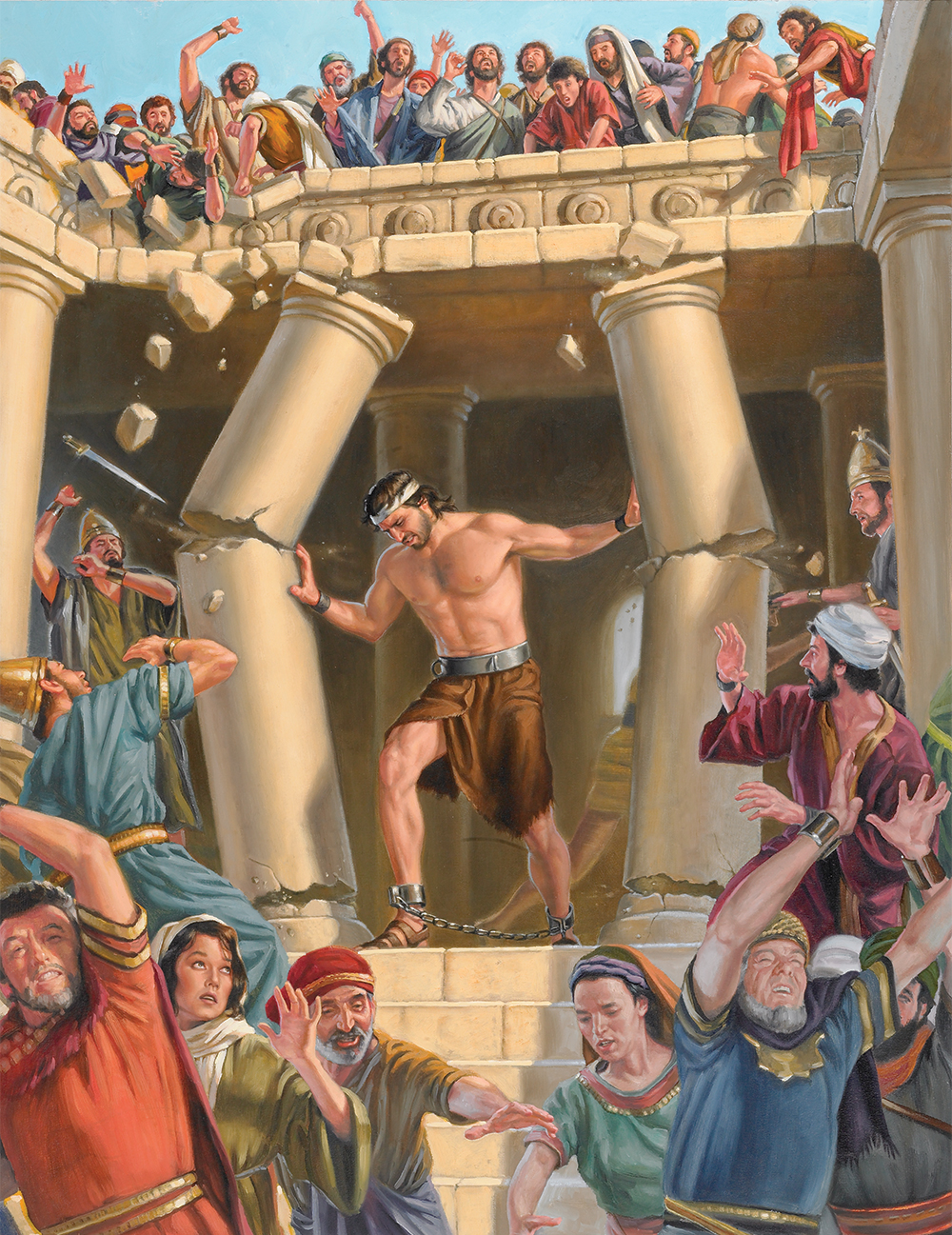
Samson had been humiliated and betrayed by the woman he loved and trusted. He prayed not for escape and life, but for revenge in death. This is not the last time a man has chosen to end it all.
Many modern men tragically end their lives when they feel they have no more strength to face reality. Men have the capacity for self destruction when faced with what they consider to be impossible odds. Today’s society has degraded and devalued men and masculinity so much that the odds feel against men already. When coupled with a trauma or seemingly intractable situation, suicide looks like a good option.
In America, women are much more likely to seek help for their mental health. While I am not downplaying anyone’s suffering, suicidal ideation or attempt by women is often a cry for help rather than a sincere act of self destruction. Men are much more likely to fall through the cracks of our society and to actually go through with suicide.
Part of this is because most mental health professionals are women, many trained under the auspices of the American Psychological Association (APA). The APA “Guidelines for Psychological Practice With Boys and Men” pushes their twisted view that traditional masculinity is psychologically harmful and could be a personality disorder.
A wise man should be concerned with the well being of his brothers. Middle aged, divorced men are especially at risk, as are men who are veterans. They have been victimized by a cruel system and may not see a positive way out.

As an informed man, you can try to provide insight and help men to see that there is always hope for a better life. The best option is to get men at risk in touch with professional help, and to follow up personally. When you counsel men, console them that everything in life ends eventually and try to focus their thoughts on the big picture. If they have children remind them that children with a living father, even if they are not living together, have better outcomes in life. Emphasizing self care, including regular exercise, can also help a man out of depression.
Be aware that men, even men who were considered heroes like Samson, have the capacity for self destruction. Make an effort to be your brothers’ keeper.




 Red Pill Rabbi