Daily dose of wisdom, Yoma 3: who pays?

Today the Talmud notes that some offerings for Yom Kippur had to come from the pocket of the High Priest himself.  The Gemara brings a debate about the meaning of phrases in the Bible:

As it was taught: “Take you” means from your own, and “Make you”, means from your own; “And they will bring to you” means from community property. This is the statement of Rabbi Yoshiya. Rabbi Yonatan says both “Take you”, and: “And they will bring to you”, means from community property. And why does the verse state: “Take you”, by the incense?  It is as if God said to Moses: I desire that it come from your own property more than I desire it from theirs.

Aaron the first High Priest was told to pay for the offerings on his first day of service, from here we learn that the High Priest brings the Yom Kipper offerings from his own pocket.  Moses was commanded to provide the materials for the silver trumpets.

Now, there was no lack of public money, Moses had to tell the nation to stop donating to the Tabernacle (Exodus 36:6).  God wanted Moses and Aaron to pay personally so they would take these items very seriously.

What you pay for out of your own pocket, you invest yourself into.  When you want to know what is important to a man, find out where he puts his money.

A modern man should be aware that in mainstream society men are often expected to pay on behalf of women.  This could be for dinner, flowers, or even paying her rent, loans or credit card debt.  However, women are usually not expected to pay for men.

You need to be careful when you are being asked to invest yourself and consider if you are getting value back from this relationship.  Keep in mind that you work for your money, you put your time and energy in.  This is your very life.  If you are entering a relationship, does she carry debt that you may end up paying off?  Does she feel entitled to your time and resources?

Daily dose of wisdom, Yoma 2: a backup wife?

Today we begin the tractate of Yoma (or Yuma) about the day of atonement, Yom Kippur.  This holiest day requires intricate ritual services performed by the High Priest, Cohen Gadol, in the ancient Tabernacle or Temple.

The first Mishnah teaches an amazing concept:

Seven days prior to Yom Kippur they would relocate the High Priest from his house to the Chamber of Parhedrin, (a room in the Temple designated specifically for the High Priest). And they would appoint another priest to replace him in case he became a disqualified.

The High Priest must be kept away from sources of ritual impurity, as becoming impure would prevent him from doing his service.  He must also study the intricate rituals so he is familiar with the tasks he will be called upon, since he will do the entire ritual, including slaughtering animals and burning incense.

The Mishnah continues:

Rabbi Yehuda says: The Sages would also designate a second wife for him lest his wife die, since it is stated “And it will atone for him and for his house” (Leviticus 16:6).  His house refers to his wife.  (Therefore the high priest must be married, and we have a concern lest his first wife die). The Rabbis said back: If so, there is no end to the matter.

First of all, note that the other Rabbis did not reply “how dare the holy High Priest take another wife!”  That was not their issue with Rabbi Yehuda’s logic, since polygyny (a man with more than one woman) is Kosher.

Their problem is more philosophical: if we worry about the remote chance that his wife would suddenly pass away during the week before Yom Kippur, we should also worry that a second wife would pass away, or the High Priest himself and his designated back up may die.  Even a Priest who already had two wives might need a third!

The Rabbis have a message in practicality here. You can’t be too worried about all the negative possibilities.  That invites anxiety and leads you to focus on what can go wrong instead of on your actual mission.

Many modern men struggle with approaching something new since they are thinking about any negative fallout that might happen.  Our ancient sages teach us that it is reasonable to have a plan and a backup, but not to be so careful that it paralyzes you.

It is also worth noting that the High Priest atones for his household, which means his wife. This is actually the only position in the Bible which requires a man to be married.  A man is expected to be the leader of his household and to help his family to attain a high spiritual level.  We see this by Abraham and Sarah as well.

Daily dose of wisdom, Shekalim 22: learning now, saving for the future

Today is the final page of Shekalim, tomorrow (God willing) we begin Yoma.

The final Mishnah in Shekalim includes this ruling:

The obligation to give the half-shekels and the first fruits is practiced only when the Temple stands. But grain tithes and animal tithes and of firstborn animals are practiced whether with the Temple, or not in the presence of the Temple.  If one consecrates shekels or first fruits, they are consecrated, and then is prohibited to derive benefit from them

If you step back and take a big picture view, you might get a bit frustrated.  We have just invested three weeks learned Shekalim, and yet without the Temple we do not bring the half Shekels at all, so we can’t use this information now. 

To see this as wasted time would be a big mistake.  We have learned valuable wisdom, and we know what to do when we again have a holy Temple in Jerusalem.  In Jewish tradition, learning about a Divine command brings the reward for fulfilling it – so learning about the half shekel gives you tremendous spiritual merit.

The Gemara today notes that a convert to Judaism was obligated to bring an offering after conversion, and they would set aside a quarter-dinar of silver for a pair of birds.  However,  Rabbi Shimon said: Rabbi Yoḥanan ben Zakkai voided that custom due to the potential stumbling block, since that money would be holy and bring a risk that it would be misused.

This is  practical lesson.  Having holy money set aside is like having a delicate antique vase on the edge of the shelf in an area prone to earthquakes.  

Having expensive furnishings or items around may look nice, but brings more anxiety.  It may feel good to have something set aside for the future, but if doing so brings a risk it will be lost or misused, then in the final analysis it is not worth it.  

You may be better off building up your potential to earn more in the future or grow your own enterprise than to focus on the numbers in the bank at this moment.


Mazal tov on completing Shekalim!


Daily dose of wisdom, Shekalim 21: the silent majority

We begin the final chapter of Shekalim, with a Mishnah ruling:

All the spittle that is found in Jerusalem is ritually pure. (Since ritually impure people were not common there) except for in the upper marketplace, this is the statement of Rabbi Meir.

We have noted that you can rely on generalities, since the exceptions prove the rule.  This is true not only in Jewish law but in your life and relationships as well.

Rabbi Yosei says: On all the other days of the year, (not on one of the three Festivals) spittle that is in the middle of the street is ritually impure, that on the sides of the street is ritually pure.  (According to Rabbi Yosei, it was common for people who were ritually impure to be in Jerusalem. Since they were common they would walk in the middle of the street, while the ritually pure minority would walk on the sides). But during the time of the Festival, when most of the people in Jerusalem were there for the Festival and were ritually pure, in the middle was ritually pure, and that found on the sides was ritually impure, due to the fact that the minority moves to the sides of the streets.

There is a deeper wisdom here than simply how to avoid stepping in spit.  Historically among human societies it was accepted that the mainstream and majority would be the loudest voice in that society.  There were always fringe elements in every society, and they were for the most part kept on the fringes.

Today the situation is totally reversed due to a conflux of corporate media, communications technology, and social media.  Those voices that are the most extreme or outraged get the most attention, even if they come from a tiny minority.  The news stories that are shocking or emotionally manipulative are pushed to the forefront, as long as they serve the interests of those driving the narrative.

One factor here is that with the internet, the people with very fringe interests can connect to one another.  They begin to feel that there are other just like them, and assume they are a significant faction in society even when they are a tiny fraction.

In America, we now have a “silent majority” (though it it likely a plurality) that is fairly silent, while fringe elements tend to dominate the discussion on social media, and a one sided narrative is pushed by the corporate media onto mainstream America.  This is very different from how successful human societies used to work.

It is important for a modern man to realize this new reality and to think carefully when weighing the messages he gets from any form of media.

Daily dose of wisdom, Shekalim 20: rescuing lost women

Today we discuss the topic of meat or cheese which was lost in a public area, and then found by someone else.  If most of the meat or cheese in the area is kosher, it was assumed kosher.  But can you assume that the prior owners gave up on it so you can keep it?

The Talmud cites a ruling:

One who rescues an item from an enemy army, from a lion, from rocks in the sea, from rocks in a river, from a large public street, or from a large public square; these items belong to him, because the prior owners have given up hope of ever recovering them.

The legal assumption, known as “Ye’ush” giving up, allows you to keep the item.  However, if it has a specific sign where the owner could identify it, there is an extra merit in trying to return it to the original owner anyway.

In modern society many men try to “Rescue” a woman.  This connotes a man stepping in to save her from someone else, typically the damage from a prior boyfriend.  This can also be saving her from herself or her addiction.  The problem is that a woman is not lost a object, and a man trying to rescue her does not make her obligated to him at all, even though he may assume that.

If you are in a situation where you are trying to “save” a woman from her problems, don’t expect any lasting gratitude.  Sure, she may play along with this assumption as it wins her your time, attention, or resources.  But this is not the basis for a healthy relationship.

Daily dose of wisdom, Shekalim 19: empty investments

The Talmud discusses the rules when we find lost money between the various boxes for offerings and donations, or find meat.  Our sages note that when you find large pieces of an animal at the Temple, you must assume that they were an Olah, an elevation offering, which must be burnt.  The Olah animal is carried up to the altar limb by limb, but not further butchered.  If you finds slices cut into edible size, you can assume they are from an offering which can be eaten by the priests.  The same logic applies outside the Temple: meat in large chunks is considered not Kosher, and was likely thrown to the dogs or simply discarded.  Meat butchered into edible cuts is Kosher, since no one would waste the time cutting up meat they cannot eat.

The wisdom here is don’t waste your life slicing an Olah into edible portions, you are accomplishing nothing.  Only put in the work when your effort helps you to accomplish your chosen mission.  As we learned recently, keep reevaluating your investments to see if you are still getting value.

Daily dose of wisdom, Shekalim 18: purified gold and refined wisdom

Yesterday, the Talmud mentioned the tables in the Temple including the famous table inside the building for the Show bread, and that King Solomon made extra tables to decorate the Temple.  Today we learn Solomon also made extra candelabras (Menorot), copying the large golden Menorah famous for the Hanukkah miracle.

The Gemara explains Solomon’s processing of the gold:

Rav Yehuda taught in the name of the Asi: Solomon would take a thousand talents of gold and insert them into the crucible and remove them repeatedly, until the gold he got its weight to one talent of gold, to fulfill that which is stated about the original candelabrum of Moses: “Of a talent of pure gold made he it, etc.” (Exodus 37:24).

The Menorah symbolizes intellectual enlightenment and wisdom.  The lesson here is that even when you have valuable information and wisdom that can help you in life, you need to refine it through using it.  Take ideas you learn and apply them to your life.  Adapt them to your individual situation and then see if they work for you.  If not, take your wisdom back into the crucible and refine your plans and approaches until they work in your situation.

It was taught that Rabbi Yosei, son of Rabbi Yehuda, said: There was an incident involving the candelabrum of gold that Moses made in the desert, which exceeded set weight by one dinar of gold. And they inserted it into the crucible eighty times, but it was not reduced at all.  And this is proper, for as long as it had not achieved its correct state of purity, gold would decrease greatly, as its refinement in the crucible removed all the impurities, thereby reducing its weight. However, once it had achieved its correct state of purity, it was not reduced at all.

It appears that the scale used in this event was off by one dinar (a tiny fraction of the total talent), and there was no need to doubt the Menorah that Moses had made with Divine help.

When you have worked hard to refine your own wisdom, or have acquired ideas already established as true and useful, then you do not need to doubt yourself anymore.  Don’t listen to your detractors when you are properly using valid ideas to pursue your chosen mission.  

In modern life, when you decide to live by your own rules, many people will judge you since you are not playing by their rules and going along with the dominant social narrative.  You need to realize that when you are living for your own mission and applying your refined wisdom, then the truth is that their scale is wrong.  In mainstream society today, the scale generally applied to judge men is not just a fraction off, but is extremely inaccurate.

Daily dose of wisdom, Shekalim 17: ancient floods and fresh water

We enjoy an amazing page of Talmud today, which mentions the various gates of the Temple.  One of these is the Gate of Water, since the water would trickle, and in the future (in the days of the Messiah) this flow will increase and go out from under the threshold of the Temple, per the prophecy in Zechariah 14:8 and Zechariah 13:1.

On this topic, our sages note that the flow of water coming from Jerusalem will strengthen as it flows outwards, eventually reaching the great ocean (via the Mediterranean Sea).  The water of the Temple will sweeten the salty oceans of the world.  The Gemara notes that the Mediterranean Sea is called “the sea of the putrid waters” in Ezekiel 47:8.  Our sages explain it was called mutza’im, which literally means taken out, corresponding to the two occasions that the sea departed, then overran the dry land, once in the Generation of Enosh, and once in the Generation of the Dispersion (the Tower of Babel).

In very ancient times, the Mediterranean Sea was cut off from the Atlantic and began to dry out.  Eventually the Atlantic wore a passage through Gibraltar and was reconnected with the Mediterranean, flooding the dry land.  

Our sages elaborate:

Until where did the sea overrun the dry land? Rabbi Elazar said in the name of Rabbi Ḥanina: In the first instance, the Generation of Enosh, it went out until Calabria, in southern Italy, and in the second instance, the Generation of Dispersion, it went out until the rocks of Barbary in North Africa. Rabbi Aḥa said in the name of Rabbi Ḥanina: In the first instance the sea went out until the rocks of Barbary, and in the second instance it went out until Akko and until Jaffa.

It may be that our sages possessed an oral history of such a geological event, or that this discussion has a deeper, non-literal meaning.

In Jewish tradition, water is often a metaphor for Wisdom.  Fresh, sweet water can stand for true, useful wisdom and ideas.  In the future, such wisdom will come from Jerusalem and sweeten the collective soul of the entire world, which is likened to the salt water oceans.

For modern men, be aware of which “waters” you drink from.  When you get your ideas from certain sources, you begin to think in the patterns the people who control those sources want you to think.  But they don’t necessarily have your own best interest at heart.

In addition, you need to try to add more “Water” into your life, lest you dry out.  But again, the source of your wisdom matters.  Many people will try to sell you a plan or idea to fix your life in a few easy steps.  Your life is not easy, there is no cheat code.  It will take hard work to achieve what you desire.

Daily dose of wisdom, Shekalim 16: anointing and fathering

The Talmud cites an ancient teaching that King Josiah hid the Ark of the covenant* under the Temple before the Babylonian exile (II Chronicles 35:3).  With it he buried the anointing oil.  On the topic of the oil, the Gemara explains:

A king at the outset (who begins a dynasty), requires anointing with the anointing oil. A king who is the son of a king does not require anointing (unless there is a dispute over which son should be king). What is the source for this ruling? God told Samuel about David: “Arise, anoint him; for this is he” (I Samuel 16:12). Only “this” one, David, requires anointing, but his son does not require anointing.

However, a High Priest, son of a High Priest, even up to ten generations or more, each requires anointing.

Anointing is an act of self preparation to engage in important work.  Before you begin a new part of your personal mission, take the time to mentally prepare yourself.  Athletes have a coach to psych them up before competition, be your own coach.

Why did a king son of a king not require a new anointing?

The people saw his father exercise authority and accepted this, and they saw the son as the natural extension of the father.  When a man acts as king, his sons learn how to be effective men and leaders. The anointing of their father – his personal authority and gravitas – works for them as well.  The people around the princes treat them with deference, which helps the prince to act naturally as leader.

However, the High Priest was a spiritual figure.  He cannot simply assume the mantle of his ancestors, he needs to forge his own path in Divine service.  Our sages teach that the current High Priest could be blamed for accidental deaths, attributed to his lack of heartfelt prayer for the people (Talmud Makkot 11a).  He needs his own personal preparation to perform his job, and cannot rely on the spiritual authority of his father.

For modern men, be aware of the reality in present day America that a vast number of boys grow up without their father present.  This impacts how they carry themselves and relate to others.  For men who lacked a strong father figure, you need to make the effort to start your own dynasty – anoint yourself and build up your personal authority.  Find your own mission in life.  It will help to seek guidance and counsel from older men to fill the void, but you have to put in the preparation and work.

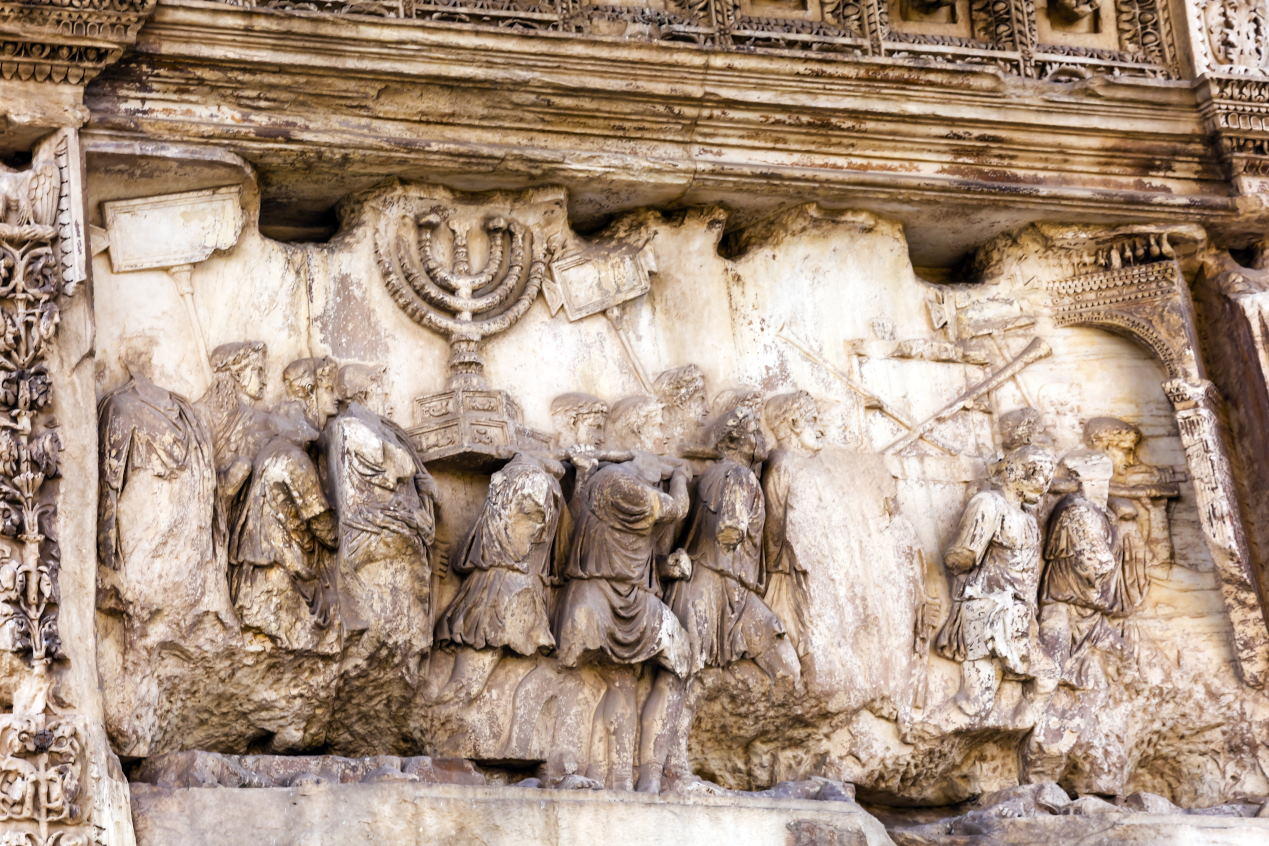
*There is a debate in our ancient sources, but it appears that there are actually two Arks.  The primary Ark which kept in the Holy of Holies was hidden by Josiah. The second Ark was taken out to war, see II Samuel 11:11 vs 6:17.  This second Ark was apparently captured by the Romans (see Arch of Titus below) and is supposedly in Ethiopia now.

Daily dose of wisdom, Shekalim 15: charity and reality

The Talmud teaches that the temple had a chamber of secrets where donations could be given and withdrawn secretly,  so the poor would not be embarrassed and the donors would not be recognized and give for their own ego.  If you saw someone going to that room, you could not be sure if they were giving or receiving.  This was especially important for poor people who came from a wealthy upbringing.

We should be sensitive to the plight of others, and aware of this deeper concept: if a rich man becomes an average man, he feels pain by this.  Imagine a billionaire losing his fortune and being reduced to only a million dollars in assets!  Our natural inclination would be to have no pity on such a soul.  However, think of the torment and self persecution he is living through.

Now apply this to yourself.  If you are doing okay and getting by, you should feel the pain that you are not doing amazing and excelling.  If you could be making billions, you will feel distress at only making one million.  This of course applies more to your personal growth than your financial outlook.  Become aware of what you are capable of and try to live up to that.  It is okay to feel some shame when you fail to reach your own standards, and use that as a motivation to improve.