Haye Sarah: Isaac and Rebecca find true love

The Torah, Genesis 23, recounts the life and death of our mother Sarah. This section is called Haye Sarah (or Chaye Sarah) meaning the life of Sarah.

Our sages point out that the famous binding of Isaac (Akedat Yitzhak) is juxtaposed with the death of Sarah.  Rashi explains, based on the ancient Medrash, that Sarah’s soul flew out when she heard that Isaac was readied for slaughter and just barely not slaughtered. In modern times we might say Sarah had a stress induced heart attack from thinking her son was being slaughtered.

Why?  Isaac was not simply her only child, but the culmination of her life’s work.  Isaac was the tangible return on her lifetime of spiritual and emotional investments.  He was the heir to Abraham and Sarah’s mission to bring ethical principles and monotheistic morality into the world.

If Isaac was dead, then it was not just her prayers, pregnancy and child rearing years that were wasted, but her entire life of teaching and leading people to God, would be for nothing.  Isaac was already 37 at the time, and Sarah had been yearning and praying for a son for decades before his birth.  Sarah had invested her ego into her son for most of her life.  He was the fulfillment of her prayers and dreams.

Sarah had given birth at age 90, after years of being barren and watching her husband raise a son with the concubine she had given him.  Miraculously Sarah returned to her youth, resumed her natural cycle and had Isaac and was even able to nurse him.

So perhaps Sarah’s stress was an overreaction. After all, if God truly wanted Isaac to perish (He didn’t), then why couldn’t God who makes all miracles then make another miracle and give Sarah a new child at age 137?

God could, of course, and Sarah fundamentally knew that.  But that wouldn’t be the same. She had already invested in Isaac.

Struggling with her faith for years while barren, the tests of watching Hagar get pregnant and then Hagar and her own husband raising Yishmael within her household… Sarah’s joy at becoming pregnant and giving birth at age 90, nursing, weaning, educating Isaac… All of these episodes carve an indelible emotional impact. 

The yearnings, the joys and the pains etched into her psyche over the years.  Like a thin wadi gradually cutting a canyon into the desert floor, Isaac had cut into Sarah’s heart.

IMG_20200205_160853

For this child I prayed

Hannah, the mother of Samuel the prophet, had a similar experience. She was barren for years while her co-wife was blessed with children, then finally received a child, Samuel, as answer to her prayers (I Samuel 1–2).  Hannah’s prayer is described as being “about her heart” or literally “on her heart” (I Samuel 1:13).

Our sages explain that Hannah in her prayers was bargaining with Heaven for a baby:

You created a woman, and every part has a purpose: eyes to see, ears to hear, a nose to smell, a mouth to speak, hands to do work, legs to walk with, breasts to nurse. These breasts that you put on my heart, are they not to nurse? Give me a son, so that I may nurse with them!  (Talmud Brachot 31b)

Hannah used her logical faculty to serve her emotional need for a child, and finally she was answered.

Hannah, grateful for this blessing, committed the boy to serve God and brought him to learn at the Mishkan, the center of Jewish ritual worship before the Temple was built.  The boy, already a prodigy, issued a public legal ruling (sh’hita kshera b’zar). This offended Eli, then the high priest and spiritual leader, since it is forbidden to issue a legal ruling in front of your teacher.

Eli plans to put the young upstart Samuel to death, but Hannah pleads to save him.  Eli answers that just like he prayed for Hannah to have this child, he will simply pray again and God would give her another one.

Hannah insists ‘For this child I prayed’ (I Samuel 1:27, Talmud Brakhot 31b).  Yes, God can always give another, but her emotional investment has already been made during the years of prayer, longing, and joy in raising this particular child. She doesn’t want a replacement, just the product of her effort.

Hannah and Sarah are examples of unyielding faith, and of dedication to their children. We see they were emotionally fixated on becoming pregnant, raising and protecting their children. Hannah argued with Heaven to give her Samuel, and convinced the high priest to spare his life.  For Sarah, the apparent death of her only son was too much to bear.

There is an important lesson from the women for modern times. When a woman is emotionally invested in her offspring, and normal women are, that is a permanent feature embedded deep in her psyche. It’s not going to change.

I’m not telling men not to get involved with a single mother.  Just don’t ever expect here to put you before her children. It is natural and normal that she won’t.

You will never be first in her world.  Her investment in her offspring is paramount.  There are always exceptions… but if a woman is ready to ignore her own offspring for the new man in her life, her own emotional attachment system is abnormal, so why are you trying to attach to her?

Yes, we have an obligation in the Torah “Don’t cause anguish to any widow or orphan” (Exodus 22:21), and “don’t repossess the garment of a widow” (Deuteronomy 24:17).  We are also told to give tithes and help widows, orphans, and the poor celebrate and enjoy holidays.  That doesn’t mean a man must marry a widow or single mother (ayen Sma, Choshen Mishpat 97:22.)

midsection of woman making heart shape with hands
Photo by Pixabay on Pexels.com

Rebecca, the second mother

Most of the Torah reading for Haye Sarah, “the life of Sarah”, is actually about the search for the wife of Isaac.  Abraham, recognizing the spiritual danger to Isaac if he marries the local pagan women, sends his most trusted servant back to Abraham’s own homeland to search for a wife from his own family (Genesis 24).

The servant prays for God to send a sign, God sends a girl, Rebecca (Rivkah), who draws water for the foreign man, saying “Drink my lord”.  Then, without being asked, she returns to the well to water his camels too (24:19).

If you have any idea how much camels drink after a journey through the desert, this is not only a feat of kindness and generosity, but a display of determination, strength and endurance (and our sages explains Divine assistance).

Not only is the girl exceptionally giving and kind, but she is described as very beautiful, a virgin, and not known by any man (24:16).

Naturally, you understand, the Torah does not waste ink.  There are no extra words in the Bible.  If she is a virgin it is obvious no man has “known” her (ayen Rashi, Ibn Ezra).  The Be’er Mayim Haim suggests that this also means that no man in her city even recognized her, due to her modesty and staying away from men.

I want to suggest an additional level of interpretation based on the Be’er Mayim Haim: when a woman offers herself to a man, that man “knows” her essence.  I’m talking on a spiritual and emotional level, the physical part is obvious.  A woman who tries to attract men is letting those men get to know her, at least on a visual level, and often that leads to a deeper knowledge.

Rivkah never showed herself off to the men in her city, she never tried to seek male attention as an object of their desire.  And yet, she is comfortable enough around Abraham’s servant to give him water and state “Drink my lord”.  She is polite and respectful but can deal with men without trying to get their attention or foster attraction to her.

A woman letting a man into her heart is emotionally investing in him, thinking (at least for now) that he is a best man she can get.  Her thoughts, her knowledge, her plans, are of him and with him.  This is part of the “knowing” that the Bible uses of as a euphemism for intimacy.  Rivkah was never known to men, even in the emotional or intellectual sense.

Even a woman interested in a man she will likely never get, a crush on a movie star for instance, involves that woman giving part of her heart and mind to that man.  Her thoughts are on that man, even if he never even knows it, he gets a part of her.

Rebecca was special because she never did that.  Not only was she physically unsullied, but her thoughts and heart had never been opened to any man.  Her mind had never yearned for any man.  She never had a crush on whatever type of man passed for a rock star 4000 years ago.  All of her capacity for emotional attachment was still available for her future husband and family.

She was perfect, unknown to any man, with no man in her heart yet.  She never showed herself off to men to get attention.  She was the female equivalent of Isaac, who is compared to a pure and unblemished holy offering.  And that is why she was worthy to be the second of the matriarchs.

“Ask her”

You will never guess what happens next.  In the ancient patriarchal Bible the men ask the young girl if she wants to go to a new country and marry.

Why?  Abraham’s servant wants to take Rivkah back to Abraham and Isaac immediately, but her family suggests that she follow the normal social custom of preparing for marriage for a year or at least 10 months (This was still the custom 2000 years later in the time of Xerxes, see Esther 2:12).

Our sages add that her family was intending to find some reason to break off the engagement while obtaining more riches from Abraham.

Rivkah was already betrothed to Isaac, Abraham’s servant accomplished this by giving her a ring, 24:22 (a nose ring actually).  For background, Jewish marriage is accomplished in two stages:

1. Kiddushin (translated as betrothal but she is a married woman at this point) is accomplished by giving the woman something of value.
2. Nisuin (Erusin – lifting), is the woman entering the domain of the man, by moving in with him for example.  Modern Jews accomplish this with groom bringing bride under a wedding canopy, and we combine the Kiddushin and Nisuin at the wedding ceremony.

Now her family wanted her to wait to complete the marriage (24:55).  Waiting was totally normal and expected at that time, but Abraham’s servant insisted on leaving.  Faced with this, her family agreed to ask Rivkah, assuming she would make the socially expected choice to stay with her family.

Amazingly, Rivkah agrees to go now, without any preparation, and marry Isaac (24:58).  Her family was influenced by the presents and wealth that Abraham’s servant brought 24:53.  But Rivkah was a different soul, she was not after material wealth, but spiritual riches.

Rivkah never even met Isaac, though of course she had heard of her distant cousin and his spiritual achievements.  She had heard that Isaac had given himself over to be slaughtered as an offering for God.  Isaac was ready to give up anything, even his life, for God.  He had proven that he would not be swayed by any threat.  He was a spiritual powerhouse.  Rivkah wanted to be a part of his world.

Her desire was for Isaac because Isaac was totally dedicated to a spiritual mission in this physical world.  She was ready to move to another country on the other side of the known world to marry a man she had never met face to face.  Because he was a man of accomplishment fixated on an important mission, even though that mission went against the socially accepted idolatrous religions.

For most young girls, especially in that society, the influence of her family and faith would normally take priority over her own desire.  Rivkah made the brave choice to go now to Isaac.  Her genuine desire for the man with his unique mission overcame her family influence over her, and the and socially accepted customs of marriage and religion.

“She fell from the camel”

Rebecca sees Isaac and falls off the camel 24:64.  A better translation suggested by Rashi is that she reclined on the camel, perhaps hiding modestly behind the neck.

Others say she dismounted and stood modestly. Perhaps she did not want to seem haughty by staying up on the camel when he approached (if you’ve never ridden a camel, they are typically much taller than horses).

Once she confirms it was Isaac, she takes the veil and covers herself 24:65.  Going back to the two phases of marriage, once she is in Isaac’s land with Isaac, it is as if she is in his household and is fully married, even though they have not met.  Jewish custom requires married women to cover their hair, at least in public (Talmud Ketubot 72, Shulhan Aruch Even haEzer 21:2).  Rivkah is continuing her high level of personal modesty and showing she is prepared to follow Isaac’s custom.

This encounter sounds like it would make a fantastic romantic scene in a movie: it starts with the dignified handsome man, piously praying on the field just before sunset. He lifts his eyes and beholds a beautiful young woman, peeking from behind the camel, then shyly approaching him, hoping he is the one. His servant explains that her presence here is the result of miracles and Divine interventions.

This must be true love, right?

But Isaac, even after hearing the miraculous way Rivkah appeared in response to Eliezer’s prayer, is not yet ready to take her as his wife.

Amazingly, he checks Rivkah’s merit by her actions, akin to what we might call vetting today.  Isaac’s vetting was actually better than what modern men try to do.

Miracles and answered prayers were not enough.  Isaac wanted to her in action to determine for himself if she was an appropriate wife and mother.  Rivkah was the paradigmatic “Debt-Free Virgin Without Tattoos”, yet Isaac still tests her suitability to be his wife.

https://i.pinimg.com/originals/0a/2e/2b/0a2e2b78b07a82babc8d7106f5cbb73b.jpg

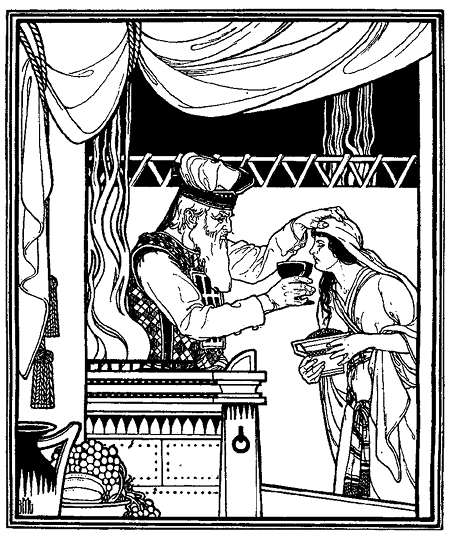
Isaac brings Rivkah into his mother Sarah’s tent, took her as wife, loved her, and was consoled for his mother 24:67.

The Bible writes these events in this order to teach us deep wisdom.  A man must observe a woman’s actions before committing to marriage. 

Then, oddly, marriage comes before love.  The words of the Bible are emotional dynamite planted under the modern commercialized concept of love and marriage.

When Isaac brings Rivkah into Sarah’s tent, it was to check if Rivkah could continue in the path of Sarah, of being a modest woman focusing her energies on her own tent, her own household, not the outside world.  Our ancient sages (Breishit Rabah) teach that when Sarah was alive, the candle she lit Friday night for Shabbat would stay lit all week, there was blessing in the dough, and a Divine cloud hovering over her tent.

These symbols of divine merit left when Sarah died, but returned when Rivkah took her place in the home.  [There is a lot of depth in those symbols, briefly they stand for the values of industriousness, caring for family, giving to others, and modesty].  Rivkah’s character and actions resulting in the return of these signs of blessing.  Rivkah acted like Sarah, like a mother.

This was Isaac’s long term vetting of Rivkah.  He saw that her actions and character were appropriate to be his wife and mother to his children (and to the future Jewish nation).  Only then did he marry her (Malbim).

After marriage, he made the effort to build love for her by noticing and appreciating her talents and contribution to his household.

Again, this is antithetical to the Disney, Hallmark pop culture version of “love”.  Isn’t “love” something people just fall into when they meet the right one?  Then fall out of?  It’s poems and pining and putting her on a pedestal.  Love is blind…?

No. That’s nonsense, and dangerous damaging nonsense.  I was taught the ancient Jewish definition of loveLove is the emotional pleasure you get from seeing the positive aspects of another person and identifying that person with those virtues.

Love is not a blindfold rendering you blind to her faults.  Love is a magnifying glass.  Love makes you see who a person really is.  Who loves you most in the world?  Your parents!  And who sees your faults more than anyone…?  Your parents!

Isaac saw Rivkah’s positive actions and modest character, the same motherly actions of Sarah.  That was enough to pass his test.  But Isaac made the extra step of identifying Rivkah with her positive elements, so when he looked at her he saw all these wonderful things she was doing and he appreciated and loved her for it.

He never “fell” in love, he used his intellect to think about the proper actions and traits in his wife, and this caused him to feel the emotion of love for her.

Isaac loved her, then he was consoled.  The positive acts of Rivkah, then in response the love Isaac nurtured for her, filled the void of the loss of his mother.  A modern man may be tempted to think poor Isaac was pining for his mother and simply got a wife to replace her.  That misses the point.  If you are looking for a good wife, you are looking for a woman with the emotional capacity to be connect to you so deeply that she will gladly be the mother of your children.

A woman willing to invest her life, energy, and body into creating and raising your family is also a wife who can support your own goso.  She will buy into your mission and join your undertaking in this world, without question or hesitation.  This is the level of love a mother gives her child.  This is the highest possible level a wife can give her husband.

The Torah tells us Isaac was comparing Rivkah to his mother, not to tell us Isaac was immature, but the opposite.  Isaac understood what he needed in a wife, what the Jewish people needed in a matriarch.  Rivkah had the huge advantage of no prior emotional investments in other men – no man knew her.

She had no other men living in her head.  She never tried to get attention from men.  All of her capacity to connect was saved for her husband and future children.  She was willing to buck the social and religious conventions of the time to join Isaac in a foreign country and help with his holy quest.

Her desire for Isaac, the man with the mission, overcame the force of normal custom and her ties to her idolatrous family.  And her actions in the tent, in daily life, showed Isaac that she is willing to become a mother, like Sarah, dedicated to her family and their goals.  She can become a matriarch, and the Bible makes her an eternal example of an accomplished woman.

In the future we will also learn about what Abraham does after Sarah dies (Genesis 25).  Preview:  He remarries and has more sons, from a new wife and concubines, then sends the other sons to the East since Isaac is the spiritual heir and will inherit the land of Israel.

One place these other sons ended up was India. The priest class in India is called “Brahmin”, possibly because the original priests descended from Abraham’s sons. Abraham is the man of the new beginning – leaving his family, his city of origin, then his country, all the trials, the concubines, children, families.  He is always ready to start again.

The revealed world

The world we experience with our physical senses is only one part of the complete world.  Our mental and intellectual processes are also physical, the result of electrons traveling over synapses in our physical brains.  Our emotions are also physical, the combination of mental processes and chemical signaling through hormones.  All physical things end, die, decay.  That’s how this world is set up.

IMG_20190920_161721

But there is something eternal, something greater.  We may call it the soul, that aspect of man which taps into another deeper level of existence.  Every language has a word or concept to describe the part of man that transcends the physical existence.  In modern times, it has become unpopular to acknowledge this reality, but men of every culture and context in our history have been trying to connect to an eternal world beyond mere physical existence.

The physical world hides and obscures the spiritual reality underneath.  Our sages taught this thousands of years ago.  The Hebrew word for world Olam is from the same root letters as Neelam, meaning hidden.  Olam literally is the thing that obscures.  This world hides something…

Our sages teach that the actions of God are hidden within natural processes and apparent randomness.  On a deeper level, nothing is “natural” or random at all since God creates everything; the creation itself serves to mask the Divine agency which allows us to have free will.  If we could see the real power behind everything we would not be able to exercise free choice, since we would be forcibly aware of God.

King Solomon (Kohelet 3:11) hints that the physical world itself is the way God conceals His actions from man.  That verse gets mistranslated; making everything beautiful in it’s season is the way to make men love the world so it obscures what He makes.  Men get so involved in the enjoyment of the physical level of existence that they don’t see how it is like a simulation covering a deeper layer.

In our generation, we are blessed that this lesson can be understood through a modern parable:
We have seen or heard of computer games that allow many thousands of players to come together and interact in the same virtual world.  The players can join forces in quests, uniting their talents to defeat monsters or puzzles that would be impossible for each individual.  Some players focus on building up treasure, or improving their skills or magic.  They can trade and socialize.

The game itself is designed so that by putting in time and effort the players improve the attributes of their alter ego characters.  Often the game will send tests or enemies against the players that are difficult, but not impossible, to overcome.  This reinforces the players’ sense of accomplishment.  If the game were too easy or the monsters to hard to defeat, the human players would quickly tire.

For a while, the person playing the game is immersed, the virtual world is his reality.  We have heard reports of people going without food or sleep for incredible lengths while playing, even ignoring their families.  Eventually, the player must log out and resume his regular life.

Now, imagine a game system so advanced, with such perfect graphical and audio simulation that it looks and sounds real.  Not only that, the game designer has modeled smell and touch, so all senses are involved inside the game.  The simulation is so good that you cannot distinguish between the game and the outside world.  Total, flawless immersion.

IMG_20191030_131047

The game itself is adaptive, sending easier tests against newer or less prepared players, and difficult challenges to experienced players.  The customization is so responsive that if a player tires in mid battle, the enemies will also tire, just enough to allow victory if the player can focus his resolve.  The game would reward effort with treasure and experience and improvement to the characters.  Again, this game is so realistic that playing it would feel truly rewarding.

Such a game would be a massive hit worldwide.  There would be a real danger that players would get so involved that they would forget their real life, and simply live inside the game.

Take this parable to another step: imagine that when logged into the game system, the actual player’s body is suspended, they don’t need to eat, drink, or use the restroom.  They don’t need to take breaks.  The result would be that countless people would chose to live in the game permanently.  After all, the game is a perfect simulation, and it offers the best in challenge, growth, and reward

This perfect game is not a mere metaphor.  This is, in a sense, our world.  Some physicists speculate the world we see is literally a simulation.  That’s almost on the right track…

Think about the back end of the computer system that would be necessary to run such a complex game world that was indistinguishable from reality.  How much power would you need to handle the inputs from many billions of players simultaneously, and adjust the entire world to allow each of them to succeed in their own personal way?  A computer that would model every detail in the game world down to each cell and even each molecule and subatomic particle, since players with electron microscopes would be able to detect the molecules, protons, electrons making up their world.

You would need, effectively, unlimited computing power, unlimited data storage, and a perfect real time interface to get the players into the game.  In other words, a system with omnipotence and omniscience.  A system with boundless capacity yet is able to immediately recognize the needs and encourage the success of each and every individual.  A system that constantly modifies the entire game universe to accommodate all players simultaneously.

Such an infinite system you might call God.

IMG_20191030_131048

“Opportunities are brilliantly disguised as impossible situations”

For a believing man, this entire world (and our lives within it) is a challenge designed uniquely for you.  The world is adapting in real time to bring you personalized tests that induce a response in you.  The goal is that you pass the test of each life situation, get better at life, and enjoy personal growth.  Since the game, or God, or whatever you want to call it, is trying to make you become a better version of yourself, then the difficulties you face become welcome challenges, not impossible conundrums.

Assuming such a purposeful universe is a practical advantage for your life.  You likewise assume each scenario in your life is for your ultimate benefit, and has a solution that you can figure out.  You don’t even have to believe in God.  You can simply assume that the universe is non-random, and therefore the situations you are in are somehow appropriate for you and there is a way for you to succeed and grow wherever you are.

Even if the universe is random, you can make a valid assumption that randomness sometimes works in your favor and puts you in the right place to seize success, if you act with the appropriate wisdom, strength and resolve.  After all, luck favors the bold.

I’m not trying to talk you into believing in God.  Or anything really.  Maybe just believe in yourself.  That’s more than most men today do.

I won’t judge you by your beliefs.  Beliefs can be totally irrational and it’s pointless to argue them with true believers.

I will judge you by your actions.  Are they thoughtful, effective, and appropriate?  Consistent?  Rational and well planned?  To the extent that your actions are reflecting your beliefs, evaluating your actions is a valid way to judge your beliefs and if they work in your environment.

IMG_20191030_132455

If you believe that the world is not entirely random, and challenges can be seen as tests and opportunities to grow, then to the extent that you internalize this belief you will enjoy a mindset that you can pass every test in life.  The belief assists you in rising to your challenges and succeeding in life.  This belief leads to a positive action.

So having the belief, which may seem completely irrational, has a rational effect since it leads to positive actions and results in this observable world.

Again, you don’t have to believe in God, or in an omnipotent quantum computer simulating the universe.  You simply act rationally and confidently within this world.  Your behavior is what matters, and how your actions bring about your own success.  Belief can be a tool to help you get there.

The first family

This week we study the portion called Vayera, “He appeared”, Genesis 18:1–22:24. This section of the Bible covers the subject of Abraham having an heir through Sarah.

Abraham and Sarah could not have children together naturally.  Sarah gave her maid, Hagar, to Abraham as a wife to produce a child.  Last week we explained why this was a significant spiritual accomplishment for Sarah, and how she was able to act against her own self interest and innate hypergamy.

IMG_20191226_165835

Abraham and Hagar produce Ishmael, the only son and ostensible heir to Abraham.  Thirteen years later, God again speaks to Abraham, changes his name from Abram to Abraham, and changes Sarai to Sarah.  God commands him to circumcise himself and his household.  Ishmael was already 13 at the time.  This is why some Muslims, the progeny of Ishmael, circumcise boys at age 13.  Jewish law states on the eighth day of life, based on Genesis 17:12.

As reward for overcoming her own hypergamy, Sarah is told she is going to have a child to be Abraham’s official heir.  The messenger is an angel, disguised as a Bedouin.  Abraham and Sarah host three angelic travelers and feed them (angels don’t actually eat, they pretended to eat).  After they eat, one proclaims to Abraham: “I will return this time next year, there will be life, behold, a son for Sarah your wife” (Genesis 18:10).

Sarah was listening at the entrance to the tent.  A shared meal was and still is an important social event that brings a sense of togetherness.  In ancient times, it was normal for women to refrain from sitting at the table with men who were not in their family.  This was extra important for Sarah, who had already been kidnapped by Egyptians for her beauty, and was later kidnapped by Avimelech as well.

Proper boundaries help ensure proper families.  The Ben Ish Hai (in Bagdad about 100 years ago) said that their practice was for the women to eat in a different room when there were outside men as guests in the dining room.  On the other hand, the Hafetz Chaim (Rabbi Israel Kagan, living about the same time in Radin, Poland) once hosted an unmarried guest who requested in advance that the women would eat in the kitchen.  The Hafetz Haim refused to have the guest instead of asking the women to move out of the regular dining room.  When I was in learning yeshiva in Jerusalem one of my elderly rabbis and his wife followed the custom of the Ben Ish Hai, most did not.

Sarah, age 90, laughed to herself, saying she was too old and her husband was too old (18:12).  Sarah does not say “husband”, she says “Adoni” meaning my master.  It is clear who had so called ‘headship’ in this first Jewish family.

IMG_20200108_081842

God speaks to Abraham asking why Sarah laughed, leaving out the part about her thinking Abraham was too old.  God explains this was a problem, as there is nothing God cannot do.  If someone asks you the riddle: can God make a box God can’t open? Then the answer is there is no such thing as that box.  God repeats the promise that Sarah will have a son.  Sarah, to Abraham, denies laughing, but Abraham presses her (18:15).

There is a lot to unpack here.

What was wrong with laughing? Sarah was too old to conceive naturally.  But, our ancient sages point out that when the guests arrived and she started preparing the meal, Sarah felt herself starting to get her period again after decades.

Sarah was on a very high spiritual level, with a firm awareness that everything in life comes directly from God.  She should have thought that maybe resuming her menstrual cycle at age 90, after decades without, was a sign that something important was coming.

I am not criticizing Sarah. In our generation we have no one even close to her level. We can’t even begin to appreciate her refinement of character and spiritual greatness.  Perhaps for someone on Sarah’s high level, a better response would be AMEN or “Yes, if God wills it”. Something to show that she believes anything was possible with Divine assistance, even if it should be impossible through natural means.

God does something odd here.  Sarah was thinking that both she and her master (her husband) were old.  When speaking to Abraham, God leaves out the part about him.  This cannot be a distortion of truth, as the Seal of the Holy one is Truth.  This is sensitivity, leaving out extraneous information that would be hurtful is not a problem.

God is properly framing the problem: Sarah had a lack of pure faith in God’s power.  The problem was not old age or a physical deficiency in either Sarah or Abraham, so that comment was not the issue that God needed to bring to Abraham’s attention.  God focuses on the actual problem, the spiritual problem.  God does not waste words.

This is an important reminder when working out your issues with someone else.  If you focus on the problem you can solve it, if you focus on what the person said you are likely to stir up an emotional response and cloud the real issue.

But why is it God takes Abraham to task for what his wife told herself?  God knows Abraham is working to enhance the spiritual level of his family and does everything he can to educate and lead them to righteousness.  God says this explicitly 18:19.

This is headship: being the responsible party for the spiritual development of the family.  Abraham is the man to talk to about a lapse of faith because he is the head of the family.  God could have spoken to Sarah directly, she also had prophetic experiences.  But since Abraham is the head of the household and the responsible party, God goes to Abraham to have him deal with Sarah.

IMG_20191120_131733

Jewish wisdom teaches that while every individual has a direct connection with the Eternal, the correct flow of authority in a family is from God to the husband, then husband to wife, wife to children, children to younger siblings and pets.  Responsibility flows uphill in the same way, the husband is the one ultimately responsible for the good of the family.

Such thinking is ridiculed in secular pop culture as old fashioned and patriarchal.  Okay, these are Patriarchs and Matriarchs we are dealing with!

The Bible takes this hierarchy for granted because it works and it works well for every member of the family.  The “man of the house” with authority and responsibility was the man, and this model has worked for millennia to create stable, loving families.

On a deeper level, our sages teach that in marriage, man makes the spiritual decisions and the wife makes decisions about physical matters (Gemara Bava Metzia 59a).  If your family’s focus is mainly spiritual, the man should be making most decisions.  If the wife is making most decisions, it reflects that the couple, the wife at least, is more oriented to the physical and less towards the spiritual aspects of life.

IMG-20200107-WA0002

Another amazing thing is that Abraham immediately takes this issue up with his wife Sarah.  From the order of the verses, it seems this happen even before the guests leave, though obviously Abraham was not insensitive and he would never critique his wife in front of others.

It takes great skill and sensitivity to properly critique people, and part of the divine command to rebuke others (Leviticus 19:17) is to only correct people who will listen.  Contemporary rabbis say that in our generation which is so squeamish this may be impossible.

Abraham is not afraid to confront Sarah for a lack in her level of faith.  He does not hold himself to one standard of faith while letting his wife remain on a lower level.  He is the spiritual head of the household.  He leads by example through expressing his personal belief and trust in God.  He is responsible to shepherd the spiritual development of his household, and the most important person for him to guide is his wife, the mother of his future heir.

Abraham would not tolerate his wife having a lower standard.  He expects her to live up to the highest levels of commitment to the Divine mission, just like he is trying to do.  Gentlemen, you must have and follow high standards in order to hold others to any standards.

Sarah’s first response is to deny laughing.  This is interesting.  She does not deny her feelings that having a child would be impossible, just the act of laughing.  Abraham repeats that no, you laughed.

On a deeper level, Abraham is pointing out that feelings are hidden from the world, but once expressed in words, song, or even laughter, they have a greater existence, more energy, more effect on the actual world.  Sarah was not lying, she thought her laugh was also merely internal and never expressed outside.  She claimed the laugh was merely a feeling.

However, it was actually expressed, which caused it to leave the world of emotions and enter the world of speech, and undermine her pure faith.  Emotions are very powerful, but as long as they are controlled and focused by the intellect their power is restrained.

IMG_20191105_142355

Now Abraham was also told at the end of last week’s Torah reading that he would have a son with Sarah.  And Abraham bowed and laughed (Gen 17:17).  Wasn’t this a lack of faith on his part?

No, we can tell by Abraham’s next words to God that he takes God seriously, and his laughter was from accepting God’s promise with joy, not incredulity.  He says “lu Yishmael yihyeh lifanecha” (17:18), meaning that despite the good news of having a child with his wife, he is afraid that this will damage Yishmael, the son he already has with his concubine.

Abraham trusts God’s prophecy so he fears that having child and official heir with his wife will make Yishmael redundant in the Divine scheme, and Yishmael will be eliminated.  So Abraham prays for Yishmael to also have a future in God’s plan.

The ancient Aramaic translation of the Hebrew text made by Onkelus, a Roman nephew of emperor Hadrian who converted to Judaism, also notes the difference.  This translation was made in accordance with the ancient Jewish understanding of the Torah, unlike the translation into Greek (see Talmud Megillah 9).  The Greek version was changed in many places, and most later translations were based on the flawed Greek.

Onkelus translates Abraham’s laugh as “Hadi” meaning rejoicing and connoting anticipation with goosebumps (see Exodus 18:9).  He translates Sarah’s laugh as “haichat”, implying laugh off or scoff, as it is used in the Talmud, Beitzah 38.

Therefore, we see that Abraham accepted God’s promise as true, and took it for granted that God would deliver, so he was already contemplating the long term effects of having another son with his wife.  When Abraham laughed it was not skeptical but an act of rejoicing.

While both Sarah and Abraham laughed at the good news, Abraham was on a higher level of trust in God.  We will see later that Sarah was on a higher level of prophecy when it came to the danger of Yishmael influencing (or murdering) Isaac, likely because Abraham was partial to his first son and could not be objective.

Again, I don’t presume to know or judge the spiritual level and behavior of our ancestors. They are giants and we are spiritual midgets, whatever we accomplish is only because we are standing on their shoulders.

We have a concept of humility compared to earlier generations, which keeps us grounded. Talmud Shabat 112b:

Rabbi Zera said in Raba bar Zimuna’s name: If the earlier ones were sons of angels, we are sons of men; and if the earlier ones were sons of men, we are asses.

Your own status depends on how you view those who were greater than you, if you see the earlier generations as mere humans, you yourself are necessarily less than them.  Today there is a total lack of respect and even basic understanding for what thousands of generations of humanity accomplished and lives they led,

For 99.999% of human existence, the were clearly in charge of the family, exercising authority and holding responsibility.  Abraham was able to guide his family as Patriarch because he was humble and obedient to God, and was setting the example for the family in following God’s will.  Therefore he was willing to exercise proper rebuke when someone did not live up to his standards.

Respect for earlier wisdom is lacking in modern-day society.  There are hucksters out there taking credit for the ideas of others, because they don’t value the thinkers for their creative genius or insight.  If they truly valued these men, they would attribute the ideas to the earlier sources.  But then they could not charge you money for their new “content”.

As for me, everything I write is based entirely on the Bible and Jewish tradition, and on what my rabbis taught me, unless I state it was my own insight.  I am a nothing standing on the shoulders of great men, who are standing on the shoulders of real giants

More about Sarah’s greatness next week…

Are Jewish women different?

They’re not.

Absolutely not.

And yet…

IMG_20190411_144305
Conventional Jewish culture is centered on the Hebrew Bible, the written Torah, aka “Old” Testament.  Jewish culture also relies on the oral law to understand and explain the written Torah.  The oral Torah is the explanation and elucidation of the concise written law.
For example the written Torah tells us “slaughter the animal as I commanded you” but never tells you how to slaughter; such laws were also given to Moses at Sinai and taught orally generation to generation for thousands of years until they had to be written down to be preserved.
The most famous and impactful stories in the Bible are about the patriarchs of our nation, Abraham, Isaac and Jacob – and our matriarchs Sarah, Rebecca, Rachel and Leah.  The deeds of our fathers and mothers are recounted in the Book of Genesis.  Moses actually gets the most mentions in the Bible, but that is more for what he teaches and his relationship with God than for his personal family life.
Abraham Isaac and Jacob, with their wives and families, are the primary exemplars for Jews to learn how to live their daily lives. And for guidance in how men and women can and should get along with one another.  Therefore, studying what the Bible says about our patriarchs, and of course our matriarchs, is the key to understanding family life.
.
Abraham was told by God to leave his land, his birthplace, his family, and go to the land we now call Israel to become a great nation (Genesis 12).  He takes the leap of faith by journeying to Israel, only to be tested again and again with difficulties such as famine, war, enemies, family strife, and abductions of his wife.  However, Abraham is not made into a great nation, he doesn’t even have children.
Again, God repeats that Abraham’s offspring will inherit the land (Genesis 12:7, 13:15, 15:18), and that descendants will become a large nation and become countless in number (Genesis 12:1, 13:16).  When Abraham reminds God that he has no biological heir, God explicitly states: “the child who will issue from your loins will inherit you” 15:4.
However, Abraham’s wife Sarah could not have children (11:30. 16:1).  At Sarah’s request, Abraham takes her maidservant Hagar as a concubine to have children.  Sarah gives the woman to her husband, and encourages the woman to sleep with her holy husband and produce children (Genesis 16:2:, Rashi from Bereshit Rabbah 45:3).
Sarah’s action is the polar opposite of hypergamy.

Hypergamy is defined as “marrying up” or looking for someone with a higher status to wed, thereby raising your own status through association.  In modern parlance, hypergamy describes the innate goal of women to mate with the best specimens of men they can, and to marry the man who makes them feel most cherished, secure and supported.

For more explanation please read the book The Rational Male.  Hypergamy was historically a subtle, secretive process; the author of The Rational Male explains who recently it has begun to flourish openly in modern mainstream society. (Nibul peh warning for Jewish readers, adult language and content on that website).

Another aspect of hypergamy is a woman trying to lock a valuable man down as the sole man for her.  She doesn’t want another woman competing with her for his time, attention, love, and resources.  She wants to feel the security that this man, with his energy and wealth, is entirely for her.

A woman expressing her hypergamous nature would naturally be opposed to sharing her husband with someone else.  Sharing him would reduce the wife’s access to love, support, and attention from the husband.  This also creates a situation where he now can have intimacy with another women, which could reduce the first wife’s value in his eyes.  If he has children with the second woman, that reduces the resources available to the first wife and her offspring.

Allowing a man access to another woman is the opposite of hypergamy.  Yet, Sarah chose to put herself into this vulnerable, compromised position by sharing her husband with a her maidservant.  What could be more of an opposite to hypergamy than literally giving another woman to your husband so he can produce children, while you watch her pregnancy and child develop, and your own husband give them his attention and resources?

I’m not going to argue that Sarah, or any of our ancestors, did not have natural hypergamy.
God made us humans with Divine Wisdom and gave us our innate desires, our biological and social subroutines.  Women are programmed by God to be hypergamous.  This is not a flaw in women, it is a purposeful feature.
Back in the first section of the Bible God saw this and testified “it was good”.  Not that hypergamy is inherently good or evil, it is a tool and urge that can create positive or negative outcomes, depending how a woman applies and channels it.
.

So why did Sarah do this?  It was her own idea, not an order from heaven.  Though Abraham heard the hint of Divine inspiration in her voice (16:2, Bereshit Rabbah 45:2) she had not been commanded to do share her maidservant, this came from her.
So how could a woman make a suggestion totally opposed to her own self interest?

This was possible because Sarah was fully committed to the mission of monotheism.  This required establishing a family as the core of the future Jewish nation, a family that would grow in size and spiritual influence throughout history.

At that time, the ancient world was polytheist and idol worshiping, and often of low moral character.  In Egypt they had to claim that Sarah was Abraham’s sister (she was his niece), so the idolators would not murder Abraham to take her (Genesis 12:12, see also 13:13).  Starting a family dedicated to the One God and teaching that men must behave with high moral standards would revolutionize the entire world.

Sarah knew that Abraham would have a descendant to be heir to the holy land and to the holy mission.  God had said so.  She did not know if she would be the actual mother of this heir.  Sarah was so dedicated to the Divine mission that she put her own desire to have children with her husband on the back burner.

When Sarah realized she was too old to conceive, but that the larger mission required Abraham to have a son, she was willing to put own personal interests and pride aside to fulfill God’s mission in this world.  Abraham and Sarah knew logically and through divine prophecy that they needed an heir to carry on this mission and continue their work on enlightening the world.  So Sarah suggested he create an heir with Hagar.

Sarah’s emotional state, characterized by intense loyalty to God and her husband, gave her the impetus to conquer hypergamy.  Even though her choice was to her personal detriment, it was for the benefit of all mankind forever.  She understood this emotionally.

Sarah’s feelings of commitment to Abraham and their mission of monotheism must have been stronger than her feeling that she should be the one to become the mother to his heir to continue that mission.  She felt that her faith and loyalty to God and her husband were more important than her own potential personal status as mother to the Jewish people.

Sarah thought she was giving up her chance to become the matriarch of the monotheists by giving Hagar to her husband to make an heir.  She put aside her own gain for the ultimate good of mankind.

And that is exactly why Sarah did merit to become the mother to the Jewish people, giving birth to Isaac at age 90.  If Sarah lacked innate hypergamy, giving a concubine to her husband would not have been a source of future merit.  Because it was so difficult for Sarah to share her husband with her servant, this act of self sacrifice earned Sarah her rightful place in eternity.

Abraham is also testing with putting his loyalty to God above his love for his son (Genesis 22), a similar concept that cemented his place as the first patriarch.

By contrast, Hagar, the maidservant elevated to concubine, became full of herself when she realized she was pregnant with Abraham’s baby (16:4).  She thought she was better and more holy than Sarah since she conceived immediately.

Hagar was indeed worthy to have a child with Abraham, but she then put her own self-importance above the mission of giving an heir to Abraham by starting up with Sarah.  The spiritual result of this was that her son could not become the true heir to Abraham’s mission.  [Ultimately Ishmael is also blessed and becomes father to a great nation as well, but not as the spiritual heir to Abraham’s mission of ethical monotheism].

Sarah herself is aware that her merit to have a child, the child to continue the mission, was due to giving Hagar to Abraham (30:18).  She realizes that overcoming her selfishness was the factor in God giving her a miraculous pregnancy in her old age.

If Sarah had taken the attitude of Hagar and put herself first, there would never have been a physical heir to continue Abraham’s mission to bring monotheism to mankind.  Abraham would have died and the future Jewish people with him.  No monotheism, no bible, no Christians, no Muslims, likely no western civilization at all.

It was the incredible emotional strength of Sarah, her ability to put her husband and their mission ahead of her personal desire, that allowed the Jewish people to come into existence, and eventually for monotheism to spread around the globe.  Sarah conquered hypergamy.

God of course knew she could do this, which is why God repeatedly tells Abraham that he will become a great nation, rather than telling both Abraham and Sarah they would be the parents to the nation.  This allowed Sarah to suspect she might not be worthy, which gave her the idea to give her husband a concubine – which indeed made her worthy.

If Jewish women are not ‘different’, then how was this even possible?

After all, “all women are like that” and have innate hypergamy.

Let us examine just who Sarah was:
The first reference to Sarah the Torah also calls her “Iscah”, a name meaning seer or looker, alluding both to her powerful prophetic vision and her physical beauty (Genesis 11:29).  Sarah was able to see the big picture.  She knew that the Abraham needed an heir to start the Jewish people and accomplish a spiritual mission in the world, and that this mission was greater than herself.
At a young age, Sarah saw her own father Haran die in a public execution.  Haran was the first man to sacrifice himself to sanctify the name of God.  In Hebrew we call this “al Kiddush Hashem”.  This occurred right after Abraham smashed all the idols in his father’s idol shop, and blamed the largest idol for the mess, to show the city how ridiculous idolatry was.
[That episode is a famous story but it’s not in the written Bible.  Conventional Judaism has saved a vast pool of ancient contextual information, the back stories, that fill in the gaps for the stories that are written concisely in the Torah.  These were handed down through the generations by the people who were there.  Many of these back stories were later written in Medrashim and Talmud.]
After Abraham smashed the idols and started preaching monotheism, the idol worshiping authorities (led by Nimrod) came after him and his family.  They made a huge fire in a furnace in front of the entire city, and threw Abraham into the fire.  Abraham was protected by God and emerged unscathed.
His brother Haran had been waiting, saying that if Abraham is tested and comes out victorious then I’ll know for sure he’s right and I will agree to monotheism. So after Abraham came out, Haran publicly agreed with Abraham, and the idolaters threw him into the bonfire too.  Because his faith was less than pure he did not come out of the fire alive.

Abraham then takes Sarah his niece as his wife, and takes his nephew Lot under his wing, and leaves.  Sarah had witnessed first-hand her father’s self sacrifice for God in public.  Haran was the first person to ever die for God.  This trait, this spiritual DNA you could call it, continues in Sarah, and gives her the ability to sacrifice selfish hypergamy to promote monotheism.

With this model, she is able to put the mission of building the Jewish people above her own self interest.  She has the ability to feel that the mission is more important than her own biological desires.  She has the spiritual power to conquer hypergamy.

When she married Abraham, Sarah joined her husband’s mission.  They were both “making souls” back in Haran (Genesis 12:5), by convincing people that there is one all-powerful eternal God, not many idols.  Ancient commentaries point out that Abraham preached to the men and Sarah the women.  Sarah saw the miracle of Abraham being saved from the fire, then saw her own father die, and now was committed to live for and teach monotheism no matter what.

IMG_20190425_163202

A Jewess growing up within traditional Jewish culture, learns a lot of Torah, starting with the basic stories in Genesis.  She sees many examples of respected women putting their loyalty to God and their husband above their innate hypergamy.  Every woman wants to mate with the best man she thinks she can get, and to marry the man who makes them feel most secure and supported.

And yet, conventional Jewish tradition celebrates and honors women who are able to put selfish goals and impulses aside in order to fulfill the main mission, building and protecting the Jewish people. We celebrate women who through their spiritual and emotional strengths conquered their biological drives and put the greater good above personal gain.

Not only are these women cherished in our culture, we have a concept called “Maaseh Avot Siman L’Banim”, meaning the deeds of our ancestors are an exemplar to their offspring.  Some explain this to mean that the spiritual accomplishments of our patriarchs and matriarchs are imprinted onto the “spiritual DNA” of the Jewish people.  Therefore we are innately able to succeed in those same areas that our ancestors did.

On a simple level, I think it also means that because we hold up the deeds of our ancestors as the example of what to do, and we educate our youth to respect these people, modern Jews are more likely to make the same choices.   A Jewish girl, knowing that Sarah is the gold standard for women, will be also be more likely to put what God (and her family and husband) needs ahead of what her biology craves.

This is a stark contrast to modern secular culture which instructs and pushes women to maximally indulge in hypergamy.  Recently the message given by society to young women can be paraphrased as: date (sleep with) the bad boys, then there will be a nice guy waiting to marry you and support you when you’re done partying”.

Modern culture uses massive social conditioning to convince women that they can be fully independent of men, and that men should sacrifice their own interests for women, but never the other way around.  This is often self-defeating, leading women to overvalue themselves, run out of time and options, then ask “where are the nice guys I was told I am entitled to?”

Effectively, women are being persuaded to be as selfish as they can get away with for as long as possible, and not to put the needs of others or any higher mission above their own pleasures.  Men are also being conditioned to allow this behavior and to overvalue women, not for her individual worth, but simply because she is a woman.  While I was writing this, The Rational Male posted an excellent essay for women, on this modern social conditioning and the effect on women specifically.

Jewish women are not inherently different, but conventional Jewish culture fosters a very different value system and typically a better outcome for women than what we see in modern secular culture.  Growing up in a conventional Jewish environment somewhat reduces the pervasive influence of modern media on women, the social conditioning that starts even before a girl’s first Disney movie.  The Jewish heritage also provides a positive alternate model to self indulgent behavior that is rampant in modern consumer culture.

Any woman can be taught and instructed in positive feminine role models.  The difference for Jews is that we truly believe that the Bible is given to us by the Creator.  We know that God loves us and the Torah (Bible) is a priceless instruction book for leading the best and most meaningful life.  Therefore, the Bible’s messages about positive femininity are of utmost importance for us.  They are not simply good advice, they are the way to attain true satisfaction in life.

Because of our Biblical tradition, conventional Jewish women come out different.  Not biologically different, women are all programmed with the same basic system by God.  Hypergamy is a biological impulse programmed into women by their Creator and it has a proper constructive use.

However, due to the influence of the Torah, the celebrated examples our holy matriarchs, and the pressure of a traditional culture, a Jewish woman is able to resist the operative social conditioning imposed by secular society and even overcome her innate hypergamy.

More examples to come as we study the Book of Genesis…

Noah: Be fruitful and multiply… abortion and castration

The second weekly section of the Hebrew Bible, Genesis 6:9–11:32, features Noah’s ark.

The flood was necessary to wipe out the evil men from the world (Gen 6:13).  The sins of that generation, including robbery and extortion, and particularly the sexual travesties, were so pervasive that even the animals started to copy the humans and breed with other species.  The misdeeds of the humans corrupted the natural world around them.  (Talmud Sanhedrin 108, Rabbi Yochanon on “Ki Hishchit Kol Basar Et Darcho… “).

A lesson here is be careful with whom you associate.  You are the average of the people you chose to spend the most time with.  Be mindful where you invest your time and energy.  Open your eyes to what your friends are doing and evaluate if they are positive role models.  Weed out corrupting influences before you become like them.

When the flood ends and the waters recede, and Noah, his family, and the animals, are told to leave the ark and “be fruitful and multiply” (8:17).

IMG_20191030_132501

Immediately after this, the command prohibiting abortion is given, Gen 9:6.  The Talmud in Sanhedrin 57 brings the source, Rabbi Yishmael explains the verse 9:6 shofekh dam ha-adam ba-adam damo yishafekh – “whoever sheds another man’s blood, his blood will be shed by a man”.  But the word ba-adam also literally means “within a person”.  Therefore, Rabbi Yishmael teaches that the prohibition on murder includes a person inside another person, to wit, an embryo inside a pregnant woman.  This exposition fits with the order of the Bible, since the following verse repeats the order to be fruitful and multiply on the earth, Gen 9:7.

Noah plants a vineyard and becomes drunk (9:20).  Can you blame him?  The world he sees is devastated, post apocalyptic.  There are unburied skeletons and ruins of a great civilization all around.  The Holy Scriptures point out that God created alcohol as a tool to help us cope with hardship (Proverbs 31:6, Psalms 104:15).  Ben Franklin allegedly quipped: “Beer is proof that God loves us and wants us to be happy” (he may have been referring to wine).

Ancient Jewish sources reveal that the power of things causing rot, like bacteria, was increased after the flood.  The same bacteria that cause fermentation of grape juice into wine.  Noah may have been surprised by the higher alcohol content of his wine.  The same wine before the flood may have been only slightly alcoholic, while the post flood wine could have been 100 proof.  This increase in rot and infection was also a contributing factor to the decrease in human life spans after the flood.

https://isthatinthebible.files.wordpress.com/2015/12/mosaic-of-the-drunkenness-of-noah-basilica-di-san-marco-venice-1215-35-cropped.jpg

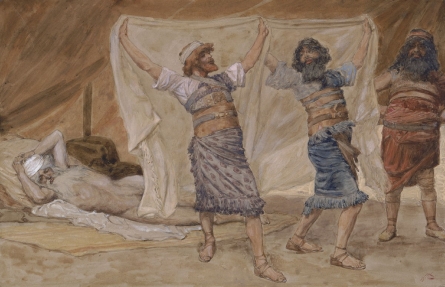
While Noah is sleeping off the strong wine in the nude, his son Ham, informed by Ham’s own son Canaan, goes in and castrates him 9:22.  Ham’s motivation was his reasoning that Adam had two sons to divide the world and they came to murder.  Since Noah had three already, and wanted more, this would cause strife and violence over dividing the world.  So Ham’s self righteous intent was to prevent future conflict by blocking Noah’s reproductive ability (Medrash Gen. Rabbah 22:7).  In response, Noah curses Ham and Canaan, and blesses his two sons Shem and Yefet who had covered him.
https://uploads1.wikiart.org/images/james-tissot/noah-s-drunkenness.jpg

Why did Ham stoop to castrating his own father?  I want to suggest that Ham was well aware that abortion had been banned by God, as the Talmud explains above.  He knew that if Mrs. Noah (Naamah bat Lamech) would become pregnant, he would not be able to cause her to abort, since if he did he would be liable to death, as Rabbi Yishmael explained above.  So Ham preempted the need to cause an abortion by emasculating his father.  [Note that sterilization too became forbidden later in the Bible, Lev. 22:24, Talmud Shabbat 110b, Rambam Issurei Biah 16:10].

Ham avoided hurting his mother and bringing liability on himself by attacking his father.  In modern secular society too, women are (believe it or not) massively protected as a group.  But men are fair game.  In modern day America, practically no one questions the “right to choose”.  The majority of American, including 74% of American Jews, identify as “pro-choice”.

This “right” to abortion extends to married women and minors who choose to terminate a pregnancy without even notifying their husband or parents.  It’s her body, her choice as they say.  By comparison, a married man needs a permission slip from his wife to get a vasectomy.   What about his body, his choice?

The secular legal and social system has made a woman’s preferences inviolable, and a man’s life subservient to hers.  If a man sleeps with a woman, and by accident (or through her inducing an “accident”) there is a pregnancy, then he has no rights to that pregnancy.  He has zero say in that pregnancy is carried to term or not.  But he is on the hook to pay for that child if she decides to keep it.  From her decision, he can be financially liable for at least 18 years, and imprisoned for failure to pay her.  He has no real influence, let alone authority, over the reproductive process.  But he has complete responsibility for the outcome that someone else chooses.  More on that later.

Getting back to the Bible… God gives us a command to mankind to be fruitful and multiply, fill the Earth.  God wants mankind in general, and you in particular, to succeed, grow, and flourish.  Now, there are many ways to fulfill the purpose of this verse.  A man might never have children, but he could be a doctor, a farmer or teacher, helping heal, feed or educate others.  He is playing a role in filling the world, in continuing humanity.  Even a garbage collector is assisting mankind in settling the planet.  There are many ways to contribute to humanity, put in the effort and find a way that works for you.  God wants you to succeed and will help you when you put in the effort.

The opposite of “be fruitful and multiply” is infringing or denying someone else’s ability to reproduce.  And yet, in the current social order, one gender is handed total control over birth, while there is outrage if the other gender wants a say in his offspring.  Abortions are not only protected, but celebrated.  Don’t take my word for it, if you are brave run a search for “hoes before embryos”.  Women’s choices, even to kill a fetus, are promoted celebrated.   But if a man would dare to assert his preference, he is shunned by modern society.

Naturally, you may assume conventional Orthodox Judaism is in the “pro-life” camp.  This is not entirely the case.  There are exceptions to the Biblical prohibition on abortion, depending mainly on the health situation of the mother and baby.  Jews do not believe that life begins (fully) at conception.  Before birth the mother’s life is more important than that of the fetus.  This is clear from the Torah, Exodus 21:22, and Mishnah, Ohalot 7:6 and Talmud Sanhedrin 57.  But the fetus is important as a potential life and should be protected.  Therefore, if the pregnancy endangers the life of the mother then a Jewish woman, after consulting her rabbi, doctor, and of course her husband, can have an abortion.

There is significant debate over how serious the threat to the mother’s health needs to be to justify the drastic step of an abortion.  Some major modern figures in Jewish law allow abortion even when there is risk that she would become depressed and potentially suicidal.  Some allow abortion when the fetus itself has, God forbid, a fatal illness like Tay-Sachs.  There is an excellent discussion of the various sources brought in the English book Nishmat Avraham by Dr. Abraham Abraham, Choshen Mishpat 425.  For Hebrew speakers, see Rabbi Ovadia Yosef zt”l “Yabia Omer” vol 4 E.H. 1.

Conventional Judaism cannot give a simple yes or no answer on abortion, since it depends on the individual circumstances.  However, it is fair to say that Judaism recognizes the infinite value and potential of a human life – even an unborn life.  While abortion may in very rare cases be appropriate, it should never be celebrated or promoted.  Jews faced with the question of abortion take this very seriously, as they have to decide the fate of a future human life, made in the Divine image.

[This essay is not a rabbinical endorsement to obtain an abortion.  You must consult your own rabbi and present your unique situation if you have an actual question.  If your local rabbi cannot answer he should refer you to an expert rabbi.]

The Creator of the world wants us, mankind, to become a partner with Him in creation. One element of this partnership is to try to “be fruitful and multiply”.  That command includes more than having babies, it is also to celebrate every human life as worthwhile and valuable.  While that truth should be self evident, but these days in mainstream American society it is not.  One can recognize the necessity of abortion in very rare instances without endorsing and normalizing it.  Celebrating the destruction of a potential person, even if that choice was necessary and morally correct in the specific situation, is not consistent with valuing human life.  Nor is giving one gender unilateral control over the reproductive process.

https://i2.wp.com/gargantuanwine.com/wp-content/uploads/2014/07/empoli-noah-drunk.jpg?resize=620%2C684

Ham violently seized control over Noah’s ability to reproduce, and he justified this as necessary to avoid future conflicts.  A modern “pro-choice” American woman would certainly understand where Ham was coming from: less kids means less trouble, less inconvenience, less costs.  It is easy enough to justify extinguishing human potential when you see another human life as another inconvenience.  The majority of the over 2 million annual abortions in America are reportedly for convenience, because the mother didn’t feel like caring for a child.  She chose to end this potential human being since she would feel put out raising her own baby.  Think about that.

People making repugnant choices that control others tell themselves that they are doing it for the greater good, for social justice, for equal rights.  You can justify a lot of evil by telling yourself it is for justice.  Hitler also thought he was doing good on behalf of all mankind.  Without an objective moral compass you can’t know if you are doing good.

Personally, I rely on the Bible, which commands us to partner with God to make this world a better place, and ancient Jewish tradition, which empowers us with the wisdom to pull this off.  I have no judgment on you if you have a different source of morality.  Judgment is the Lord’s.  Having an unalterable and unassailable outside source to guide my conduct keeps me doing what I should be doing.  You may find the same.

On a societal level, the modern system has been set up to protect women from the consequences of their reproductive choices, and to saddle the man with the long term burden of the choices she makes.  As a man you can end up paying for a child you never wanted, or can have your child, your biological legacy, destroyed because she didn’t want it.  And you have no say.

The practical outcome of this system is lower rates of marriage and birth, as some men realize that in the current system they would put themselves at a massive disadvantage by marrying or fathering children (see MGTOW).  One could fairly argue that the entire modern social system is now at odds with “be fruitful and multiply”.  Modern mainstream society effectively emasculates men by removing their voices from the reproductive process, and also by indoctrinates women that to be a mother is shameful compared to being a successful career woman or living it up (that’s a topic for another time).  Even though normal people have a biological imperative to be fruitful, the current culture no longer values this inherent reality of humanity.

Abortion is not always morally wrong; Jewish law permits it in rare circumstances to save the life or health of the mother.  When one party controls the decisions of life and death and the other is shut out there is terrible injustice.  That situation encourages women to end a potential human life without regard for the long term consequences or the feelings of the father.  This dangerous state of affairs ignores human biology, belittles our ability to partner with God in creation, and undermines the boundless value of each and every human life.

The Genesis of intersexual dynamics

Genesis.

“In the beginning…”

You could spend a lifetime figuring out what is going on in the first section of the Bible. Today we will focus on one aspect of what happened between Adam and Eve that has permanently imprinted a powerful effect on every man and woman in the world.

“And when the woman saw that the tree was good for food, and that it was a delight to the eyes, and that the tree was desirable to make one wise, she took of the fruit thereof, and did eat; and she gave also unto her husband with her, and he did eat.” Genesis 3:6

There are no extra words in the Torah. The words “with her”, which imply Adam was with Eve when he ate, but that she had been alone when she picked the fruit and ate it. We see that Adam was not present when Eve picked the fruit.

img_20191230_071206.jpg

By the way, according to ancient Jewish sources the Tree of Knowledge was not an apple. See Talmud, Brakhot 40a and Sanhedrin 56b.

“And the eyes of them both were opened, and they knew that they were naked; and they sewed fig-leaves together, and made themselves garments.” 3:7

This is the world’s first “red pilling“, a modern term meaning someone opening his or her eyes to a reality that was previously not realized. Obviously the physical eyes of Adam and Eve were already opened prior to eating this fruit, since “the woman saw that the tree was good for food, and that it was a delight to the eyes” (3:6).

However, at this moment they realize that there is good and evil, and that they have now sinned. That life in the Garden of Eden will never be the same. And they also realize are without clothing and feel that somehow this is a problem.

Then the real trouble starts…

Then the LORD God called to the man, and said to him, “Where are you?”
And he said: ‘I heard Your voice in the garden, and I was afraid, because I was naked; and I hid myself.’

And He said: ‘Who told you that you were naked? Have you eaten of the tree, whereof I commanded you that you may not eat?’

And the man said: ‘The woman whom You gave to be with me, she gave me of the tree, and I did eat.’

And the LORD God said unto the woman: ‘What is this you hast done?’ And the woman said: ‘The serpent beguiled me, and I did eat.’  3:9-13

It sounds like Adam is trying to absolve himself of responsibility by blaming Eve. On the surface, his reaction seems reasonable. After all, Eve listened to the snake and picked the fruit independently of Adam, and she fed it to him.

Some commentaries bring ancient Midrashic sources that Eve, aware that she had made a mistake and was now mortal and vulnerable due to this sin, berated and physically beat Adam until he agreed to eat also. See the Tur for example, who reads Adam’s explanation “she gave me from the tree and I ate” as meaning she beat me with a branch from the tree until I ate.

If it was clearly Eve’s fault, then wasn’t Adam correct in deflecting the blame?  Why does God punish Adam as well?

Adam was the man in charge. See Genesis 2:15 where God puts him in charge of the Garden, before Eve was even created. In addition, God gives the commandment to eat from any tree except the tree of knowledge before Eve was around, Genesis 2:17.

Adam knew the rules and was the appointed guardian of the Garden.  He must have told Eve the rules and the punishments. So why did she pick the fruit and eat?

I heard from my rabbis an amazing explanation that solves this mystery.

When Adam relayed God’s instructions to Eve, he did not say “the rule is don’t eat from that tree”.  Adam told her “God commands: Don’t eat or even touch that tree or you will die”.   This is apparent from Eve’s answer to the serpent in 3:3: “but of the fruit of the tree which is in the midst of the garden, God hath said: You shall not eat of it, neither shall you touch it, lest ye die.”

Adam was extra stringent to make an additional safeguard around God’s commandment, so he told Eve that God ordered them not to even touch it. The serpent, knowing the actual orders from God, was able to take advantage of the difference between God’s instructions and Adam’s  expanded order.

The serpent (our sages note that before he was punished to go on his belly he had arms and legs, like a dragon) pushed Eve onto the tree, then pointed out that she did not die from that contact. Therefore, the serpent argued, eating from the tree would also not be fatal, and Adam’s orders were entirely wrong.  We know the serpent pushed her because the Torah says God punished him for what he did – a physical push.  The serpent had been permitted to tempt with words only, not through physical actions.

Adam was at fault for giving the wrong instructions to Eve.  Specifically, by stating the more strict instruction not to touch the tree in the name of God, not in his own name.  Eve says in 3:3 what Adam had told her: “God hath said: Ye shall not eat of it, neither shall ye touch it, lest ye die.'”

Since Adam was responsible to give the correct instructions to Eve, he was punished for her action.  Adam had told Eve his own boundary about touching was in fact the Almighty’s rules. (see Mictav mEliyahu on why Adam would do this).  Adam’s order to Eve not to touch the tree should have been explained as a man-made safeguard, not a Divine command.

Adam should have said “God commanded us not to eat from the tree, and I don’t want you to even touch it, so you are not tempted to eat”.  That would have been accurate and reflected his goal.

We also see that once Eve was corrupted, Adam agreed to join her, afraid of losing her to death (she was, after all, literally the only woman in the world. We can also understand that he become “with her” in Genesis 3:6 as meaning he agreed to join her in her fallen status.

IMG_20200206_074608

The lesson is clear.  First, the man should be the guardian of the family and give the instructions. He is responsible to give the right instructions.

Take responsibility for your own individual needs.  If you have different standards than the mainstream, or you have a certain need to be happy, don’t claim that a Higher Authority is behind it.  It’s your rule and your life, so enforce it as your own rule.  You don’t need to appeal to higher power to enforce your own boundaries.

If you need your woman to act a certain way, don’t tell her that the Almighty commands her to do it your way.  Tell her it’s from you, own your expectations and personal boundaries, and hold people accountable if they break them…

Accountable to you, not God.  The Almighty is a Big Boy, He can hold people accountable when they violate His expectations.  He doesn’t need hordes of self righteous enforcers pretending that their personal sensitivities are manifestations of Divine will.

You have your own set of expectations from other people, acknowledge those as your own.  Don’t act like a holy man, a prophet, making up rules for people but claiming those rules are from Heaven. You’re not so holy.  If you want people to play by your rules, make and own your rules.

We have a hint that Adam was chastised for playing God, see 3:22 “behold the man was (acting) like one of us…”

IMG_20191227_071721

Strangely enough, when God tells Eve her punishment, it includes “your desire will be for your husband and he will rule over you.” This doesn’t sound like a punishment at all, this enigmatic statement actually holds the key to a healthy relationship based on mutual desire.  More on this later.

Some of the same Hebrew words regarding this desire are used later, when Cain is thinking of attacking his brother Hevel. God tells Cain that sin desires him but if he improves, he can rule over sin. This mirrors the language used for Adam and Eve.

Another thing that needs explanation is that the tree of knowledge “etz hadaat” is the same word as a man knowing his woman, in the Biblical sense.  How is physical intimacy the same as wisdom?

Also, why does the Bible tell us Lamech had two wives?  That was totally normal then (and for almost all of human history).  Why point that out in detail?

The answers will come, God willing, as we invest our energy in learning actionable wisdom from our Holy Bible.

Pleasure and Pain

There is a misconception which is extremely common among Americans, it pervades our culture and society on all levels.  This is the mistake that the opposite of Pleasure is Pain.  We want to maximize pleasure and minimize pain.  This assumption causes massive problems as we American go to great lengths to avoid pain and seek pleasure at all costs.

whip.png

Years ago, in Yeshivah (a Jewish school of Wisdom), my rabbi proved to us that the opposite of Pleasure is really not Pain.  The opposite of pain is no pain… comfort.
But pursuing comfort and shunning pain leads to warped values and wasting your life.  The ultimate comfort is what?  Zoning out, sleeping, death.  You won’t need to make any effort, there is no pain, no change, no growth.  Growth requires pain.  Anything worth accomplishing requires you to invest your energy, time, and talent.

Pain is the price you pay for Pleasure

Pain is the price you pay for Pleasure.  Remember this, use it as a slogan when you are faced with difficult decisions, tough workouts, choices that will bring you pain now and pleasure later.

My rabbi, many years ago, pointed out that valuing comfort had made American society decadent.  To seek comfort, to avoid pain, is decadence.  Avoiding pain means avoiding a hard job, difficult classes, points of view that challenge your own.  It is avoiding growth, conflict, change.  Decadence is weakness, avoiding pain brings stagnation.

Most Americans now avoid or delay marriage and having children, as these are painful.  Of course they also bring pleasure and meaning to life, but too much pain!   It’s hard to manage the relationships with a wife and children, to lead in those relationships, to be a worthy guide to next generations.  It needs a high level of competence, preparation, and all of your effort and dedication.  This is pain.
Interestingly, in Jewish culture, a man does not finally fulfill the entire commandement of “Be fruitful and muliple” until his own children beget offspring.  This means he has guided his family to become mature and successful, and to value continuity and legacy.  Any man can impregnate a woman, but to raise their children to share his values and continue his legacy is the mark of a real man.  This requires a high level of passion and commitment to your goals, to teach your children by your example.

Comfort does not equal Pleasure

Seeking comfort often leads to prioritizing pleasures now, and putting off the inevitable pain.  We all know the couch potato who is going to start dieting and exercising…right after this TV show…or after the next one.  Next week.  In January.  Putting off the pain leads to the need for a greater dose of pain to earn the pleasure being fit and healthy.  Choosing to continue the comfort may mean the ultimate pain of a premature death that was preventable.
You may be in a relationship that is not working, but it’s comfortable.  You are used to it.  Comfort.  Lobsters also get used to water coming up to a boil.  Comfortable, mmm, nice warm water… until it is too late.  For you, ending or deconstructing then reconstructing this relationship will be painful.  Seriously painful, with permanent consequences.  But it’s not working out.  The challenge is to see that your choice is NOT between comfort and pain, your choice is comfort or pleasure.  Getting to the pleasure will take pain.  What you you have to weigh is comfort without pleasure against pain now and pleasure later.

Pain is the price you pay for Pleasure

The men in the best shape are those who take the pain of exercise, of lifting heavy weights, with the awareness that this pain brings their pleasure, their growth, their muscles.  But it takes wisdom, you can’t just lift your max every day and expect to grow without injury.  You need to plan, prepare, warm up, lift, rest.  The men who win in competetive sports take the pain of pushing themselves harder and faster in training and races.  Again, they don’t just go out and kill themselves, they have a plan and prepare.  They are aware that their sport demands pain to win at high levels, and at least subconsciously they accept that pain is the price you pay for pleasure.

Tool #1 become a student of life

Pirke Avot 6:6

Greater is learning Torah than the priesthood and than royalty, for royalty is acquired by thirty stages, and the priesthood by twenty-four, but the Torah by forty-eight things: 1 By study

The language of our sages is Talmud, translated as study or learning.  The word itself is in the ongoing form, implying by the grammar our sages mean constant study.

How do we achieve constant study?  Don’t waste any time.

Imagine you are taking a bus to a city a few hours away.  Across the aisle there is a man looking out the window.  After 10 minutes, he takes out his wallet, takes out a five dollar bill, and throws it out the window.  You are not sure what you just saw, was that real?  After another 10 minutes, he takes out his wallet, takes out a five dollar bill, and throws it out the window.  This guy must be crazy!  Again, 10 minutes later, out comes the wallet, the five dollar bill, boom, out the window. What kind of fool thing is he doing?

This goes on, until you get to the destination.  The man looks in his wallet. Empty. He looks over at you, in a polite voice says: “Pardon me, sir, could I borrow five dollars?”

Ridiculous. You’re laughing.  You would never throw five dollars out the window.

Brothers, did you ever throw five minutes out the window?

What did you accomplish during your last bus trip?  Looked at some scenery? Read the newspaper?  What did you learn? How did you grow?

img_20190416_150846

You saw some pretty scenery. And did something on your phone. Fine, it was just a few hours you wasted.  Hours add up to days, days to months, months to years, until you look back in horror at the loss of time and wonder what you could have accomplished.

If you want to be student of life, to grow into the best version of yourself, don’t waste a day, don’t waste an hour, not even a minute.  Life is your opportunity to make something of yourself.  And even if you are young and healthy (Thank God), you don’t know when this opportunity is over.

Does this mean you can never relax, never take a day off, never zone out?  No, some degree of unwinding is necessary to keep your equilibrium.  When you are resting or playing in order to have the strength to then learn and accomplish, even those activities contribute to your personal growth.  You can apply this concept to sleeping:  if you just conk out after a long day, your body is, hopefully, maybe, refreshed when you awake.  If you consciously choose to sleep in order to have power tomorrow, power to learn, to grow, to exercise, to build yourself…that is a different level of sleep.  Now you involve the soul, the mind, not just the body.  Your relaxation and recreation can fuel your personal growth if you are mindful.

Another aspect of this is long term planning.  You want to learn to paint? To really paint?   You can’t just decide one day, go buy an easel, canvas, and oil paints, and throw some paint on the canvas and see what happens.  You first study art, the history, the famous painters.  You go to the art museum and see what appeals to you, you ask established painters how they got started.  Maybe you watch someone paint, and think about the process.  You meditate on what makes the great painters great, and how to learn from their art but develop your own unique style.  This can’t be done in a short time, you need to determine the right path and be conscious of your study.  Any worthwhile goal or skill takes some planning and goal setting.

Continuous means when you choose to learn something, you focus on that. Your email can wait. Your life is more important.  Learning for 10 minutes without interruption is better than 2 hours of learning while multitasking.  Plus, you get used to focusing on one subject, and can build your concentration.  This is a lost art today.  Start with 10 minutes of focus, build up to an hour, and you will be shocked how much you can accomplish in one hour.

Continuous also means consistent.  Again, it is better to study something for just one hour a day than to try to cram 8 hours in once a week.  You develop a rhythm and make it part of your routine.  This gives it a power and makes you more likely to continue.  Consistency even works for activities you may not do every day.  Think about lifting.  You wouldn’t lift every day, but your rest days are a key part of the process of building strength.  Don’t take extra days off, but be conscious that your rest days are part of your training.

Continuous requires commitment.  Review what you learned. Keep it fresh, add new insights to old material.  You may have a great insight and lose it the next day. If you learn an important lesson about people, relationships, life, yourself – write it down! Don’t lose it.  You are the product of everything you have learned in your life.  If you learn a valuable lesson from experience, but then go home and zone out with TV or games all night, and forget your lesson, then friends, you never learned.  Don’t waste your life experience, every situation in your life is a chance to learn and grow.  Your study of life should change you.

My rabbi explained the seriousness of personal growth like this:

Imagine a 1 year old baby.  He is crying, crawling, exploring, grabbing things on the floor.  He’s beautiful.  If you came back and the kid was now 3 years old, but doing the exact same thing as when he was 1, you know what that means.  A tragedy.

Imagine a 5 year old bow.  He’s playing, laughing, running, not a care in the world. Beautiful.  If you come back and he is 10 years old, but doing the exact same thing as when he was 5, that is a tragedy.

Imagine a 10 year old boy.  He is reading, playing baseball with his friends. Beautiful.  If you come back and find him 20, doing exactly what he was doing at 10…Tragedy.

Imagine a 20 year old, maybe he’s in college, maybe learning a trade. He’s trying to get somewhere in life.  You come back and find him 30, still trying to get somewhere.  Tragedy.

Imagine a 30 year old, or imagine yourself….if you come back in 10 years and you are doing the same thing, the same people, with the same ideas, the same life as before.  What is that friends?
It’s a tragedy.

Who are you going to be 10 years from now?  It is never too late to reassess yourself and decide to use your time to learn, to grow.

If you choose to be a student of life, you will learn from everything that has happened so far in your own life, and learn from those around you, and from the wisdom of people who came before you.  You will learn in order to apply wisdom to improve your own life.

Choosing to be a student of life means choosing not to waste time. Time is, after all, what life itself is made of.

Sometimes you will make poor investments of your time and energy.  Some relationships are a drain on you instead of a mutually beneficial partnership.  Don’t just keep doing what you have been doing and expect it to magically get better.  You may have to cut your losses and move on.

Your life isn’t a Hollywood movie where of course the good guy wins with dramatic background music.  You have to build yourself into the good guy in order to win at life.  I don’t mean the nice guy, trying to please other people.  The good guy does what is right because it is right, not to make people happy or avoid their wrath.

If you stop learning, stop growing, it means you are giving up on life, throwing away the chance you have to become whatever it is you want to be.  Worse, it’s a total lack of recognition of the gift God and your parents gave you, the gift of life itself.  The gift of opportunity.

My blessing is that you make yourself a constant student of life.

Father’s Day in the Bible, Numbers 4:21-7:89

In just a few days, American culture will celebrate (maybe that is too strong a term) Fathers’ Day.  It’s not often that people consider the value of a father, of fatherhood, of a man raising his children, building his family and legacy. What does the Bible say about the role of the father and husband?

Tomorrow is the Sabbath and we Jews will read from our holy Torah scrolls the same portion all over the world, a section called Nasso. 

In this week’s reading, there is a famous, or infamous, ritual commanded by God to the Jewish people (Numbers 5:11-31).  The rite of the wayward wife, the Sotah in Hebrew, also known as the bitter waters, was performed in the time when the Holy Temple stood in Jerusalem.  This ritual was a way to clear a woman of guilt, if she had been behaving in an inappropriate manner.

You see, in the Bible there is zero forgiveness for a married woman cheating on her husband. Zero.  She cannot stay married to her husband, and when that marriage inevitably ends she cannot then marry the other man either.  There is no taking her back, there is no option for her to enter a new relationship that began in betrayal and sin.  If there were witnesses to her defilement, both her and the man involved are put to death by the court (Leviticus 20:10; Deuteronomy 22:22-29).

But what if she was merely behaving suspiciously, flirting seeking attention from other men?  What if she had been alone with a man and there was an opportunity to sin, but there are no witnesses to any actual sin?

The Bible (Numbers 5:12-31) commands us to perform a detailed procedure to clarify her status. If there are witnesses that a married woman and another man were secluded together, but no witnesses to any actual intimacy, God Himself gives us a way to prove her guilt or innocence. The husband of the wayward wife brings her to the Temple, and she brings a guilt offering, and her hair covering is removed and her robe torn.  

sotah

A special potion is prepared by the priests in the Temple, which requires writing and erasing curses which include the name of God into the water.  Erasing a Name of God is usually a grave sin (see the 10 commandments), but is allowed here to save this marriage.

The wayward wife is urged to confess, and told she will be cursed and die if she was guilty but does not confess.  The wayward wife can choose divorce and the loss of all alimony, or she the test of drinking the bitter water.  If she drinks and was guilty, she dies painfully in public humiliation.  The man who defiled her, wherever he is, is also killed out.  The Almighty has many messengers.  If she was innocent, the curse turns to a blessing, and she returns to her husband and bears healthy children.

You see, one of the grave abominations that the Bible does not countenance is cuckoldry, a woman married to one man becoming pregnant from a different man. This act undermines her marriage, her family, her entire society.  It destroys the father’s connection with his putative children.  Therefore, if it were even possible that a married woman was intimate with another, she cannot stay married until we are sure that she did not sin.  The ritual of Sotah was something like a genetic test in our day, it would prove that a woman’s children were those of her husband only.  The Sotah test was even better: it also proves that she never had any intimate relations with any other man.  This is something that only God Himself could know.

It is a great kindness to this woman that God created such a test to clear her, otherwise she would lose her marriage, her family, and her reputation forever.

The women of that time would warn their daughters: Do not behave like so-and-so, who died from the bitter waters.  Do not go behind closed doors with another man.  Be loyal to God and your husband.  Our sages teach us that people would curse others with this fate, and make oaths, as the righteous swear by the punishments that befell the wicked (Sifre 18).

The ritual of Sotah sends a stark message. When a wife has strayed, has been flirting and acting to attract other men, and has had the opportunity to become defiled, there is no forgiveness and reconciliation without divine intervention.  A husband has to be 100% sure his wife is his and only his, and 100% sure their children are from his seed.  That is the definition and prerequisite to being a husband and father.  Without certain paternity, the father cannot invest himself fully in his wife and family.  This is so vital a concept that God Himself instructs us of the Sotah in His Torah.

Now, one forgotten detail is that this whole ritual only gets off the ground if the husband of the wayward wife first warned her not to behave this way (5:14, Rashi, Sotah 3).  A husband who does not stand up against inappropriate behavior is not eligible to bring his wayward wife to the Temple to be tested.  The husband could be a spineless pushover and simply choose to believe her claims that she was innocent, it was nothing, he’s just a friend.  Naturally, this husband is not worthy of God’s help to clear his wife’s name and remove the doubts about his family.

The Bible is clear as day.  If the husband, the father, does not stand up against the wrong behaviors of his wife and family, he cannot expect divine assistance in correcting them. God is willing to have His holy name written and erased to prove the innocence of this wayward woman, who is already guilty of flirting with and being alone with another man.  God is ready to help, to give up His own honor, to save this family, troubled as it is. 

IMG_20190425_163202
Good fences make good families

But first the man has to take a stand and warn his wife and set healthy boundaries. If he won’t stand up for paternity and fatherhood, how could he ask God to stand with him?

Brothers, you can’t sit back and expect God to help you.  One of our ancient sages, Hillel, teaches: If I am not for myself, who will be for me? (Avot 1:14).  We have a rule in Judaism, God helps those who help themselves (and even more those who help others).

There is a classic story to illustrate this:  A massive storm and flood is coming, evacuations are ordered.  Jimmy is a firm believer in the Almighty, an upright man, staunch in his faith.  He feels God will save him.  The deluge begins, thick pouring rain.  His neighbors shout “Jimmy, get in the truck, let’s go!” Jimmy says “I believe in God, He will save me!”
The waters start rising. A motorboat comes by, the men say “Hey you, quick, climb in!” Jimmy is steadfast in his mighty faith: “God Almighty will save me!”
The flood waters deepen, gushing into the house.  Jimmy climbs up on his roof to await divine salvation.  Suddenly, the roar of a helicopter above.  A rope is lowered from the chopper, it’s dangling right in front of Jimmy.  Over the bullhorn the confused rescue crew yells: “GRAB THE ROPE!” Jimmy shouts back “God will save me!” He waves them off…

Soon, Jimmy is no more.  His soul ascends to above.  He is a bit surprised by this.  He asks the first angel he sees: “I am a man of faith! Of conviction! Why didn’t God save me?!”  
The angel sighs, and softly says: “My child… The Lord sent you good neighbors. He sent you a boat.  Even a helicopter.  Just for you…”

gray scale photo of trees
Photo by Ian Turnell on Pexels.com


Brothers, divine love and mercy are endless.  God will help you.  When you begin to help yourself.  Do what is in your power, and pray for what is not in your power.  Sometimes confronting family members directly causes more harm than good, ask Him for the wisdom to be effective in guiding your family relationships.  Sometimes changes must come from you first, to set examples for others.

Set healthy limits on the behavior of your family.  Do not tolerate evil because it is popular.  God values strong fathers and husbands, God wants you to be confident and sure of your paternity.  This is no longer an important value in (what passes for) Western Civilization: sadly, almost half of children are born outside of marriage.  Even within marriage, women can cheat and lie about paternity.  But fatherhood is so important that God is willing to have His holy name erased to prove paternity and loyalty.

A Father’s Day blessing to all readers: become a strong father, stand up for what is right, walk in the true path and enjoy blessings from above.

The world behind the world

We live with our eyes closed, our inner spiritual eyes which have vastly greater powers of perception than the physical ones. 


First, realize there is a spiritual world.  You don’t need to believe in God or in miracles to sense that there is something deeper at work in the world, some realm that lies hidden from regular observation.  Some people believe in ghosts, or a cosmic energy linking all things together, or aliens.  Others simply feel like the repetitive rat race is just not fulfilling, and think that can’t be all there is to life.  Of course you have felt this yourself at times.  We all know that there must be more to this world than what we see on a superficial level. 

Second, open your inner eyes.  You won’t see anything at first.  The spiritual world is felt through experience and reflection.  You can develop your sensitivity, much like how a newborn develops eyesight.  When they are born, babies have 20/400 vision and can only see about a foot away.  This is perfect to allow them to see their mother when nursing (not a coincidence).  We are so used to only using our physical eyes that our spiritual eyes cannot focus yet.  That is natural, developing your inner life is a long process.

One way to start feeling spiritual energy is to notice how your physical energy changes in response to your spiritual situation.  We all have those mornings, you know, you got plenty of sleep and are (Thank God) in good health, but you just don’t want to get out of bed.  The energy is not there.  This is a palpable lack of physical energy. 


A change in spiritual energy can fix this.  Imagine you were up until 1am packing for an amazing trip.  Maybe your first trip outside the country, or to meet up with a childhood friend you have not seen in years, or to your loving grandparents who may not have much longer. 
Your alarm goes off.  You roll over.  The clock says 4:30am.  Right now your physical energy is low.  Your body wants to stay under the warm blankets.  Then you think about the trip.  Your soul wants to move, to go, to accomplish.  Your soul suddenly injects energy into your body, via your thoughts and emotions.  “4:30!” you say “Wake up everyone, it’s time to go! Out of bed!”

Wow, how did that happen?  The soul took over from the body. The soul realized it was vital to get the body to move, and immediately injected the spiritual energy into the body to get you moving.

You can create this experience any day. Sleep is one of the most body driven activities we perform (and on a mystic level sleep is 1/60 of death). But the soul can master even sleep. Before you go to sleep, you can reflect: why am I sleeping? I have so much to accomplish tomorrow, I need my energy and health. I’m not going to sleep because I am lazy, just the opposite, I am busy and important. Therefore getting proper sleep is important..

You can end the struggle of how to get up in the morning. Simply go to sleep with a sense of purpose and joy and you wake with purpose and joy. The energy to get out of bed is a soul energy. You can put the soul in charge of the body

Naturally, becoming aware of this reality, that the soul brings the energy into the body, allows you to begin working with your soul to optimize your life every day.