Vayigash: Responsibility to brothers

Conventional Jews read a section of the Bible, the Torah, each Shabbat.  Last week in the part called “Miketz” we learned how Joseph gained power, then set up a test for his brothers.  The other brothers had not recognized the vizier of Egypt as the brother they had sold into slavery, which allowed Joseph to insist that they bring the youngest brother Benjamin, Joseph’s only full brother, down to Egypt (Genesis 43-44).

Joseph was able to do this after he became fluent in working within Power Pyramids.  The Torah left us at an emotional cliffhanger:  Joseph has just framed Benjamin for stealing a goblet from the palace and insists that he remain a slave in Egypt while the other brothers return home (Genesis 44:17).

Arrival_of_some_foreigners_in_Egypt._Wellcome_L0027408

This week in “Vayigash” we learn the resolution of the epic saga of estranged brothers finally reconciled.  Yehudah (Judah) approaches the throne and begins to argue with the vizier of Egypt, in truth his long lost half brother.  Judah offers himself as slave in Benjamin’s place, takes responsibility for Benjamin’s alleged crime, and insists that he will not return to their father without Benjamin.  He threatens to draw his sword and assassinate the vizier, then go down fighting Pharaoh and his army, if that is what needed to return Benjamin home (Genesis 44:18-34).

Recall that it was Judah himself who suggested that the brothers sell Joseph into slavery (37:27).  See Brothers and Power, Kings and Harlots for why this fraternal schism occurred.  Now he is willing to attack the leader of the mightiest nation in the world, and give up his life fighting an army to rescue Joseph’s full brother. 

Judah has learned about the responsibility brothers need to show for each other.  Through Tamar’s instigation, Judah fulfilled the commandment to provide offspring as legacy for his deceased sons (Genesis 38).  While he had gone into exile from his brothers after they sold Joseph, he is back as their leader, and was the only son Jacob trusted to protect Benjamin (Genesis 43:11). 

Judah has atoned for his role in the family schism, and extended his umbrella of responsibility and protection over the entire Jewish family, not just his full brothers.  Judah is ancestor to King David, himself the ancestor to the Messiah.  A king, in the Jewish concept of kings, is the ultimate responsible party.  The buck stops with the King. 

Joseph’s plan to test if his brothers regret selling him and are able to take responsibility for one another sets the stage for Yehuda to fully step into the role of Patriarch to Jewish royalty.

Joseph reveals himself to his brothers with an intense emotional cry (Genesis 45).  The brothers are shocked and assume they will be punished.  But instead of blaming them for selling him, Joseph explains that it was in reality God’s plan to set Joseph up as vizier of Egypt so he can provide for them during the famine.  Amazingly, Joseph seems to harbor no ill will against his estranged brothers, despite the years of slavery and imprisonment he endured. 

Joseph focuses on the big picture and understands their decision was in context of a larger divine plan.  He understands that he needed his difficult experiences in Egypt to correct his own views of power and leadership.  Now Joseph plans to bring Jacob and the entire Jewish family down to Egypt to weather the famine, and Pharaoh endorses this idea (45:17).  They send wagons to retrieve the entire family and resettle them in Goshen.

This encounter sets the stage for the next phase of Jewish history, for the family of Abraham, Isaac, and Jacob to begin to grow into a nation.  This would have been impossible if Joseph had not reconciled the brothers and Judah had not taken the burden of saving Benjamin, to the death if necessary. 

The family needed this strength of unity and mutual responsibility to survive and flourish into a people in exile among other nations.  Joseph needed to learn how to influence those in power in a subtle way.  Judah needed to take the mantle of responsibility for the entire family to become the ancestor of the Jewish Kings.  Jews are called Jews after Judah, one reason for this is that Judah was willing to step up be the man on the line for his brothers.

The ancient lesson is obvious to modern men:  Take responsibility for your brothers. 

Benjamin was a mere half brother to Judah, we discussed how the 12 tribes descend from one man and four women.  However, Judah accepts complete responsibility for him and proves that he is loyal to the death.  Responsibility is the attribute of a mature man, who is not bothered by the fact the fact that he makes mistakes.  He accepts his capacity for error and acts to correct his mistakes. 

Every man makes mistakes.  Actually, the Talmud (Bava Batra 17a) identifies only four men throughout Jewish history who never sinned.  Interestingly, none of those men became leaders, since they never needed to learn how to accept responsibility and correct themselves after mistakes.

Danger in taking responsibility

But there is a danger inherent in a man’s God-given ability to take responsibility.  As I recently wrote about in Chanukah and the Red Pill, the current mainstream culture in America has acculturated the past few generations of men to redefine responsibility, to redefine masculinity itself.  Men are instructed to promote women above men, above their brothers and even above themselves.  Pop culture indoctrinates you to put the needs of women above all else, to take responsibility for life mistakes other people made, if those people are female.

Women are absolved of practically  any real responsibility in modern society.  When something goes wrong with a child, the blame is assigned to the father, or the lack of a father in the home (which is assumed to be the fault of the man, never the woman).  No one blames the mother, who typically is a greater influence on her children than the father.  If a female teacher rapes her underage student, the consequences are minuscule compared to what would happen to a man accused of such a crime.

Rollo Tomassi has discussed how intrinsic male attributes such as honor and responsibility are redefined and repurposed to serve feminist goals.  From his essay The honor system:

What ever aspect of maleness that serves the feminine purpose is a man’s masculine responsibility, yet any aspect that disagrees with feminine primacy is labeled Patriarchy and Misogyny.

See also “Be a man”  [A nibul peh warning for orthodox Jews, adult language and content on that site].

In current mainstream culture you, as a man, cannot expect any praise or credit for your work, but you are expected and coerced to take full responsibility the moment anything goes wrong.  If you won’t step up when others want you to, you are an labelled an irresponsible pathetic loser.  For not obeying them!

The idea of responsibility has been perverted in modern society to shame and blame men for all manner of social ills, and to nudge men into accepting the burden of other people’s mistakes.  This is a manipulative twisting of the natural God-given masculine attribute of responsibility.

The Torah teaches that men and women are equally responsible for their actions, both are liable for punishment for sins (Numbers 5:6) and liable in civil court for damages.  In modern parlance, men and women have equal agency.  They are equally responsible for their actions and choices, both in the temporal realm and before God.

Contemporary feminist society manipulates us to absolve women who make poor choices from consequences and place the burdens onto men.  This is against the truth that the Bible teaches us: every human being is a responsible agent.  The messages from modern culture lead people to conclude that women have less agency than men.  This is contrary to reality and against the Bible.

Fix the problem, not the blame

We see the modern corruption of the power of responsibility on the micro level too, in our interpersonal relationships.  Some people are quick to blame, always looking for another party to take responsibility for whatever goes wrong.  Be aware if a woman is manipulating you to take the fall for the fallout from her emotions.  A woman may act as if managing her emotions is your responsibility.  Don’t fall into this trap.

We have a famous saying “Fix the problem, not the blame”

If someone around you is often fixing the blame and not the problems, or placing responsibility for her emotions and issues on others, get away from that person.  They lack the capacity for self reflection and to take proper responsibility for their own life.  They have taken the concept of responsibility and turned it upside down.  You will end up the miserable fully responsible party for this person if you stay in such a relationship.

As we noted above, it is a common element in modern mainstream society to teach men to “step up” or “man up” and take responsibility for women.  This is tempting due to our innate masculine attribute of taking responsibility for others.  Men in this situation must remember that you are first responsible to yourself and your mission, and if you are a religious man, to God and your community.

Proper responsibility

In the Torah, Judah takes the blame for selling Joseph, and goes into exile.  He learns to take responsibility for his own sons, his biological family.  Then he returns to his position of leadership over his brothers.  Finally, as leader, he owns the responsibility for Benjamin, guaranteeing his safe return to Jacob, and is willing to lay down his life to fulfill his responsibility.  Due to his complete development of his capability for proper responsibility, Judah’s descendants (through Tamar) become our kings.

What Judah doesn’t do is to take responsibility for someone else’s mess.  He knows the sale of Joseph is his fault, he was the leader of his brothers and suggested the sale (37:27).  He realizes that taking full responsibility for Benjamin is his way of fixing his own mistake and internalizing his changed perspective. 

But Judah is not out to take responsibility for someone else’s mess, or step in to fix a squabble that isn’t his own.  He isn’t going to help Pharaoh iron his laundry or fight Egypt’s wars.  That would be a waste of his time and resources, and would be irresponsible to his own family which needs his talents.

Yehudah attains a high level of selflessness, reminding us of Rachel’s spiritual achievements.  As we learned in Rachel and Leah, the first Sister Wives, Rachel was able to expand her sense of self to put her sister and husband over her own needs and emotions.  She overcame her innate selfish hypergamy for the benefit of the family as a whole.  Rachel conquered hypergamy to become our ‘Mama Rachel’ to all Jews.

Judah is able to take responsibility for selling his half brother, and put his own life on the line to save another half brother.  He sets needs of the larger family unit ahead of himself and his pride.  This shows his ability to be the leader of all the brothers, and gives his descendants the monarchy.  Judah steps up as the responsible man, and Jews are known as ‘Jews’ after Judah due to this power that Judah developed.

For all of us, first we need to take responsibility for ourselves.  Own your own actions.  Just your own.  You don’t need to be perfect, you need to be willing to work on yourself.

After accomplishing this, perhaps you can start to take responsibility for your families.
Only after that can you contemplate taking leadership of local community matters.
Maybe, after much experience and success in that area, you can think about making a tiny impact on the world at large, to benefit more people.


Upside down world

There is a pervasive problem in modern society today when people get responsibility flat wrong.  They try to assume responsibility for the outside world before they fix their own life.  We see this with people obsessed with saving the environment, or social justice, feminism, or some cause du jour.  Then we find out these people have horrible personal or family issues.

The self identified “male feminist” was using his position to molest women and clutching his feminism as a shield.  The so called environmentalist is flying first class to tell you not to drive to work.  The social justice warrior allegedly striving for equality will unquestionably support discrimination and bias when it works in her favor or punishes her enemies.  People are using popular movements for personal gain or to mask their own hideous character flaws or perversions.

These personalities never fixed themselves or owned their own actions before they started their crusade to change other people.  Their need to control others has eclipsed their faculty of self control.  As one of my own rabbis taught us: “People who cannot control themselves feel the need to control others ”.  If you can’t realize that you need to work on yourself first, then trying to work on the entire world is the greatest hubris.


tikkun

The Jewish notion of “Tikkun Olam”, literally fixing the world, is often invoked by misguided do-gooders.  Yes, we have “Tikkun Olam” in Jewish wisdom.  The Talmud applies that doctrine in a limited number of areas, not as a blanket invitation to go out and change the world so you feel good and purposeful. 

For example, “Tikkun Olam” is the reason we bury other people’s corpses with respect, so they will have the decency to bury ours.  We provide food and shelter for the needy of any faith, hoping that they will do the same for ours.  These acts make the world a better place for everyone by setting a good example yourself.

However, “Tikkun Olam” gets used by people with an agenda to foist their plans onto the world.  If there is something they want to do for their own selfish reasons or to control others, they can call their idea “Tikkun Olam” to get Jews to buy into it.  This is a corruption of Jewish philosophy.  Trying to change the outside world before you confront your own flaws belies a deep spiritual weakness.

Sadly, some hoodwinked Jews do get involved in such agendas. Observers point out the Jews in these movements and assume that since nominally Jewish people are involved, this thing is a Jewish conspiracy. Obviously that is a logical fallacy, assuming it was entirely Jewish, or supported by the Jews generally.

Jewish wisdom actually teaches that everyone is responsible to change himself before he tries to change anyone else.  Our mystics hint that a soul that does not fix itself will be forced to return to a different body to make it right.

The modern fixation by some people of changing everything else except themselves is the opposite of what needs to happen to get a better world.  May we be worthy of taking responsibility for our own lives, improving and fixing ourselves, instead of wasting our efforts to bear the burden for the mistakes of others.

Miketz – Power Pyramids

The Biblical narrative of Jacob and his sons keeps returning to riff on the power of dreams. We see how men take action based on the visions they see in dreams. 

Jacob’s famous dream of angels on a ladder (Genesis 28:10, the inspiration for the “Jacob’s Ladder” toy) inspired him to dedicate his mission to God and pray for a safe return. Then Jacob’s dream in Haran reflected that he was getting angelic help with his livestock breeding program (Genesis 31:10).

Then Joseph had prophetic dreams, of gaining power over his brothers and rising to kingship (Genesis 37:5).  Sharing these dreams led to a rift in this family when his brothers took action to prevent the fulfillment of his dreams at their expense (See Brothers and Power, Kings and Harlots).

Imprisoned then sold by his own brothers, taken down to Egypt and sold as a slave, Joseph’s dreams are crushed. He is almost seduced by his master’s scheming wife, then accused of raping her (Brothers and Power, Kings and Harlots). Instead of rising to prominence he rots in prison.

Then in jail, his fellow prisoners have vivid dreams (Genesis 40:8).  Joseph, recognizing these dreams are from the spiritual realm, asks the butler to help him by informing Pharaoh of his plight.  But two lonely years go by, with Joseph still in jail.  There is no reasonable hope of Joseph’s dreams coming true, but he never gives up faith.

Finally, we have the dreams of Pharaoh, which no one in the Egyptian royal court could properly interpret.  Then the butler remembered a certain boy in prison, a lowly Hebrew slave, who gave a correct reading of his dream.  They rushed Joseph out of the pit and bring him in front of Pharaoh (Genesis 41).

Joseph interpreting Pharaoh's dream

Pharaoh was the absolute monarch of Egypt, and Egypt of that time was the superpower of the ancient Mediterranean world.  Pharaoh, the man at the tip top of the world power pyramid, is asking lowly Joseph, who woke up this morning as a worthless imprisoned foreign slave, to help him.

Now Joseph has a chance to act to make the dreams come true, to fulfill prophecy.  The amazing thing is that he does not take credit for any special skill or ability to help.  Instead, he tells Pharaoh that the interpretation of dreams is from God (41:16).

This is an amazing statement.  Joseph has his chance to shine in the limelight, to brag about his powers, and he humbly says that only God has the power, not himself.  While this is a statement of humility, there is a deeper level.  To tell the Pharaoh, a pagan polytheist, that the One God will take care of him is also an assertion of the validity of monotheism.

Joseph is a slave, the only Hebrew then in Egypt (with the exception of his future wife Asnat).  Every person around him believes firmly in the various Egyptian deities.  And here, standing in front of the Pharaoh, who held himself out as a divine entity, a God-King*, Joseph dares to invoke the One God of the monotheistic Hebrews.
[*Pharaoh would wade into the Nile to use the bathroom to keep up the illusion that he was divine]

You may be familiar with the 48 Laws of Power (a recent book by Robert Greene, not to be confused with the 48 Ways to Wisdom, which is part of our ancient Pirkei Avot).  This is a book about recognizing and using power dynamics, with practical advice.  The first law is Never outshine the master. 

Joseph is doing this by humbly replying that he himself lacks the power to help Pharaoh.  He is a slave, clearly subject to Pharaoh’s whim.  He is not trying to upstage Pharaoh in his own royal court.

But he is also stating that while his physical life is under Pharaoh’s control, his spirit belongs only to God, the God of his fathers, not an Egyptian idol.  Joseph is also asserting that part of his identity is totally outside of Pharaoh’s power structure.  In a sense, he is expressing that despite his bodily presence in Egypt, he is truly under God’s jurisdiction.

Joseph is hinting that God is the top of Joseph’s power pyramid, despite Pharaoh’s absolute temporal power.  This is an expression of Law 34: Act like royalty to be treated like a King.  Only a man with nobility of spirit would challenge the Egyptian religion in front of Pharaoh.  Later Pharaoh learns that Joseph was not born a slave, but was part of the famous noble line of Abraham, Isaac, and Jacob.

Dreams to action

Joseph goes on to interpret Pharaoh’s dreams, despite Pharaoh leaving out a key detail.  In light of the dire omen of upcoming famine, he immediately suggests an idea: appoint a chief minister over the economy to save food for the famine (41:33-35).

Take a close look at the verses, in every sentence Joseph makes Pharaoh himself the active party in saving Egypt: “Let Pharaoh find a man…”, “Let Pharaoh go appoint”, “let grain be collected under Pharaoh’s hand” (41:33-35).

Joseph never suggests that he be the one appointed to lead this effort, he always defers to the authority of Pharaoh.  This is a wise implementation of Never outshine the master.  In addition, Joseph is effecting Rule 41: Avoid taking the place of a great man. 

Joseph had already risen to be the alpha in charge of managing Potiphar’s estate, as we saw Brothers and Power, Kings and Harlots.  Later, in jail, he is so successful and positive that the chief jailer puts him in charge there too (39:22).  Joseph is obviously trained and qualified for the job of running the Egyptian economy, but he never even hints at this or mentions his resume.  Instead, by constantly deferring to Pharaoh in his proposed plan, Joseph proves that his is truly worthy of wielding power since he will not challenge Pharaoh’s own power.

Joseph understands from Pharaoh’s repeated emphasis of the river in his dream that Pharaoh is obsessed with his own power.  The Nile symbolizes the life force and power of Egypt.  Egypt without the Nile is empty desert.  Pharaoh proclaimed himself a deity, a God-King, and claimed credit for the Nile’s flow which brought life to all Egyptians.  Ezekiel 29:3 “Behold, I am upon you, Pharaoh, king of Egypt…who says, ‘My river is my own, and I have made it for myself.'” 

Joseph realizes that only someone very jealous and sensitive of his own power could try taking credit for the Nile river.  Therefore he is careful not to step on Pharaoh’s pinky toe when interpreting his dreams and offering the advice to save Egypt from famine.

Awareness of power

Joseph, at age 17 was innocently sharing his dreams of power with his brothers, breaking Rule #1.  His childlike unawareness of the power dynamics at play, and the potential jealousy over his dreams contributed to a horrible schism in the Jewish family.  Now at age 30, he is appointed not only minister over the Egyptian economy, but prime minister over all of Egypt (Genesis 41:44).  

This was only possible since he hid his dreams of ruling and his practical experience wielding power from Pharaoh, and also realized Pharaoh’s rabid sensitivity to his royal power.  Joseph has mastered himself and become master over his dreams, instead of letting his dreams master him.  This allowed him to achieve power when God put him in the right place as the right time.

For us modern men, we can take a vital lesson.  First, have an awareness of power hierarchies – power pyramids if you like.  Second, be the master over your dreams and desires.  Don’t let your dreams lead you into trouble.  Yes, it’s important to have goals, plans, even wild fantasies about improving your lot in life.  Set your sights high.  Our ancient sages taught us in the Midrash: “A man dies with half of his wishes fulfilled” (Kohelet Rabbah 1,34).

Dreams and desires give you emotional and spiritual energy to propel you forward. You need to use your mind and mouth carefully to work towards your dreams, one step at a time.  If Joseph had even hinted that he could challenge Pharaoh’s power, there is no way he would have been appointed prime minister.

IMG_20191004_152732

The second half of the Torah reading this week focuses on the brothers coming to Egypt to buy food during the famine.  They do not recognize Joseph, he had left without a beard, and is now in royal Egyptian garb and speaking Egyptian (Genesis 42:8).  This would be Joseph’s chance to prove his dreams were right.

Instead, Joseph devises an elaborate test for his brother to determine if they are loyal to each other and to their father, and to find out if they regret betraying him (Genesis 42:9-20).  He accuses them of being spies, and takes Shimon as captive to force the brothers to bring Benjamin down.  He wants to see if the brothers will protect Benjamin, Joseph’s only full brother from the same mother, Rachel (see Rachel and Leah, the first Sister Wives.)

Joseph is wielding tyrannical power, arbitrarily accusing and imprisoning his brothers, but he is not callous.  He is looking carefully for signs that his brothers regret their actions against him. When he hears Reuben chastise his brothers for selling him, he turns away and cries (Genesis 42:24).  Joseph is an emotional man, as anyone would be after 22 years apart from his family, a stranger in a strange land, and now faced with the possibility to reunite and reconcile with his brothers. 

However, Joseph understands that he cannot display any weakness or vulnerability now.  He has to control himself and show only steadfast power for his test to be successful. Later, when the brothers bring Benjamin down to Egypt, Joseph is again overcome with emotion.  He understands the power of his emotional life over his behavior, and leaves the room before he cries to his brothers will not realize it, then recomposes himself before they see him (Genesis 43:30-31).

From here, we learn more about Joseph and how to improve our own internal life.  We will have strong emotions in life, that’s how we are wired from the factory as men.  [An aside, women have more volatile and easy to change emotional states.  Men change slowly but more intensely, their lows are lower and highs are higher.  On a graph, men have slower frequency and greater amplitude].  It’s important to feel your emotions, but never to let emotions change your chosen course of action.

If Joseph had broken down and cried in front of his brothers, and then had a tearful group hug, nothing would have been fixed in his family.  Joseph has to prove to himself that his brothers are fully committed and loyal to each other, to Benjamin, and to their father Jacob.  Giving up his identity or showing his vulnerability would ruin his ability to clarify if the brothers have atoned for selling him. 

Joseph can’t give away his special attachment to Benjamin at this point, since he will accuse Benjamin of stealing in order to test his other brothers (Genesis 44:4-17).  Joseph has mastered his dreams and his emotions.  He has become worthy of ruling the ancient world’s superpower, and he is able to deal with his brothers from a position of power.

We can use our dreams and emotions to drive and energize us.  They are like fuel.  The engine and steering for our growth needs to come from rational organized planning, not emotional reactions.  Master your feelings and hopes, or they will master you.

Hanukkah and the Red Pill

Happy Hanukkah

(Or Chanukkah, the guttural H does not have an English equivalent)

Naturally, you may have heard that Hanukkah is a Jewish holiday involving lighting candles.  Hanukkah celebrates a miracle that God did about 2300 years ago by having a small amount of olive oil burn in the holy Temple for eight full days.

This occurred as traditional Jews purified and rededicated the Temple in Jerusalem after defeating Greek forces.  The Greeks had defiled the Temple with pagan idols.  The Jews found enough uncontaminated oil for only one night, but God made it last for eight days, time enough to make more oil in a state of ritual purity. 

This miracle was the final culmination of a long and arduous social, cultural, and military struggle.  The true miracle was the victory in that epic war despite overwhelming odds favoring the Greeks.

Greek culture had recently began to dominate the Mediterranean and near East after the conquests of Alexander the Great.  Alexander himself had been friendly to the Jews (see Talmud Yoma Daf 69), but the generals that succeeded him and divided his empire were interested in taxing the Jews and imposing Greek values and religion. 

When the Greeks begun pushing their culture on the Jews of Israel, they started an intense struggle between “modern” Hellenistic values and ancient conventional Jewish practice going back to Moses.  During the reign of Seleucid Greek king Antiochus IV Epiphanes, this tension burst into open war.

img_20191203_191147-e1577360702650.jpg

Pagan tolerance

The Greeks saw their culture as the most advanced, rational, scientific, and tolerant to ever exist.  Our ancient rabbis explain how idolaters were tolerant: when a Baal believer went to a different area he worshiped the local deity, when followers of various idols got together for a feast they honored all of their deities, often by pouring out wine libations. 

Since they already believed in the existence and power of multiple deities, the Baal worshipers had no moral conflict over engaging in Athena worship when among Athenians.  Compared to the centuries of bloody religious wars in Europe over minor doctrinal differences within Christianity, the ancient pagans were quite tolerant and accepting.

The Greeks felt they were bringing science and modern values to the world, and bringing people together under Greek leadership.  They often fused Greek religion with other pagan cultures, through telling the conquered peoples that their own favorite pagan deity was already in the Greek pantheon under a Greek name. 

This made Hellenistic culture more acceptable to local idolaters.  Greek religion was seen as a modern cosmopolitan update to their old paganism. 

The Jews were the odd man out

However, Jewish monotheistic culture was the polar opposite to Greek idolatry.  The fusion tactic could not work on Jews dedicated to their one God to the exclusion of any others.  Keep in mind this was before any other monotheistic religion had started.  You could not teach Jews that their God was part of the pantheon, since being Jewish by definition rejects any notion of a pantheon of gods.

In Greek eyes, the Jews were irrationally clinging to their old beliefs, despite the Greek culture being more rational, logical, and tolerant.  In addition, the Greeks dominated the known world militarily, and felt this was a blessing from the gods to impose their mores on everyone else.

Judaism has always emphasized the use of intellect, logic, and questioning to find the truth.  Famously, Abraham debates God over the fate of Sodom and Gomorrah (Genesis 18) and Moses argues with God about sparing the Jews after the golden calf (Exodus 32).  This continued into the rabbinic tradition of arguing the fine points of the Law and comparing one subject with others to figure out the truth. 

The Talmud, aka Gemara, uses logic and deliberation to determine which laws are correct.  In a Yeshivah (a Jewish institute of higher learning) today, you hear young men debating, arguing, bringing  and rejecting proofs.  A secular study hall or library is supposed to be silent, a Yeshivah is supposed to be loud, a place of finding truth through clashing ideas and verbal combat. 

The Jewish cultural emphasis on intellect and debate led some Jews under the influence of Greek culture, as they thought the Greek logic was compatible with Judaism.

With the victorious Greeks being in political control and seeking dominate culturally as well, some Jews began attending Greek plays, debates, and gymnasiums (the ancient gym was not just an athletic hub, but also a place for socializing and debauchery).  These Hellenized Jews continued to practice Judaism at home, but were involved in Greek culture in public.

There was social and economical value in associating with the Greeks, who were then ruling over the entire near East.  The Greek king appointed a Hellenized Jew as high priest in Jerusalem, to spread Greek culture and help collect more taxes. 

As their social power increased, the Greeks began to demand the Jews worship of Zeus.  Then they put idol statutes in the Jewish Temple in Jerusalem.  This led to a backlash by traditional Jews, and a struggle over the direction of Jewish society.

Rape and War

In response to the growing protests of conventional Jews, the Seleucid Greeks forbade Sabbath observance, Torah study, circumcision, and Rosh Hodesh (the sanctification of the new month in the Jewish lunar calendar).  These commandments are critical since they give Jews control over their own minds, time, and bodies.  The Greeks chose these to show the Jews that they were under Greek control now and could not control their own fate. 

One of the other heinous decrees against the Jews was “jus primae noctis“, the law giving the local Greek governor or Hegemon the legal right to abduct and rape a bride on her wedding night (Gemara Ketuvot 3).  The Greeks wanted to dominate the Jews not just spiritually and culturally, but even in their sexual lives.

An inspiration for armed rebellion was the Greek soldiers kidnapping brides to take to the governor for legalized rape.  When the Greeks told the brothers of the bride that they were not real men, the Jews drew swords and slaughtered the entire platoon. 

Another version (likely both happened) was that the bride herself told her brothers that she had thought they were real men and was disappointed, which was the impetus to act.  We see that at least in classical societies, men would never stand by and allow the sexual exploitation of their daughters and sisters.

Despite all these laws designed to push Jews away from conventional Judaism, the organized war did not begin until one man took a public stand.  In Modiin, a representative of emperor Antiochus IV Epiphanes ordered the Jewish priest Mattathias ben Yohanan to offer sacrifices to the Greek gods.  Mattathias refused to do so, and then killed a Hellenized Jew who volunteered to offer the sacrifices.  Mattathias then killed the Greek official too.

When the Greeks came after him, he fled into the wilderness to hide, and was joined by his 12 sons.  They were 13 men against a dominant military and political force that had conquered most of the known world.  They started to fight anyway, knowing they would likely lose their lives.  They called themselves Maccabees. 

The Maccabees began a bloody guerrilla war for religious freedom, and begun to gain support among traditional Jews.  Mattathias proclaimed “whoever is for God come to us” and was joined in arms by many Jews.  

The Greek army was over 10 times the size of the Jewish militia, and had modern military equipment and elephants (ancient tanks).  This was a slow and gory fight, with bloody reprisals by the Greek forces on Jewish civilians.

During this war, the Greeks went on raping Jewish women.  One of the famous stories from this war is Yehudit, the daughter of the high priest, who was taken by the Greeks to be raped by the Hegemon.  She played along and fed him salty cheese so he would get thirsty, then kept giving him wine until he was very drunk.  When he tried to rape her she was able to slay him with his own sword, then display his head to his soldiers and escape.

Eventually, with great difficulty and sacrifice, the Jews won.  The victory was not merely military, but social and cultural, a victory of conventional Jewish tradition over a watered down Hellenized Judaism. 

This was a triumph of people who wanted to maintain their ancient way of life over those who wanted to modernize their culture and make it just another sect under the umbrella of Greek culture. 

Remember, many Jews had fallen under Greek influence and accepted that Hellenism was the bright future for them and their people.   These Jews thought they could be Jewish in private and Greek in public.  The Maccabees destroyed that notion.

The Greeks were not used to their culture being rejected.  The Jewish resistance was not a mere military war, it was a cultural clash.  The Greeks had been very successful in spreading their culture and religion by fusing it with local pagan culture.  Since Jewish culture was not pagan and polytheistic, it could not fuse and survive as Judaism. 

The Jews could not identify their One God as a personality within the Greek pantheon.  The Hanukkah war was life or death for Judaism.  The conventional Jews could not tolerate paganism.  They were intolerant, bigoted, and clung to monotheism even though the polytheistic Hellenistic culture appeared more modern, tolerant and enlightened.

Frame

This struggle was really over who gets to decide what society thinks is respectable, normal, and good.  The Greeks wanted the Jews to start seeing the world through a Hellenistic frame.  The Jews wanted to determine their values the old fashioned way, through the conventional Jewish practice of their fathers as laid out in the Hebrew Bible, the Torah. 

The Greeks demanded that Jews to look at themselves through logical Greek eyes, rejecting faith for Greek philosophy. This is why they targeted the Sabbath, Rosh Hodesh, Torah learning, and circumcision.  These practices were illogical and set Jews apart from Greeks in areas of mind, body, and sense of control over time.  The Hellenists wanted the Jews to see their minds, bodies, and time through Greek eyes and become part of the Greek narrative.

This is a powerful, crucial concept.  If you let someone else provide you the lens through which you examine your life, you give up your freedom to them.  The Hanukkah struggle was really over who would define the framework of life for the Jews.

We call this idea Frame, as in the framework through which a person views the world and their role in it, or the basic assumptions that we live by and don’t think to question.

We can use frame to describe an element of romantic relationships, and we used this concept to explain the sexual temptation of Joseph in Egypt, see Hard to get is not new in Brothers and Power, Kings and Harlots.  

This concept applies not just to interpersonal relationships, but to your life as a whole, and how you view yourself in the world.  From Rollo’s classic essay on Frame:

In psych terms, frame is an often subconscious, mutually acknowledged personal narrative under which auspices people will be influenced. One’s capacity for personal decisions, choices for well-being, emotional investments, religious beliefs and political persuasions (amongst many others) are all influenced and biased by the psychological narrative ‘framework’ under which we are most apt to accept as normalcy.

The Greeks came in with tremendous military, political, social, and financial power which helped them to push their culture on others.  They saw themselves as bringing a modern, enlightened, universal culture to backwards primitive peoples.  Greek logic and Hellenistic high culture was, in their view, the inevitable future way of life for everyone. 

The Greeks had already established a dominant frame over most of the Mediterranean and near East.  Most people in the ancient world were beginning to understand their lives through Greek eyes.

The Jews had only their faith and commitment to tradition, a frame built on ancient observance and adherence to the Bible.  A few loyal Jews, the Maccabees, were able to fight off the Greek imposition of a new cultural framework onto the Jewish people.

They found the strength to do so because they sensed that to give up their ancient frame of conventional Judaism would mean losing their ability to define their life as religious people.  It would be a loss of control on the ability to define their lives and live them on their own terms.

This a reoccurring theme in our long history: an outside group or a sect of Jews with a goal of modernizing or reforming Judaism tries to convince Jews to change how we see ourselves in order to gain power.  The proposed changes were often small and incremental, but the desired result was to make Jews no longer see our ancient conventional Jewish practice as valid.

If they could get Jews to start looking at Judaism through a “tolerant” or “logical” or “modern” framework, this would detach then from their religious traditions.  In fact, our sages teach in our Passover Haggadah that in every generation there are those who try to subvert traditional Judaism in some way.

img_20191225_190659.jpg

What frame are you in?

In modern secular American culture, the framework through which most people understand the world and their relationships is a feminist framework.  We are taught to put women first.

This is the result of many generations of efforts to change key social and cultural values in American life to fit the feminist perspective and empower women.  Children are exposed to female primary values at a very young age, through books, movies, and especially in public schools.  Boys are educated like sub standard girls, and medicated if they act “wild” (as boys naturally should be). 

In the media, movies celebrate female heroines (who behave like men), while women who choose to value family are looked down upon or ridiculed.  Young women are told them men should be at their beck and call, that they shouldn’t lift a finger to please a man.  Young men are trained to serve women and put their interests first.

This narrative is so commonplace and has been going on for so long that we take it for granted.  The feminist view of life is the default frame in present day America, and most Americans live within this frame without ever realizing it. 

Part of the reason this happened is that American culture was not inherently opposed to feminism.  Feminism was (originally) about equality, or so they said.  And America is all about equality.

So in America it was very easy to accept feminist ideas into mainstream dialogue and make feminism a favored political and social cause.  The female empowerment narrative grew and was misunderstood as part of an inevitable movement for equality, like the Civil Rights movement.  The women pushing their agenda saw it as modern, enlightened, progressive, and destined to dominate over and destroy the traditional social order.

The changes continued gradually until today, when by real metrics that matter, women are much more favored than men by society at large.  Most college graduates are women, most suicides are men.  And yet feminists continue to argue that they are the victims of the patriarchy.

The so called wage gap is the result of women choosing different jobs or choosing to work fewer hours than men.  Actual wage discrimination, meaning paying a man and a woman a different amount for the same work, is illegal. In addition, while men in aggregate still earn more money (since they work more hours), women spend more money.

But the narrative is that discrimination against women continues due to the patriarchy, when the reality is that women have it far better than ever before and men are suffering.  There has been no patriarchy in America for generations.  Since feminist ideas control the frame, most people accept this without question.

ForEvery100Girlsd-684x1024.png
Source: https://www.aei.org/carpe-diem/chart-of-the-day-for-every-100-girls-women/


Accepting a feminist frame has created a massive cultural shift that most people are only ephemerally, at most, aware of.  The culture, through generations of feminist instigation, has moved the goalposts for men. 

New rules

Men often feel like they can’t win in today’s society; they are right, the rules have been changed on them, and the other team is not playing by the same rules anymore.  Even the language has been corrupted to fit the female primary framework. 

For instance, men are indoctrinated that “man up” means to take responsibility for a woman, and often for her mistakes.  As in “man up” and marry that single mother and adopt her kids, or “man up” and marry the woman who is past her prime and has six figures of student loan and credit card debt you will pay for. 

The culture has shifted so far that man up does not mean be a man, it means be responsible to bail out women who made mistakes in life. 

And men do that, because they have been taught and urged to see the world through a feminine primary lens, to make women the center of their life.  They think it makes them respectable, because American secular culture has chosen to redefine respectable for men in order to protect women from their own bad choices.  [See Rollo’s essay The Honor System]

This is a radical shift away from conventional masculinity, which was a man putting himself and his interests first, in order to be valuable as a man.  This often meant, historically, that he became the main provider for a stable family.  The quality woman was the metaphorical icing on the cake that he was baking for himself.  He was not baking the cake to impress and win her, but because he wanted to be an accomplished man.

The changes are so pervasive that I don’t think that the broader secular society can ever revert to anything like the previous (sometimes idealized) state of gender relations.  You can’t change back the clock, even if you wanted to.  In many ways the old culture was imperfect too, but the past is a foreign country that gets idealized by those unable to adapt to the present.

What you can do it try to open the eyes of young men and women* to the dangers of living within the toxic framework that presently dominates our mainstream culture.  Especially for men, let them know that the rules have changed to their detriment, and how they can manage to win under the new rules.  It’s a tough job since most men are deeply invested in the mainstream narrative.
[*Rollo again has an excellent essay on the dangers for women of living in the modern default feminist frame].

We call opening our eyes to this reality “taking the Red Pill” (see Red pills).  I have the benefit of living both among the modern society and also within a religious subculture that maintains a semblance of ancient social values.  This contrast makes the issues more obvious to me. 

Most men struggle to see the reality of what is going on in mainstream culture due to the total dominance of the feminist narrative.  Unplugging men is akin to the ancient Jewish struggle against the pervasive Hellenistic culture.

You don’t have to be Jewish to appreciate Hanukkah.  The fight that gave us Hanukkah was a war over frame.  The real issue was through which eyes we are going to look at the world, if we get to define for ourselves what is valuable, respectable, and important. 

Our ancestors fought to reject the notion that they had to accept what the powerful forces in society told them was right.  True freedom is being able to determine for yourself the meaning of your life. 

A few proud Jewish men were willing to lose their lives for the freedom to choose their own frame.  Despite the terrible odds against them, this inspired a vast cultural movement that eventually won the war.  We can learn from them and become examples to other men. 

The ancient Greeks thought their way of life was the inevitable future for humanity, and fought to impose their will on others.  This hubris echoes down to the present day, when radicals are bent on pushing their agenda on the world, on controlling every man and woman by manipulating their life choices.

Hanukkah was a victory of rejecting a frame imposed on you from outside and winning the freedom to choose your own life.  Hanukkah is a Red Pill holiday.

Lighting of the Menorah in the Temple, Jerusalem.  There is a disagreement among our sages if the branches were straight or curved, we will find out soon when we rebuild the Temple in Jerusalem.


Brothers and Power, Kings and Harlots

In Genesis chapter 37, Jacob settles back into the Holy land.  Our sages point out that Jacob wanted to settle down peacefully after surviving 20 years with Lavan in Haran, meeting Esav and his army, the abduction and rape of Dinah, and losing his beloved wife Rachel during the birth of Benjamin.  Jacob felt that he deserved a break.  However, God had other plans.

Jacob, the Leader for Generations, grew up with his father Isaac favoring his more aggressive and alpha appearing brother Esav.  Even after his own childhood experience, Jacob himself plays favorites among his sons, giving extra attention and a royal garment to Joseph (Yosef), the first son of Rachel.  Our sages point out this dynamic and the danger therein (Sforno on 37:4).

Joseph himself adds fuel to this fire, by reporting alleged wrongdoings of his brothers to their father (37:2 Chomat Anakh on 37:4 points out that the bothers did not hate Joseph for reporting them, but only when they realized Jacob was showing him extra love), Joseph especially irks his older brothers by telling them his prophetic dreams which indicated that he will become a king over them (37:5-11).

Joseph seems unaware of the dangers of this unstable power dynamic.  Joseph is asserting that he will become the dominant brother in the family, while that role was traditionally reserved to the eldest son.  Joseph was Rachel’s firstborn, but he was not Jacob’s firstborn.

Not only that, Jacob’s first son Reuven has five brothers from the same mother, Leah.  These brothers are cunning and ready to use violence when necessary, as we saw by their effective response to the abduction of Dinah.  Joseph has only one full brother, Benjamin, who is still a small child.

Perhaps this is why Joseph spent time helping the four sons of Bilhah and Zilpah, Jacob’s concubines (37:2).  This friendship may have been intended to balance the family power dynamic (Rashi on 37:2).  Joseph perhaps felt closer to the brothers closer to his own age, as Leah had given birth to four sons before Jacob’s other wives had any sons.

Joseph seems quite eager to share his dreams with his potential rivals, repeatedly using the emphatic word “heenay” meaning behold or listen.  The brother become aware that Joseph was excited over the idea that he was worthy to rule over them.

Yosef seems blind to the fact that he is making his brothers aware of his desire for power, and that they might take action over this.  [see The 48 Laws of Power by Robert Greene, laws three and four].  The Torah itself testifies that Yosef was childlike (Rashi on 37:2 based on Genesis Rabbah).  His sharing of the dreams seems to have been innocent, without intent to establish dominance.

The brothers for their part understand that there has been a historical dynamic in their family: every generation has a schism amongst the sons.  Abraham left his family and idolatrous brother behind and went to the Holy Land.  Isaac was chosen as the true heir to the mission over Ishmael.  Then Jacob obtained the main blessing instead of the firstborn Esav.

Every step of the way, God seemed to be choosing part of the family to continue the core mission of monotheism while leaving someone out.  The brothers concluded, based on Joseph’s power hungry behavior, that he was their generation’s Ishmael or Esav.  To the brothers it appeared that Jacob, like his own father Isaac, was mistaken or deluded in favoring Joseph over them.

This rivalry led into a horrible tragedy.  Infamously, the brothers, instigated by Shimon and Levi (who had massacred Shechem to save Dinah), conspire to murder Joseph (37:18).  Then Reuven convinced the brothers to leave him to die in a pit, though Reuven himself secretly wanted to rescue Joseph (37:22).

This is vital as Reuven, the firstborn, would by default fill the role of leader over the family.  Reuven is the only brother to see that having Yosef killed would not be worth the anguish they would cause Jacob, and that he would be help responsible.  This is due to Reuven having developed emotional sensitivity.

Finally Judah (Yehuda) argues that they should sell Joseph into slavery, and the brothers agree (37:27).  A slave can never be elevated to become a king, so they assume that his dreams of domination will be quashed without requiring bloodshed.

The brothers were playing hockey just before selling Joseph, according to this medieval depiction

The brothers apply goat blood to Joseph’s famous coat and return it to Jacob, who assumes the worst.  Jacob had thought that all 12 of his sons would be righteous, and thinking that a wild animal killed Yosef dispels that notion (37:33).  A truly righteous person has divine protection from wild animals (but not from his own brothers as they are made with free will).

Jacob had received prophecy that he would have 12 sons that would become the greater Jewish nation.  Jacob thought that the era of family schism was over.  Perhaps that is why he did not see the danger inherent in favoring one son.  Jacob felt that he had been utterly wrong about his family, and was inconsolable, and says he is going down to Hell, where he assumes Yosef is now (37:35).

The politics of brotherhood

Interestingly, the four oldest brothers, sons of Leah, are all active instigators of the various plots against Joseph.  However, all of the 10 brothers (except Benjamin) become part of the scheme, and all swear to never reveal the secret.  Even the sons of the concubines were involved.

Our sages explain that the older brothers convened a court and made legal arguments to convince the other brothers that Joseph was a pursuer, intent on seizing power at their expense.  The sons of Leah elevated the sons of the concubines to be their equals when arguing and voting on Joseph’s judgment.  While Joseph had befriended them, the sons of Leah did more for them by having them be an equal part of the tribunal against Joseph.

The brothers appear to be in favor of a more democratic approach to decision making, since they voted on Joseph’s guilt with each brother having equal power in the decision.  This is at odds with Joseph’s dream of becoming above his brothers in power.

This hints that the older brothers are more aware of power dynamics in the family and a need to share power even with the sons of the concubines.  It would be logical for one of them to be the leader of the family, not childlike, ambitious Joseph.

However, there is a larger divine plan in play.  It required separating Joseph from Jacob for 20 years, as Jacob was absent from his parents for 20 years, and requires Jacob’s family to go down to Egypt, into exile, where they, through struggle and oppression, become a great nation.  Joseph himself, after years of struggle, learns to wield temporal and spiritual power and becomes the regent of Egypt, the superpower of the ancient world.  That is all future history; at this point the brothers are acting to protect their own power system from a rising threat in their own family.

The brothers, seeing Jacob’s reaction to Joseph’s “death”, blame Judah, who had convinced them to sell him into slavery (38:1 with Rashi from Genesis Rabbah).  They state that they were ready to follow Judah as their leader, even if he had told them to bring Joseph home.  Judah departs from his brothers into his own exile.

Now with the brothers separated, the Biblical narrative splits for the first time.  We have the sub plot of Judah, who took culpability for the sale of Yosef and chose to leave his brothers, who makes his own family.  Then we follow Joseph into Egypt.  Both of these sub plots revolve around a woman trying to get close to the protagonist, giving us an opportunity to learn power dynamics in romantic relationships as well as among brothers.

Onanism

Judah marries his oldest son Er to Tamar, but his son is taken by God for sin (38:6-7).  The verses imply that that this was due to spilling his seed.  Our sages explain that Er did not want to mar Tamar’s beauty by impregnating her (Talmud Yevamot 34).  Yehuda commands his second son Onan fulfill the commandment of Yibum aka Levirate marriage (Deuteronomy 25:5).

He is to marry Tamar to continue his dead brother’s name through their children.  It is no accident that it is Yehuda, the brother held responsible for exiling his brother, who is the first to act to continue the legacy of a dead brother.  However, Onan too practices a crude birth control and refuses to impregnate Tamar.  Our ancient sources say that when he was intimate with her he would pull out and waste his seed so Tamar should not become pregnant, since he felt that he didn’t want to continue his brother’s name.

For this sin, this lack of concern for his brother, Onan is also taken.  Yehuda tells Tamar to wait as a widow in her father’s household for his youngest son Shelah to come of age.  Yehuda is not sure that the spiritual problem was due to his sons or Tamar herself, and does not want to lose his last son.

The righteous harlot

Tamar sees that Shelah is grown up but Yehuda is not bringing her back into his household to marry him.  She takes radical action to fix the spiritual problem.  She dresses as a harlot and goes out to the crossroads and seduces Judah.  She takes some of his personal items as a security deposit (Genesis 38:14).  Yehuda has no idea this harlot is his widowed daughter in law since she is veiled (meaning she had always been veiled in his household but was now exposed like a harlot).

When Tamar becomes noticeably pregnant, it appears that she has strayed.  Yehuda judges her for death by fire (38:24).  This was because Tamar was still bound by a marital link to Yehuda’s sons, and she was the daughter of a priest, Malki-Tzedek.  On her way out to execution, Tamar brings out the items Yehuda had left with her (38:25).  But she does not accuse or incriminate Yehuda.  She leaves it up to him to acknowledge his responsibility or not.  If he does not speak up, no one will know he was the father.

Yehuda, in front of everyone, owns up to his act.  Since he is from the family of his deceased sons, he has inadvertently fulfilled the commandment of Levirate marriage, to provide offspring for one who died without child.  Tamar has twins, representing a spiritual fix (tikun) for both Er and Onan.  The firstborn Peretz will become the ancestor to the King David.  And David is the ancestor to the Messiah.

Yehuda’s act of taking responsibility, of admitting his shameful act, sets the spiritual stage for the future kings of Judah.  He has rectified the sins of his sons in spilling seed, wasting their potential and ignoring their familial responsibility.  Not only that, but Yehuda now realizes his error in selling Joseph into slavery, he has been taught the importance of brothers caring for brothers despite their vast differences and power struggles.  Now Yehuda and Tamar are spiritually ready to be the ancestors of Kings and of the Messiah.

img-20190831-wa0000.jpg

Meanwhile in Egypt

Joseph has his own sexual temptation in Egypt.  He is bought by Potiphar, a noble and high officer in Pharoah’s court (Genesis 39).  Our sages teach us that ancient Egypt was the political and military superpower of that time, and that the culture was very promiscuous.  When Joseph begins serving Potiphar, Joseph becomes incredibly successful due to divine assistance.

Potiphar puts him in charge of the household 39:4-5, and Joseph found favor in his eyes.  The Torah hints that Potiphar tried to seduce Joseph, who refused him.  Our sages elaborate that Potiphar wanted to rape Joseph, but was rendered impotent by divine intervention.  It appears that in ancient Egypt, the nobility was accustomed to getting their way with the bodies of their slaves, both male and female.  As we shall see, it appears these people had a sort of open marriage, with little expectation of exclusivity.

The greater sexual test came from Potiphar’s wife.  Not only was Joseph put in charge of the household, running the estate and managing all of the workers and slaves, but the Torah points out that he was distinguished looking and handsome in appearance (the Torah uses a double expression yefe-toar vife mareh 39:6, which is difficult to translate).  Rashi brings the Midrash, “Because he saw himself as a ruler, he began to eat, drink and curl his hair. The Kadosh Baruch Hu said, ‘Your father is mourning and you are curling your hair! I will incite a bear against you…’”. This refers to his master’s wife.

She is very direct, ordering Yosef “lie with me”.  She is so direct because, like her husband, she was not loyal in her open marriage.  In addition, she is nobility and he is a mere slave, so she expects him to fulfill her wishes, as slaves should do.  Joseph gives her a long speech explaining why he won’t (39:8-9).

Hard to get is not new

Just like in Egypt 4000 years ago, people still want what they can’t have.

Being too eager with a young woman is not a good idea.  She, subconsciously at least, wants to have some challenge, some thrill with her ability to start winning your attention or affection.  Especially if you are a higher value man than average, and can demonstrate that you are more competent and successful than other men, like Joseph in Egypt.  Being easy to get to implies a lower value. So let her chase you, it helps her feel attraction and a sense of accomplishment when she wins attention from you.  Don’t give your time for nothing.

The other aspect is a man chasing a woman demonstrates that he think she has higher value.  An interesting aspect to Joseph’s refusal of his master’s wife is that he goes on about how he is well respected by his master and the household.  He adds a little at the end that it’s a sin to God too.  This is in response to Mrs. Potiphar trying to seduce him by virtue of her high social position, as a rich noble while he is a penniless slave to her.  She is also likely to have been much older than Joseph.

The main point Joseph makes in his speech is that he feels that he is so high value now that sleeping with his employer’s wife is below his dignity.  He is asserting his own self worth and not letting her set the frame that she is the more valuable party in their interaction.

This only increases her attraction to him, since he is the highest value man around (recall that her husband was not loyal to her and was interested in men).  Joseph has held his frame of reference, on the level of personal power and spiritual commitment.  He has not allowed Potiphar’s wife to make him feel inferior to her and subservient to her lascivious wishes.  He has also asserted that she cannot change his moral frame as it is linked to unchanging divine morality.

However, Mrs. Potiphar continues to work on Joseph, dressing in luxurious clothing and throwing lavish parties, displaying her body, wealth and high status. Remember, Joseph is only 17 years old, and he knows he is a fine physical specimen.  She also tells him that she knows prophetically that the divine plan will bring them together.  She was not totally wrong, her (adopted) daughter ends up marrying Joseph. However,  she assumed it would be her and acted accordingly.

Finally, on a day when everyone else is gone, Joseph comes into the house to do his work.  Some of our sages (Sotah 36b) explain that he was about to give in to her.  His resolve had weakened and he lost his strong independent frame, now he is literally walking into her frame.

He has internalized her messages that she is higher status than he is, and that they were divinely chosen as mates. In addition, he was just betrayed by his brothers and has no one else in the world. A dalliance with a high class women could bring companionship and protection. Joseph is about to let her dictate the rules of engagement.

At the crucial moment, Joseph thinks of his father and steels his resolve, and runs out.  He manages to restore his frame by remembering the discipline of Jacob.  He realizes the danger of entering her frame and having a relationship under her rules.

Our sages say that Joseph saw a vision of his father (perhaps while seeing his own reflection) and realized that he had to choose now to be like his father or be lowered into prostitution.

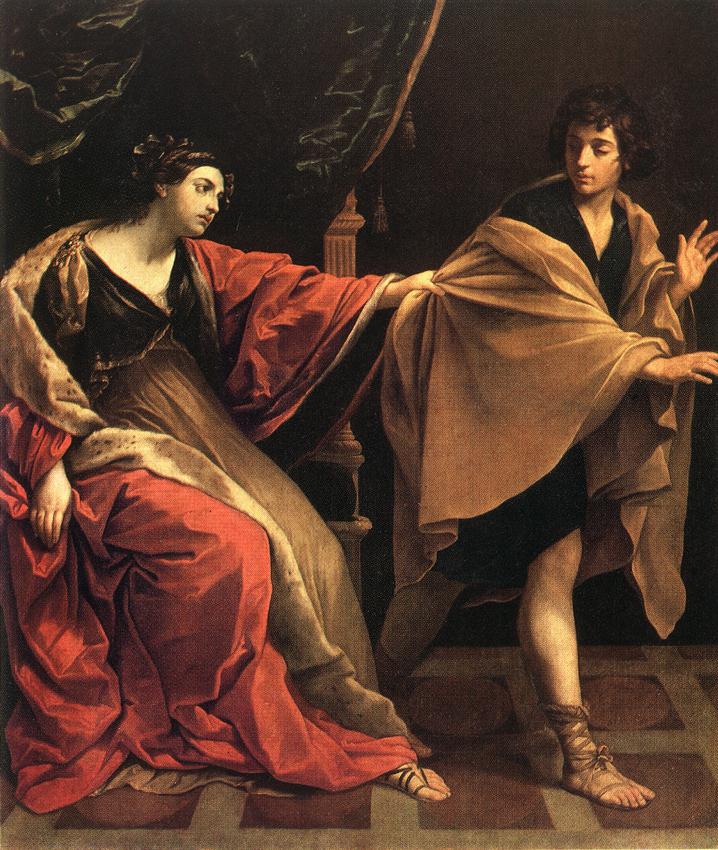
Mrs. Potiphar snatched his cloak and makes up a rape accusation, telling everyone.  This is the first such accusation in recorded history, the ancient Egyptian #Me Too.

To Potiphar’s credit, he doesn’t believe her.  We know because the punishment for rape in the ancient world was the sword (see Rape, murder. It’s just a shot away. The abduction of Dinah).  She keeps telling the story and it gets embarrassing, so Potiphar puts Joseph into jail to get his wife to shut up (39:20).

Acting the Harlot vs being a harlot

Our sages teach that the episodes of Tamar with Yehuda and Mrs. Potiphar’s attempt to get with Joseph are placed side by side in the Torah for a reason. In truth, both women were trying to fulfill divine destiny.

Mrs. Potiphar had seen through some form of prophecy that her family and Joseph would become connected and have children.  In truth it was Mrs. Potiphar’s adopted daughter Asnat who would later marry Joseph (41:45).  Asnat was actually the daughter of Dinah and Shechem. Being the product of a rape was so embarrassing to her and Dinah that she went to Egypt.

However, even though she meant well, we understand that Mrs. Potiphar’s motivation were also selfish.  She wanted intimate affection that her husband was not oriented to provide, and Joseph was the alpha male of the household, young and physically attractive.

It was not just a spiritual itch she wanted to scratch.  We can’t be too hard on her, she was the product of an extremely decadent and promiscuous society that had normalized open marriage and the sexual abuse of slaves.

By contrast, the Tamar and Yehuda story does not mention Yehuda’s appearance once.  We find out much later that he was strong since he was ready to fight Joseph and all of Egypt if needed (44:18), but we never know if Yehuda was handsome.  The narrative never mentions if he was physically attractive because it was not important to Tamar.

What Tamar wanted was to join Yehuda’s family and fulfill the divine plan by bearing children to be Yehuda’s heirs and fixing the spiritual damage caused by Er and Onan.  Her motivation was for the group, the tribe and to help Yehuda’s own mission.

She came before Yehuda as an anonymous harlot, the lowest on the social ladder; it was not for her own grandeur that she seduced Yehuda, it was for him to fulfill his destiny as leader to his brothers and progenitor of kings.

More importantly, Tamar went out to Yehuda – she wanted to live in his world, within his frame, and be part of his holy family.  Despite years of sitting as a widow waiting for her chance, she never demanded her right from Yehuda.  Tamar was not pulled by her own physical pleasure or hypergamous instinct to lock down an attractive man.  She never tries to lock Judah down.

Therefore, Tamar, who pretended to be a harlot, was worthy to be the great grandmother to royalty.  By contrast, Mrs. Potiphar, while she had a misunderstood spark of divine inspiration and motivation, tried to act on this noble desire in an unseemly and selfish manner.

First she tried to lord over Joseph by virtue of her wealth and social standing and pull him into her frame.  When that failed, she tried to act like a harlot, then invented the world’s first rape accusation when she couldn’t get her physical desires met.

After these sub plots, both Yehuda and Yosef are changed.  Their experiences with these special women have taught them the dangers of power.  Joseph knows now that leadership is not just a child’s dreams but has real risks, and that power and status must be displayed amd used with proper tact.  Yehuda has learned about brotherly responsibility through Tamar.  They are both ready to become kings, as we shall soon see.

You don’t have to be Jewish

I’m in a strange place.

keyb (3)

I am writing for a Jewish audience, yet aware that chances are, many of the actual readers online will not be Jews. I write about certain areas, especially intersexual dynamics (how men and women get together), that are somewhat taboo to openly discuss in Orthodox Jewish circles. We all know what goes on between men and women but it requires special sensitivity and the proper situation to talk about it.

The “Red Pill” approach to relationships and masculinity is also considered politically incorrect to liberal Jews. The more liberal strains of Judaism have been largely compromised by feminist and secular values, and no longer value conventional Biblical depictions of masculinity and family.

The Red Pill approach to spirituality is relevant to religious people of any denomination. There is spiritual energy masked behind physical existence, that humans can tap into and use. Most men, most of the time, ignore the spiritual development of our lives. This idea too is not commonly discussed even among religious persons, let alone in the wider secularized society.

But these “Red Pill” approaches to life are useful. They work: you get better results when you start living with your eyes open, discard the limitations of external conditioning, and change your actions to succeed in the world as it really is.

One thing I do want to make crystal clear is that you don’t have to be Jewish. You can make use of Jewish tools, ideas, and wisdom without becoming Jewish. In fact, if you go to a Jewish rabbi and ask to convert, he will talk you out of it.

Jews don’t have the Christian concept of evangelism or spreading the gospels, not the Muslim propaganda of Dawah to convert nonbelievers. Nothing I write is to encourage you be Jewish. You would have to be a little crazy to want to become Jewish, we are the most hated and persecuted people in history. To this day, Jews can get (God forbid) attacked, ridiculed, and murdered for nothing more then being Jews. Also, no more bacon if you go Jewish.

The Bible does have a concept of the Seven commandments for the children of Noah. These are basic moral expectations for every descendant of Noah, i.e. every human, not just Jewish ones. These are: do not worship idols, curse God, commit murder, adultery or sexual immorality, steal, eat flesh torn from a living animal, and do establish courts of justice for a just society. Chabad has more background. Jews have these seven plus 613 more commandments specific for Jews.

img_20191207_195016.jpg

Establish courts of justice

I am not writing to influence you, but why am I writing?
On a personal level, as an American and a Jew, I appreciate and honor what Americans have accomplished historically.  America, despite all its problems, is still basically a free and just society. The founding fathers of America, when they set up our government, used certain universal concepts from the Hebrew Bible, including equality under the law. They wanted America to become a “shining beacon on a hill” (shining city for Reagan fans) to show the rest of the world the ideas of freedom and self governance.

That attitude mirrors the Jewish concept of being an example of holiness and proper conduct to the wider world. This idea is expressed in the prophet Isaiah 42:5-9 and 49:6, where Jews are called to act as “a light for nations”. Deuteronomy 4:5-6 has a similar concept.

Intellectuals among the founders of the USA were especially interested in the Hebrew Bible and our Prophets as a source of social and political ideals.  There was even some discussion by Ben Franklin about making ancient Hebrew the official language.

Moshe Feinstein, a European rabbi who escaped to America and became one of the greatest figures in modern Jewish law, made this comment about politics and freedom in the ominous year of 1939:

Every superstition and every nonsensical opinion in the world claims to bring light to the world and creates beautiful things to deceive and win over adherents. However, since many do not espouse them, they compel anyone they can, with sword and spear, to adopt their views.

This is true in all times, with respect to both matters of faith and matters of ideology, past and present, and especially in Russia and Germany … Ultimately, all that is left is wickedness, not the ideology it was fashioned to support; what need do they have for it once they have swords and spears? … In the end, only the sword and spear remain, while the light is completely extinguished, as we see in the extremes of Germany and Russia…

It thus emerges that no national regime may espouse a single system of beliefs.  Rather, it must only serve its function, which is to see that no one perpetrates injustice against another, steals, or murders, for if not for the fear of the regime, people would swallow one another alive. However, with regard to opinion, religion, and speech, everyone shall be free to do as he wishes.

Therefore, the United States, which established in its Constitution 150 years ago that it will not uphold any faith or any ideology, rather, that each person shall do as he desires, and the regime will see that people do not molest one another, is carrying out God’s will. It is for that reason that they have succeeded and become great in our times.

(Darash Moshe, Vol. I, pp. 415-6)

America was rightly seen as the exception to states that sanctioned their official ideology to the exclusion of all others.  In later works, Rav Moshe called America medinat hahesed “the land of kindness”, for allowing religious freedom. For Jews who escaped the situation in Europe, where there was a long history of state sanctioned religious coercion and discrimination, this is an immense kindness.

In my opinion, because America valued religious tolerance and equality under the law, there was a special divine favor granted to America. Since America was the land of the free, people who were oppressed sought to move here, and took a special pride in their new native land.

America did not demand that immigrants to become something else in order to join. You could be both Irish and American, Jewish and American, Chinese and American, atheist and American. This made it was easy for newcomers to become patriotic citizens. Freedom and tolerance leads to proud and productive citizens. Otto von Bismarck said: “God has a special providence for fools, drunkards, and the United States of America.”  If you study American history with an open mind, you will see this for yourself.

Enjoying the decline?

IMG_20191129_145828

I also have an awareness that America is in trouble in many areas, especially in intergender dynamics. The causes are many, the results are more divorces, fewer and later marriages, less children, more in single parent homes, more damaged souls.

There is a stark contrast between many secular people I know, who were not seriously interested in marriage until close to age 30, and Orthodox Jews, who are almost always married with children by 30. The divorce rates are also vastly different. Maybe there is something that conventional Jews are doing right in their relationships that can be extrapolated to the broader American society. Maybe the Torah itself, the Bible, has some relevance for modern men looking for a fulfilling romantic life. Maybe I can help somehow.

There are many who say “Enjoy the decline”, and assume the fall or slow rot of America as we know it is inevitable, or those who espouse men to Go Their Own Way (MGTOW). I understand these sentiments. Admittedly, since I am a member of a religious minority, and spend much of my time around my fellow conventional Jews, I don’t experience the full depths of depravity in modern secular society.

But I am not isolated from the mainstream culture. I know there are serious issues. There are also times when Orthodox Jews end up in the same predicaments as anyone else (and tell me about them). Then there are the statistics, that the USA leads the world in divorce, in single parent households, in juvenile delinquency and incarceration.

Statistics alone don’t tell the full story. I have met many, Jewish and not, and heard personal stories that point to fundamental systemic problems in families and in male-female relationships in this country. Sometimes I walk into a room full of young Orthodox Jews who, busy with full time Torah learning, are more insulated from the wider culture. I feel the “I’ve seen things you people wouldn’t believe” sentiment.

Back to our hypothesis that the USA historically enjoyed divine assistance because America provided equality under the law and thereby became a haven for the free expression of religion. John Adams famously wrote about the constitution: “Our constitution was made only for a moral and religious people. It is wholly inadequate to the government of any other.”

Today’s American mainstream culture tolerates and accepts as normal moral abominations and open insanity, and despises the free expression of religion when that expression conflicts with designated victim groups endorsed by the elites and media. It could be that in our generation, some of the ingredients that invoked divine favor for America are missing. Friends, we’re a long, long way from John Adams and Otto von Bismarck.

Now we are in an era when the federal government told public schools they must let men who identify as women into the girls’ bathroom; when bakers are forced to decorate a cake for a wedding they believe is not a wedding, or lose their business and reputation; when freedom of speech is only allowed at the whim of the easily offended; when women’s athletic records are broken by men pretending to be women; when professional psychologists insist masculinity itself is dangerous to mental health. Why would God want to save such an upside down backwards culture? Maybe it is too late.

But there is always hope. You can’t save everyone. But you can try to help those who will listen. God gave each person free will. All of us can raise ourselves to sublime heights, barely lower than angels, or lower ourselves into the depths of hell, one free choice at a time.

Certainly we can reach out to people who are trying to make a better life for themselves and their families by living life with eyes open, trying to understand the dynamics at play, be they sexual, financial, or spiritual. I feel that if there is a chance I can help someone, I should try to help. At the end of the day, it’s God who will decide the fate of the USA and every individual here.

IMG_20191212_152003

The People of the Book and You

When God made the Jewish people into the People of the Book, He already knew that the Book was going to become the bestselling book for the ages, for all humanity. God asked us Jews, right before giving us the Torah, the Book, if we would be a Kingdom of Priests and Holy Nation (Exodus 19:6).  We agreed to this mission.

Our commentators explain the use of the word “Priests” in this context. Not every Jew can be an actual Priest (Cohen), as that role is reserved for the sons of Aaron.  Ibn Ezra says it means we are “servants”, while the Sforno says it means “teachers”. So Jews, in relation to the wider world, can function as examples of holiness, or servants, or teachers. Or fill all of these roles in a certain sense.

So, if you are not Jewish, thank you for reading, and remember that I’m not trying to get you interested in becoming Jewish.  I hope you can glean something useful to your own life. God calls the Bible “Torat Haim” which is literally “The instructions for life”. It’s an instruction manual for man written by the One who designed mankind.

The Bible contains key concepts that can help men and women have healthy romantic and sexual relationships. But the Bible has actionable wisdom for every area of your life, as I hope to explain. You don’t have to be Jewish to use it.

Is our sister a harlot? The abduction of Dinah

Jacob left the Holy Land with nothing, then spent over 20 years in Haran with his uncle Lavan.  In this week’s Bible portion (Vayishlach, Genesis 32:4–36:43) he returns to Israel with vast flocks, two wives, two concubines, eleven sons and at least one daughter.  Some ancient sources explain that Jacob’s family did have more daughters, but only Dinah is named due to her importance.

genmap

Jacob was away from his own parents and from the Holy Land for so long in part to effect a profound change in his wives.  Jacob’s mother Rivkah (Rebecca) insisted that he not take an idolatrous woman (Genesis 27:46) and his father Isaac instructed him specifically: go to Padan Aram to the house of Bethuel your mother’s father and take from there a wife for yourself… (28:2).

The phrase “for yourself” seems extra, so is “from there”.  We already know Jacob is going to get a wife for himself, and Isaac already told him where.  There are no extra words in the Bible.  Every letter has meaning.

These words teach us that Isaac instructed Jacob to make sure that any wife he marries will be loyal to Jacob himself and no longer attached to her father’s household.  The proper wife for Jacob needs to be “from there” but no longer feel that she belongs there.  Isaac says she needs to be “for yourself” as in wholly for you, Jacob, and no longer loyal to her family of origin.  This is incredible wisdom for men.

The typical pattern in a healthy family is that even after the daughter gets married and moves away, she returns to visit her parents.  Even if she does not live close by, even once she has her own children and grandchildren, she still has the desire to spend time with her own parents.  That is expected for a normal young woman who had a positive and supportive family experience growing up.  Daughters have a lasting bond to their parents.

However, Isaac knows that in his time there are no truly healthy families.  Practically the entire world, except for the small Jewish tribe, was serving idols.  Along with the idolatry was loose morals, theft, child sacrifices, bestiality…

It was a world of moral relativism, each person doing what their idols allowed.  Or behaving however they felt and then claiming their gods required or encouraged it.  Polytheistic religion was based on justifications and emotional manipulation, until Abraham’s logical approach.

Isaac is aware that a woman still connected to an idolatrous family will not be able to help Jacob build the next generation of the Jewish tribe.  The best bet for Jacob to find a proper wife was at the house of his mother’s brother, the household where Rebecca herself came from. We discussed how Rebecca was special, with a high degree of modesty that protected her from the idolaters around her and made her fitting for Isaac. 

Isaac is aware that his wife’s brother Lavan was a cunning idolater, he was told that by Eliezer the servant of Abraham.  Jacob’s task in Haran will be to detach his wife from Lavan’s influence and her entire cultural framework of polytheism and relative morals, and then attach her to his mission of monotheism.  Not a simple process when the entire world was steeped in idolatry.

Reverse Dowry

From a simple reading of the Bible, we may assume that Lavan, the trickster, duped Jacob in working for seven years to marry Rachel, then after switching in Leah, forced Jacob to work another seven years for his two wives.  Not only did Lavan not give Jacob a penny for dowry, he had Jacob doing arduous work as a shepherd for his daughters, but did not give any of the profits to Leah and Rachel as dowry or wedding gifts.  This was in effect a reverse dowry.

After the 14 years, Jacob and Lavan go into business as partners, with Jacob responsible for the flocks and only getting spotted, specked, or striped (abnormal) sheep and goats as his wage.  During the six years of supposed partnership, Lavan changes the terms over and over to cheat Jacob (31:41).  We see Lavan is greedy.

However, it was Jacob himself who suggested a term of seven years of labor to marry Rachel.  Why was he willing to work so long?  I propose that Jacob thought that would take this long to ensure that Rachel was not under the influence of Lavan and idolatry.  We will learn later that seven years is a complete cycle, the seventh year is a Sabbatical year and freeing of slaves.

In reality, Jacob was not a sucker who trusted the mischievous Lavan (29:12, Rashi, and Genesis Rabbah 70:13).  The hard work he did for Lavan, with Lavan keeping all the profit and not sharing any with his daughters, was to demonstrate to his wives that their father was not treating them as family but as chattel.

Jacob was willing to stay on another six years building up his own flock of speckled animals in order to prove to his wives that he is generously providing for the family.  This set up a stark contrast to Lavan’s greed of taking away a dowry that should have been theirs.  After the 20 years of work, Jacob tells his wives the situation, that Lavan and his sons are no longer friendly to him.

Rachel and Leah now realize that Lavan has no interest in them as people, that he used their marriages to extort work and profit from Jacob.  They tell Jacob that there is nothing for them in their father’s household anymore (31:14-16).  Jacob succeeded in following Isaac’s directions to take his wives “for himself” away from there.  They are no longer loyal to Lavan at all, since Lavan has displayed his true greedy nature.

They no longer feel that there is any benefit for them to remain in Haran, in an idolatrous society.  They are “from there” but no longer feel that they belong there.  The wives and concubines are fully in the camp of Jacob, of monotheism, and are now ready to accompany him back to the Holy Land.

IMG-20191204-WA0001

For modern men, it is crucial to understand that women (yes, men too, but especially women) are profoundly influenced by their families of origin, friends and the general society/culture they are in.  You can tell so much about a woman by observing how her family and friends act.  Any person is the average of the people they spend the most time with.

In previous generations, and today in very traditional families, this is a woman’s family.  The Torah teaches us to evaluate a potential wife by her brothers (Exodus 6:23 and Masechet Sofrim 15:10).  In the Biblical society it was quite rare for a woman to be regularly interacting with men outside her family, but her brothers would be accessible to a suitor looking to understand the character of the woman.  A wise man would investigate the family to understand the nature of their sister.

Today the nature of women has not changed, but our culture is radically different.  A young woman, depending on her phase in life, may have little apparent connection to members of her biological family.  But usually played the main role in her psychological development.  The girl with “daddy issues” (usually an absent father) is a cliché in modern secular society.

Parents who are present can also cause severe damage.  If a woman you are interested is close to her parents and siblings, that is an opportunity to ask about them and learn indirectly about her own character.  If she distances herself from her family of origin, that is also relevant to you.  Find out why.

Friends are another huge influence.  If a young woman hangs out with a certain crowd, you can extrapolate her likely behavior based on what that social circle does.  If those people get drunk and get tats, this girl has a very good chance of doing the same eventually.

Yes, every individual has free will and makes their own choices.  But we know from life experience that so often those choices are heavily influences by the people around us.

If you are interested about a woman, find out about her friends and the company she keeps.  For yourself as well, it is vital to spend your time with positive people who are focused on personal growth and learning.  The Torah teaches us that despite your innate individuality, your environment, family, and friends make a huge impact on the development of your personality.

IMG_20191126_151004


Fateful encounter, missing daughter

In Genesis 32, Jacob finally returns home, only to have his estranged brother Esav come towards him with an entourage of 400 armed men, seemingly to get revenge for Jacob stealing the firstborn blessing.  In preparation for the encounter, Jacob sends lavish gifts, prays, and prepares his family to fight if needed.

When they finally encounter Esav and his army, Jacob bows to his brother, they hug, and Esav cries, seemingly reconciled with his brother.  Then Jacob introduces Esav to each of his wives and sons (Genesis 33).  Missing from the list is Dinah, daughter of Jacob and Leah.

In preparation for the meeting Jacob had hidden her, thinking that if Esav sees her beauty, he will become interested in taking her as a wife.  As we have seen, marrying within the family was common in that time.  Jacob is fully aware of the power of family and society over women, having successfully freed his wives from the influence of their idolatrous family and society.

Jacob wants to protect young Dinah from becoming corrupted by Esav, knowing that Esav is a strong and powerful man, and power is attractive (Jacob himself calls Esav powerful, Targum to 33:10 is “ravrevei”).  Jacob understands that if Esav takes Dinah, she will be seduced and corrupted by his aggressive power and influence, he does not think that Dinah would be able to change Esav for the better.  However, our sages teach that Jacob was mistaken, and Dinah’s ultimate fate will be worse…


The rape of Dinah and Stockholm Syndrome

In Genesis chapter 34, Dinah goes out to see the local girls in the city of Shechem.  Our ancient Medrash Aggadah learns that she went out to show her own beauty as well, while Pirke dRebi Eliezer teaches that Shechem, the prince of the city, brought out the girls of the city to dance and make music, which lured Dinah there.

Both interpretations could have validity, and our sages point out that her mother Leah was also described as going out (30:16), and quip like mother like daughter (Breishit Rabbah 80:1).  Dinah’s readiness to display herself, learned from her mother, and the lure of fresh excitement, music and dance, brought Dinah to Shechem.

The prince of Shechem, named Shechem son of Hamor, saw her, took her, lay with her, and afflicted her (34:2).  This was clearly an aggressive abduction and rape.  Our sages also teach that the order of words here is important.  Obviously if he raped a virgin that would afflict her, so why does the Bible add “afflicted her”?

After he lay with her he, then “afflicted her” also means that after he had seduced her, he then withheld additional affection and intimacy from her, which she now wanted from him (Talmud Yoma 77b, Torah Temimah from Bereishit Rabbah).  Once he had taken her, Dinah fell for her captor and wanted his love and commitment.

The Torah is teaching us about what is known as Stockholm Syndrome, in which kidnapped persons, especially women, begin to sympathize with their captors.  Some even become romantically attracted to them.  They may join cause with the very terrorists who are attacking their society.  The Rational Male has a discussion about this.  Dinah was the first recorded victim of Stockholm Syndrome.

When her brothers hear about the rape, they take calculated action.  They tell Shechem, who comes to Jacob to arrange marriage with Dinah, that he and his city must undergo circumcision to be eligible to intermarry.  Shechem agrees and circumcises himself immediately.

Shechem and his father, the king, persuade the men of Shechem to get circumcised in order to intermarry with Jacob’s people, telling them that they will overwhelm Jacob’s small tribe and take all their women and wealth for themselves (34:23).  The men agree, greedy to absorb the tiny Jewish tribe.

While the men of Shechem are recovering, Simon and Levi, full brothers of Dinah, attack the city and kill out every man.  This radical resposne was justified as not a single man among them had objected when their prince had violently taken Dinah and raped her, though they saw the crime and heard her screams.

Massacre of the Hivites by Simeon and Levi

The First Alpha Widow

When her brothers come to rescue Dinah, she does not want to leave (Medrash Bereishit Rabbah on 34:26).  This hints to another profound psychological consequence of Dinah’s abduction.  After Shechem, she has traits of what is called an Alpha Widow.  Shechem, the rich and powerful prince, aggressively took what he wanted: her.

He displayed classic alpha dominance, decisiveness, and confidence.  No doubt he had done this with other girls before, since as the prince he felt entitled to take her, and was sure that his countrymen would not try to stop him.  The Medrash tells us that Dinah fell for this powerful man and did not want to leave his side, even after her brothers took revenge for his crimes.

Dinah was the first Alpha Widow, a woman who dwells on the memory of a prior lover, a man she feels was the best she could get.  Having experienced Shechem exercise his dominance, she may have felt that she could never get a man as strong and powerful as Shechem.  Dinah is also aware that after being assaulted she may be considered less valuable as a wife, and fears she may never be able to marry at all now that Shechem is dead, let alone marry a man on his level.

Shechem too became infatuated with Dinah, and seduced her with promises of marriage and the luxurious life of being princess and queen (34:3).  Shechem was ready to make a dowry at any price (34:11-12) and then circumcised himself immediately to win her hand in marriage (34:19).  He appears totally infatuated with Dinah during the negotiations with Jacob.

Dinah had something special that the other girls never had, which changed Shechem.  Probably Shechem sensed that there was a deeper spiritual and emotional wealth inside Dinah compared to the girls he had seduced so far.  Likely she was more modest and restrained, making for a more difficult conquest.  This challenge may have made Shechem more romantically interested in Dinah than his prior conquests, who were probably more willing to give themselves over to the rich powerful prince.

At this juncture Dinah feels that she had tamed the beast that is Shechem, causing him to temper his bad boy ways and plan to settle down with her.  This is an ego powered fantasy of women, the belief that she is able to tame a wild dominant man with her femininity and lock him down.  This challenge of taming the beast is one of the reasons girls are thought to be interested in “bad boys“.  Dinah, the daughter of our holy patriarch, raised with an acute awareness of the spiritual forces in the world, actually had this ability.  We see this in Shechem’s dialogue with her brothers.

Jacob had thought that if his brother Esav saw and married Dinah, she would be totally lost to his power.  Our sages in the Medrash (Genesis Rabbah 76:9) state that Jacob was mistaken, and the rape of Dinah was the consequence of his mistake.  Jacob did not realize the true power a woman may have over a man, even a dominant alpha male.

While Dinah was emotionally lost to Shechem as an Alpha Widow and victim of Stockholm Syndrome, she had tamed him.  Dinah was the first girl Shechem the rapist prince actually wanted to settle down with.  While Jacob was correct that Esav would have changed Dinah, he did not realize Dinah would have had influence over Esav too.  Our ancient sages, aware in retrospect of Dinah’s unique power, point out Jacob’s mistake.

This Alpha Widow complex, on top of her Stockholm Syndrome, led Dinah to feel like she would never be able to get a better man than Shechem son of Hamor.  This adds another element to the outrage her brothers felt over her abduction and rape.  Now they need to rescue her not merely physically but also emotionally.

For modern men in secular social circles, you will meet women who have some degree of fixation on a past love, the “one who got away”.  Often this was a powerful man she thought she could tame or lock down; a man who made a big impression on her, even if they were only together for a short time.

The more romantic partners a woman has woman been with, especially at a young age, the greater the chance of her developing these feelings.  The Alpha Widow will always measure you against an idealized past lover.  This is a clear disadvantage for men who come after (you), and the danger may be difficult to recognize.  If you notice these traits in a woman, read The Rational Male’s essays on the Alpha Widow.  (Warning for Jews, that site has adult language and content).

This aspect of female psychology will be rare within strict religious, especially Orthodox, circles.  Thank God, the young women in more religious groups are simply less exposed to the experiences that could increase their chances of getting this complex.  Jewish law makes it difficult for unmarried men and women to spend time together, for good reason.  But this topic is something to be aware of.

As our father Jacob knew, it only takes one deeply emotional experience with a powerful alpha male to make a permanent impression on a young woman.  If a potential shidduch (match) has a past, you will need to ask subtle questions to discreetly elicit information about her prior romantic interests.  She may be trying to hide or minimize her experience.

If you are checking references and talking to her friends, pay close attention for hints about her past.  You don’t want to end up competing with another man, who is now not even a real man but idolized and enshrined in her heart.  You would always be at a disadvantage since the past is idealized in her mind.

Jacob’s return home after 20 years of weaning his wives away from their idolatrous family of origin reminds us that women can be subject to tremendous familial and social pressures that mold her identity.  The Bible teaches us that a woman’s family and her chosen peer group allows us the chance to learn about her.

The heinous abduction and rape of Dinah, and her reactions give us deep insight into a woman’s psychological response to intense stress, and her ongoing attraction to an idealized alpha lover that she lost.  We learn that the concept of Alpha Widow is not a recent phenomenon.  The Torah instructs us in this wisdom to help us understand our relationships and improve our lives.

Kosher Polygamy, part 2

In Kosher Polygamy we discussed some of the Biblical and Rabbinic sources about polygyny, a man married to multiple women, and how our history of polygyny affects modern Jewish society and dating.  Read that first.

1*wvTFFf61-UO6_qLUAuOdCw

You read that polygyny is extremely rare, which implies that it does still exist among modern Jews.
Yes, that’s right.  We are now going to delve into some the legal issues regarding polygyny as practiced today.

This will get technical, we will keep this simple and brief because I am not an expert and there are volumes of material on this topic, especially in Hebrew sources.  [Caveat for Jews: I am not a Posek and this post is not issuing any legal/halachic ruling.  We are just exploring the issues.]

As we saw in Kosher Polygamy, since ancient times polygyny among Jews was legal, safe, and rare.  European Jews in Germany made a temporary edict against polygyny around 1050 years ago, called the Herem of Rabeinu Gershom after the leading Rabbi of the city, Rabeinu Gershom.

Some sources explain the reason for this injunction was as a response to a local Christian ban on polygyny (polygyny among Christians actually continued in some places throughout the middle ages).  Since their Christian neighbors had banned polygyny, the Rabbinic court of Rabeinu Gershom did likewise to prevent jealousy against Jews, according to the Emet leYaakov (Yakov Emden).

With the ban there was an exception, called “heter meah rabbanon”, which would allow a man to marry a second wife when 100 rabbis agreed.  This was used in cases where the wife had become mentally incapable of accepting or understanding a writ or divorce, which would leave the husband stuck caring for his sick wife but without the benefits of having a functioning wife.  There are a few other exceptions, as we will discuss below.

We don’t have the actual text of the Herem of Rabeinu Gershom, but many sources state that it was meant to be temporary, until the end of that millennium in the Jewish count (year 1240 of the common count).  The Beit Yosef (Responsa Beit Yosef, dinei ketuvot no. 14) states that the scholars who said that after 1240 that the decree was still in effect were only doing so because they were unaware that it was issued on the condition that they only lasted until the year 1240.  The Shulhan Arukh (Even Ha-Ezer 1:10) states that the decrees are no longer in effect.

In any event, when the ban was effective it would have applied by force of law only to the area in Germany were the Rabbinic court of Rabeinu Gershom had jurisdiction.

To each their own

Jewish law has a concept of respecting local customs.  When there is no clear law otherwise, we allow communities to adopt their own customs and for local rabbis to decide for their own people if those customs are binding (see Talmud Pesachim perek makom sh’nahagu).

Rabbi Moshe Feinstein, a major figure in modern American Jewish law, explains that a custom is binding on a person if it was a custom of the residents of that city which they were keeping based on the approval of the sages of that city.  However, a single individual, even the Gadol haDor (greatest sage in the generation), is not able to create a custom that will have this status to obligate others, not even those in his own domain. (Igrot Moshe, Even haEzer Chelek 4, siman 100, seif 4).

In short: To each (place) their own (customs).

However, it became accepted as custom to follow the ban of Rabeinu Gershom not just in Germany but in many European Ashkenazi Jewish communities.  Understand that a custom is not the same level as a real ban, but Jews are very fond of traditions and customs.

The Rema, writing from Poland, states that the custom there was to continue to follow the ban after 1240.  Later Ashkenazi sages reiterate that the ban is in effect, as a matter of custom (Pishei Teshuvah, Even Ha-Ezer 1:19).  This ban had the force of local custom wherever it was accepted (Shulchan Aruch Even Ha’ezer 1:9).

The ban of Rabeinu Gershom was never accepted by Sefardi, meaning Spanish, Jews (the Rashba attests to this), or in the other Jewish communities outside Europe.  Sefardi or Sefardic refers specifically to Jews descending from those who lived in Spain and Portugal prior to the Spanish Inquisition.  Sefardi or “Mizrahi” meaning Eastern, is also used to include Jews of Middle Eastern, Asian and African origin.  There are also distinct customs among Italian and Yemenite Jews.  As a shorthand, we refer to all Jews from outside of Europe as Sefardi.

Geographic map

The law of the land is the law

In America today, polygyny would be technically forbidden under Jewish law as Jews are subject to American civil law.  Jews are required to follow the civil law of the land they reside within, a concept called “Dina d’Malchuta dina” (Talmud Nedarim 28a; Gittin 10b; Bava Kamma 113a; Bava Batra 54b and 55a).  So in America polygyny would be (for the time being) unapproved by Jewish law because it is banned by secular law.

If the civil law was changed, some Jews would likely assume that the Herem of Rabeinu Gershom should apply in America.  That is not a solid position.  The ban was never accepted by the majority of Jews or even the majority of Jewish communities.  It was binding as custom only in the few places where it was accepted.  The ban was never accepted by the sages of America, further, there is no such entity as the sages of America with the authority to bind all American Jews to follow specific customs.

America has Jews of every stripe, from every national origin.  Some Jews follow Rav Moshe’s rulings, others Rav Soloveitchik, Rav Shneerson, or Chacham Ovadiah Yosef…  There is no single source of binding custom on American Jews.  Rav Moshe makes the point that there is no “minhag hamakom”, no single body of customs of the place, for America.

If secular laws banning polygamy were changed, Jews, especially Sefardim, would be allowed under Jewish law to practice polygyny.  One can assume that the majority of Ashkenazi Jews (meaning Germanic but technically this refers to any non Spanish European Jews), would refrain from taking additional wives, even though technically they could do so too.

In a Muslim country or other area allowing polygamy, polygyny is already permitted to Jews under Jewish law.  I have heard there are Jews living in Indonesia or Malaysia practicing polygyny, but that it is rare.  Jews in Muslim countries may take multiple wives as allowed by those countries.  There are a few Jews still residing in Muslim countries, most of them fled from persecution decades ago.  The refugees brought their families to Israel, and existing polygynous families were tacitly accepted. These were mainly among Moroccan and Yemenite Jews. A notable Moroccan sage known as the Babi Sali brought both of his wives to Israel in the 1950s.

When I was younger, I studied with a rabbi of Moroccan descent.  His grandfather had been a merchant in Morocco who had taken two wives, one in each city he travelled between, and consequently had two families.  My Rabbi had very little knowledge of the other side of his family.  This was considered normal in Morocco.  I also heard from a friend that he spoke with an elderly Sefardi woman in Israel who was widowed when she had young children, and she said she was thankful to God that her co wife was there to help her with the kids.

In Israel, not so clear

In Israel, the situation is a bit more interesting, since the laws of marriage and divorce in Israel follow religious law.  A Jew must follow Jewish marriage and divorce laws, Christians follow their own religious authorities, and Muslims the same.  The state of Israel recognizes unions conducted outside Israel, some Israelis go to Cyprus for a civil union to avoid religious laws.

But a Jewish marriage inside Israel would follow Jewish law.  Israel made a law in 1951 officially outlawing polygamy, but it is well known that the authorities look the other way when Muslims, especially Bedouins practice polygyny.

Here is the wrinkle: the criminal law against bigamy was made with an exception to the ban on polygyny among Jews.  A man can apply for a second marriage when the Rabbinical court approves and the judgment was confirmed by the President of the Rabbinical Grand Tribunal.  These exceptions are if the wife was mentally incompetent to accept a divorce, refused to accept the writ of divorce, or in a case where the wife was unable to have children.

Jewish law indicates that if a man lives with his wife for ten years or more without children, he should take another wife to fulfill the commandment of Be Fruitful and Multiply (Genesis 35:11, Talmud Yevamot 65b–66a, Rambam Ishut Chapter Fifteen).  This is why our Matriarch Sarah suggested that Abraham take a concubine after ten years of living in Israel.

If the first wife does not want a divorce, she signs before the court that she agrees that the husband marry another woman and the court will give him permission.  When the state of Israel started, the law required a final decree of a Rabbinical Court of the Jewish Community, ratified by both of the two National Chief Rabbis giving permission for the subsequent marriage.

The National rabbinate was set up so one of the Chief Rabbis was an Ashkenazi scholar, and the other a Sefardi.  Apparently this did not cause any significant issue until the 1970s, when Chief Rabbi Goren took office and refused to approve permits for second marriages, where apparently prior Ashkenazi chief rabbis had approved permits.  The Sefardi Chief Rabbi at that time was Ovadiah Yosef, of Babylonian descent who had been chief rabbi in Egypt and in Tel Aviv previously.  He was strongly in favor of granting second marriages, as was always the Sefardi position.

I wasn’t around then, but apparently there were some major differences in both opinion and style between Chief Rabbis Goren and Yosef.  Eventually in 1980, Rabbi Yosef convinced the government to change the law to require only one Chief Rabbi’s approval for a second marriage.  He immediately approved all of the pending permits.

He writes about this in detail in his book on Jewish law, Yabia Omer, Even haEzer helek 2 page 310.  Rabbi Ovadiah Yosef, who is typically reserved and academic in his writing, is much more emotional and excited in this section, describing how with Divine assistance they changed the law and he acted instantly to allow these men to fulfill the Bible’s commandment to be fruitful and multiply.

Yemenite brotherhood

Another exception allowing a man to enter a second marriage is to fulfill the commandment of Yibum, what is known as Levirate marriage, from Latin “levir”, a husband’s brother.  If a man dies without any children, his brother is commanded to marry his widow, and they together create a child who will inherit and  continue the name of the deceased brother (Deuteronomy 25:5).

The divine commandment applies even when the living brother is already married (provided his first wife is not closely related to the widow).  However, for most communities the prevalent custom is for the brother to release the widow to remarry outside the family instead of taking her as a wife (Deuteronomy 25:7-10).


An exception is the Yemenite Jews who had the custom to continue to practice Yibum.  In Israel, there was a ruling by the Chief Rabbis in 5710 (1950), that all residents of Israel should no longer perform Yibum, “so it should not look like there are two Torahs” (R’ Herzog’s Heichal Yitzchak 1; Even HaEzer 5).  However, the Yemenite Jews wanted to continue their custom. 

When a Yemenite immigrant and his brother’s widow wanted to fulfill the commandment, as was the custom of their community, Rabbi Ovadia Yosef, then a judge in the Bet Din in Petach Tikvah, allowed it.  He wrote a strong defense of continuing the Yemenite custom (Yabia Omer 6, E”H 14).  In a sense, this ruling marks the beginning of the modern assertion of Sefardic legal authority in Israel, allowing Sefardic Jews to follow the rulings of the Shulchan Aruch, who was the accepted authority in Israel hundreds of years ago.

Polygyny by consent

The families in question are practicing Jewish polygyny by consent.  If the original wife does not want to stay married if the childless husband adds a new wife, there is nothing keeping her.  If a brother’s widow does not want to marry her brother in law as his second wife, she can refuse this as well.  Jewish law is clear that in these rare situations we cannot start a situation of polygyny without everyone’s consent.

As we mentioned in Kosher Polygamy, Jewish culture extols women like Sarah, Rachel, and Leah who put selfishness aside and shared their husbands for the greater good and to build the first families of the Jewish people.  Perhaps these first wives feel that they are stepping into that proud role that our holy Matriarchs exemplified.

These dramatic episodes of clashing Jewish and secular Israeli law are the signs of a subtle shift in the political-theological balance of power.  In brief, the government of the State of Israel has been historically more inclined to go along with European Ashkenazi customs in religious matters.

This is even though there were many Sefardi Jews living in Israel prior European Jews returning in the 1800s, even before the settlement by the Talmidei haGra.  Some Jews, despite the many attempts to exile them, never left Israel.  Their descendants were still living in the Holy Land and practicing Sefardic customs before the modern State of Israel was a twinkle in Herzl’s eye.

However, the self government that evolved into the modern state in Israel was dominated by the European Jews, and they tended to place Ashkenazi Rabbis into power.  After the influx of Jews from Arab countries and Ethiopia, the Ashkenazim are actually now the minority group (slightly).  Most Jews in Israel today are Sefardi/Mizrahi.  I’m not well versed in the politics, but we saw the Sefardi Jews begin to assert themselves with electing the Shas party in the government, with the support of Rabbi Ovadiah Yosef.  There has been some shift of political power reflecting the population.

Politics aside, on a religious level it makes sense to accept the Sefardi opinion in Israel, or at least not to prevent Sefardim from continuing their customs.  The Shulchan Aruch, the major code of Jewish law, was written in Israel and accepted by the rabbis of the land as binding law on the land of Israel.  Rabbi Ovadia Yosef (Yabia Omer 7:2) wrote that Sefardim follow the rulings of the Shulchan Aruch, and there is no need to heed the decree of Rabbeinu Gershom.

However, he adds that a common custom is for the marriage contract (Ketuvah) to include an explicit oath that it is forbidden for the husband to take a second wife.  (This oath is binding unless one of the exceptions comes to apply, so if the groom had known that would happen he would never have made the oath, so it was never valid).

In America, the marriage contracts I have seen do not have this oath, as most American Jews are not even thinking about adding a second wife on their wedding day.  A friend of mine married the daughter of a Moroccan man, who added the oath (“shavua hamura”) in the marriage contract.  This shows that in even in America, Jewish polygyny is not forgotten, it occurred in living memory and still does occur outside America.  If polygamy were legalized under secular law, there would certainly be some religious Jews who would endorse and practice polygyny.

As we concluded in Kosher Polygamy, Jewish polygyny casts a long shadow on our current social life.  The knowledge that a man could, technically, marry more than one wife profoundly changes the mindset of our young people when dating, and acts as a sort of inoculation for a man against becoming obsessed with one specific woman.  Under Jewish law, polygyny is still lingering just offstage, ready to return when the conditions become favorable.

Rachel and Leah, the first Sister Wives

We already asked the big question: Are Jewish women different?

We have started to answer that based on the Bible and ancient Rabbinic sources, and explained how Sarah’s struggle to overcome her innate hypergamy was crucial in creating The first Jewish family.

Perhaps the greatest example in the Bible of overcoming hypergamy is the story of sisters Rachel and Leah, and how they become co-wives to Jacob and matriarchs to the Jewish people (Genesis 29).  Hypergamy as a social science term is defined as a person marrying a spouse of higher caste or social status than themselves.

In modern parlance, hypergamy refers to the innate goal of women to mate with the best specimens of men they can, and to marry the men who make them feel most cherished, secure and supported.  For a primer on hypergamy, see The Rational Male [warning, adult content and language on that site].

Any healthy woman naturally wants to reproduce with the fittest, most attractive, and highest status man available to her.  She is also wired from the factory to seek to marry the man who she thinks will be the best source of support and attention for long term security.

In modern secular society, in which the most biologically attractive mate for a woman is often not considered by her to be “marriage material”, we do not typically see one man fulfill both sides of this equation.  So women often make trade offs, for example settling for a less attractive man because he has greater earning potential.

In the generation of Rachel and Leah, a man who fits both sets of criteria comes to town looking for a wife from his mother’s family.  He is also the only staunch monotheist, and the recipient of a Divine blessing to father a great nation.  You can imagine how Rachel and Leah, from his family and living amongst idolaters, consider this opportunity.

Last week, we discussed why Jacob was The Leader for Generations.  He is a man of physical, intellectual, and spiritual might and determination, and was worthy to be Isaac’s heir to God’s mission in the physical world.

Jacob has also shown his commitment to Rachel, he works for seven years to earn the right to marry her, and he loved her so deeply those years flew by like days (Genesis 29:20).

Rachel now has her chance to marry not only the best man for her, but the best man then in the entire world.  She is about to fulfill her hypergamous desire in the optimal way by marrying the highest quality man anyone in her world could ever dream of.  And then something amazing happens…

IMG-20191204-WA0002

As background, Jacob, receives the primary blessing from Isaac to be his heir, then flees Israel as his brother Esav wants to murder him (Genesis 28).  At the urging of Isaac and Rebecca he goes to his mother’s family in Haran (in what is now Northern Iraq).  There Jacob, himself the younger twin to Esav, meets and falls for the younger twin sister, Rachel (Genesis 29:11).  He works seven years for her father Lavan, his mother’s brother, to marry her (Genesis 29:18).

On the wedding night, Lavan switches the older sister Leah in for Rachel (29:23).  This episode is the origin of veiling the bride at a wedding, which in this case allowed Lavan to sub Leah in for Rachel.  When Jacob complains, Lavan dodges responsibility, claiming that it was not allowed in Haran to marry off the younger sister before an older sister.  Then Lavan allows Jacob to marry Rachel after the week of wedding celebrations, but requires another seven years of work for her (reverse) dowry.

Jacob and Rachel knew that Lavan was an idolatrous trickster and might try this move, so in advance they arranged secret signs they would exchange on the wedding night to confirm her identity.  However, when Rachel saw that her sister was switched in to marry Jacob, Rachel had mercy on Leah, realizing Leah would be massively embarrassed when she failed to give the signs to Jacob and was revealed as an imposter.

To avoid humiliating her sister, Rachel gave Leah the secret signs.  Not only that, but our ancient sources explain that Rachel went into the bedroom and hid under the bed, and spoke to Jacob that night so he would not realize from Leah’s voice that he had been duped.

This means Rachel, after waiting seven years to marry her husband, the best possible man for her, witnessed and aided her sister becoming intimate with the man she loved.  She gave up her spot as the first wife, the first priority, to save her sister from shame.  This choice to act against her innate hypergamy has permanent spiritual consequences for the entire Jewish people, as we shall see, God willing.

Many of our ancient commentaries explain Rachel’s motives in sharing the secret signs as preventing public embarrassment for Leah (Rashi et al on 29:25, Talmud Megillah 13b).  I think there is also a deeper level as well.  I heard an amazing explanation that the secret signs were in fact the Jewish rules of marriage and intimacy, that Jacob had taught Rachel in preparation for their marriage.

When Lavan told Leah she would be the bride, Rachel told her sister “since you are about to get married, let me teach you rules and guidelines for marriage, what to do on your wedding night…”  What Rachel did not tell Leah, according to this interpretation, was the fact that she was Jacob’s intended bride.  Rachel did not let Leah know that the rules she was giving over were themselves the secret signs already arranged with Jacob.

According to this opinion, Leah herself was blissfully unaware that she was not Jacob’s wife of first choice, as the Torah later hints.  Rachel not only spared Leah from being rejected by Jacob, but never even clued her in that Jacob did not want her.  (The Medrash in Eicha Rabbah explains the pasuk Yesh sachar lfulatech like this).

This interpretation underlines the sheer power of Rachel’s act against her self interested hypergamy.  Not only was she sparing her sister from public shame, she saved Leah from the private internal shame of feeling like she was not first in Jacob’s heart.  [If anyone can tell me who came up with the pshat that the simanim were halacha please let me know, I heard it without attribution].

This was the polar opposite of hypergamy, the desire of a woman to lock down the best man she can get.  Rachel has already earned Jacob’s commitment, he worked seven years for her dowry.  They are simply waiting to marry and consummate their relationship.  Jacob realized prophetically when he first met her that she was destined for him, to help him create the Jewish nation.

Then, at the moment when Rachel is finally about to fulfill her seven years of desire for her husband, she lets her sister take her place, take the attention and affected she earned in Jacob’s heart.  This Jacob is not only the best man she could get, but the one man in the world most committed to God and the mission of monotheism.  He is the spiritual heir to Abraham and Isaac, the torch bearer for God’s holy mission in this physical world.

Jacob is a man with an eternal destiny, and the drive and passion to fulfill his destiny and create an eternal nation.  And whoever will become his wife will get to join him in the holy mission and birth the ancestors of the Jewish people.  She will be an eternal Matriarch to the timeless people.

Understand that at this moment Rachel does not know if her father will even let her marry her Jacob [the Torah later forbid marrying two sisters while both are alive, effective with the Sinaitic revelation].  Even so, she gives Leah the secret information to marry in her place, knowing that she may forever lose Jacob, her man.  And with him, her chance to join her man’s mission, to become a Matriarch, to become something eternal.

Do you feel the depth of Rachel’s spiritual victory?  She was able to put her sister’s potential shame above her own feelings of entitlement to Jacob, the man who loved her the moment he saw her, and above her own self interest and her own future.  Rachel overcame hypergamy.

When Rachel finally gets to marry Jacob as his second wife, she is unable to have children, while Leah has son after son.  The sisters knew through prophecy that these sons would become the tribes of the Jewish people, and that there will be only 12.  At this point, Rachel feel jealousy towards her sister, who already has four of the 12 (30:1).  This is not a petty jealousy, this is a desire to join her husband’s Divine mission and help Jacob establish the Jewish people.

Rachel takes a page from Sarah’s anti-hypergamy playbook (see Are Jewish women different?) and gives Jacob her maidservant as a concubine, to have children with that Rachel will raise (30:4). Rachel was willing to act as mother for another woman’s children with her husband in order to establish the Jewish nation.

Leah, even though she already had four sons, does the same and gives Jacob her own maidservant.  Abraham himself had only one wife, who gave him a concubine.  Now Jacob has two wives and two concubines, and all have given him sons except for Rachel, his original intended wife.  For background on polygyny, see Kosher Polygamy.

On one occasion, Leah’s oldest son gathered flowers, usually translated as mandrakes, which were thought to help with sexual performance and conception and brings them to Leah.  In an dramatic exchange, Rachel barters her right to her turn with Jacob that night for these herbs.

When Rachel asks for the mandrakes, Leah pounces: “Was it not enough that you took away my husband? Will you also take my son’s mandrakes?”
Rachel replies “Therefore he can sleep with you tonight in return for your son’s mandrakes.” (30:15).

From their conversation in the Torah, it sounds that Leah never knew that Rachel was the intended first wife, she sincerely feels that she was the rightful first wife of Jacob and Rachel the junior wife.  Rachel knows exactly what happened, and even at this juncture, after experiencing profound jealousy at Leah’s ability to give sons to Jacob, Rachel again conquers her feelings that Jacob was her husband, and keeps the secret from her sister (which fits the explanation in the Medrash).  You can imagine how a lesser woman, faced with this incredibly difficult test, might fold and reveal the truth to Leah.

Rav Hirsch explains that this exchange was not catty and aggressive, but light hearted banter, as the sisters had learned to share Jacob.  Every other commentator disagrees, and points out the intense emotions and pain of both sister wives.  Both Rachel and Lead had a valid claim to be his primary wife, and that feeling colored their exchange.

Rachel agrees to the trade, and Leah displays her desire for her husband (30:16).  That night produced a fifth son for Leah, Issachar.  This episode requires future exploration as a window into the desire dynamic].  For Rachel, she has again given up getting first priority attention and affection from her husband in order to join him in the mission of creating the Jewish nation.

Again, they knew prophetically there would be 12 sons for Jacob, so every time Leah or a concubine had a son, that was one less that Rachel would be able to have.  Not only that, but Rachel has swallowed her price and again kept Leah from feeling shame and jealousy.  This extra act of going against her hypergamy and giving up her rightful turn changed Rachel’s heavenly judgment, since she finally conceives.  The herbs were just a minute physical manifestation of the immense spiritual reward that Rachel earned.

Like with Sarah before, it took an act sharing her beloved husband, a difficult test of self sacrifice in opposition to hypergamy, to earn the right to be a mother to the Jewish people.  [There are deep reasons why Leah was not barren, the Torah states that God saw she was hated and opened her womb (29:31), obviously Jacob did not really hate Leah since he stayed married to her, and the Torah also says he loved Rachel more than Leah, meaning he in fact did love Leah.  Later, despite Rachel being Jacob’s intended wife, he calls both wives to the field to discuss leaving Haran.  A lesson here is that a woman can feel that anything less than 100% love is to her subjectively like hate.]

Rachel finally gives birth to Joseph, and since Jacob has a son from his primary intended wife he prepares to return to the Holy Land.  Jacob will upon return to the land of Israel fight with an angel and obtain the additional name of Israel.  On a mystical level, Rachel represents the wife of “Jacob” the individual and Leah represents the partner for “Israel”, the nation.  However, Rachel is more than just a wife and mother.

For the past 2500 years Rachel, even though she gave birth to only two of the twelve tribes, is called “Momma Rachel” by every Jew.  We commemorate her yahrzeit (date of passing) on the 11th day of the month of Cheshvan.  We even have songs and music videos about Momma Rachel.  Why is Rachel our “mother” and not Leah, mother of six tribes?

Rachel died in childbirth and was buried on the road to Ephrath, now known as Bethlehem. Jacob set up a monument on her grave.  This is the monument that is on Rachel’s grave to this very day (Genesis 35).  The other Patriarchs and Matriarchs of the Jewish nation were buried in Hebron.  Only Rachel was alone, Jacob buried her there, between Jerusalem and Bethlehem, by Divine inspiration.

Kever-Rachel1.jpg

Roughly two thousand years later (2500 years ago), the Babylonians invaded and conquered Judah and Jerusalem, butchered countless Jews, and sent many myriads into exile.  The exiles were herded out of Jerusalem towards Babylonia, on the same road where Rachel was buried.
And then Rachel came out to cry for her children, not just her genetic children, but the entire Jewish nation.  “A cry is heard in Ramah— Wailing, bitter weeping— Rachel crying for her children. She refuses to be comforted for her children, they are gone.” (Jeremiah 31:15).

The ancient Medrash Eichah, an explanation of Lamentations, explains that when Jerusalem fell all of the Holy Patriarchs and Matriarchs came before the Divine Throne to plead for their children.  With no answer.  Finally, Momma Rachel bursts out before the Holy One, blessed be He:

Master of the Universe, it is revealed before You that your servant Jacob loved me exceedingly and toiled for my father for me for seven years.  When those seven years were completed and the time arrived for my marriage to my husband, my father planned to substitute another for me to wed my husband for the sake of my sister.  It was very hard for me, because the plot was known to me and I disclosed it to my husband.  I gave him a sign whereby he could distinguish between me and my sister. 

After that I relented, suppressed my desire, and had pity upon my sister that she should not be exposed to shame.  In the evening they substituted my sister for me with my husband, and I delivered over to my sister all the signs which I had arranged with my husband so that he should think that she was Rachel.  More than that, I went beneath the bed upon which he lay with my sister, when he spoke to her she remained silent and I made all the replies in order that he should not recognize my sister’s voice. 

I did her a kindness, was not jealous of her, and did not expose her to shame.  And if I, a creature of flesh and blood, formed of dust and ashes, was not envious of my rival and did not expose her to shame and contempt, why should you, a Merciful King Who lives eternally, be jealous of idolatry in which there is no reality, and exile my children and let them be slain by the sword, and their enemies have done with them as they wished! 

From Rachel’s plea, the mercy of the Holy One, blessed be He, was stirred, and He said, for your sake, Rachel, I will restore Israel to their place (Lamentations Rabbah Prologue XXIV).

Rachel was ready to sacrifice her own feelings and desires for her man to spare her sister shame.  Then, childless, she gives her maid to her beloved husband in order to help Jacob with his mission to create the sons that will be the Tribal progenitors of the Jewish people.  She puts others above her self interest, she puts her husband’s holy mission above her biological and psychological needs.

Rachel wins her inner struggle against jealousy and hypergamy, her sense of entitlement to her man, her desire for the sole affections of her husband.  She succeeds in expanding her sense of self identity and responsibility to not just herself and her biological children, but to include her sister, her maid, and all of the sons, the holy tribes.  Rachel defeats her hypergamous impulse to become the mother to the entire Jewish people.  This act of self sacrifice saved the Jewish people from complete exile and destruction, causing Rachel to be the spiritual mother to our nation.

[In this old picture the sign says Kever Rahel Imenu – Tomb of Rachel Our Mother.  The tomb is now behind an additional security wall due to terrorism]

As we discussed in Kosher Polygamy, our Matriarchs are held as an example for Jewish women today.  Rachel has a special status among them.  She is “momma Rachel” to every Jew from every tribe.  This is because of her great victory over selfishness.  Growing up in traditional Jewish culture, our daughters see our people celebrating the women who were able to put their loyalties to God and their husbands above their innate hypergamy.

Conventional Jewish culture exalts women who put selfish goals aside in order to assist in building and protecting the Jewish people.  We pray that the Lord will give strength to our daughters to be like our momma Rachel, and to our parents, teachers, and Rabbis to show all of our children the proper path to divine service.

[The tombstone of Rachel inside her crypt.  These girls are praying to God in her merit]

Kosher Polygamy

The Bible allows and endorses polygyny.  

Polygyny is the form of polygamy defined by one man with more than one woman, these could be wives and concubines or any serious relationship.  This is the only version of polygamy ever accepted in traditional monotheistic religions.

The modern definition of polygamy, aka polyamory or simply “poly”, commonly means an open relationship without sexual loyalty from the men or women involved.  Typically a woman is having intimate contact with multiple men.  The men typically know about their rivals and accept this compromised situation, trading away loyalty and exclusivity for some degree of sexual access.  Modern “poly” includes a woman being with more than just one man, something which was abhorrent to ancient human societies.

There is a push to normalize this version of poly in present day America.  The American Psychological Association* (APA) has a “Consensual Non-monogamy Task Force,” which advocates for polyamory, open relationships, swinging, and more.  The APA aims “to generate research, create resources, and advocate for the inclusion of consensual non-monogamous relationships in the following four areas: Basic and applied research; Education and training; Psychological practice; and Public interest.”  With APA backing and support by the mainstream media to normalize such behaviors, it’s likely a matter of time before the legalization of poly ‘marriages’ becomes another social justice cause célèbre.
*The same APA whose “Guidelines for Psychological Practice With Boys and Men” claims that traditional masculinity is psychologically harmful.

IMG_20191129_145727

However, according to the Bible, a married woman being intimate with more than one man is absolutely forbidden, with the punishment of death for both the adulteress and adulterer, provided she was not forced.  Even a serious suspicion of adultery triggered an elaborate ritual in the Holy Temple to determine if the wife was actually guilty, as we discussed in Father’s Day and the Bible.  The Bible does not countenance cuckoldry or sharing women.  The only permitted type of polygamy was polygyny, which was rare among ancient Jews, but was practiced free of stigma or judgment on the people involved.


The feminists vs the Bible

Part of the reason why feminists have been vehemently anti religion is that the Bible – at least the Old Testament – explicitly endorses patriarchy and allows polygyny but not polyandry, a woman married to multiple men.  They call this a double standard, which is actually inaccurate.  The Bible has one law for adultery: both the man and women who committed adultery are executed by stoning (Leviticus 20:10).

However, adultery is defined as sexual relations between a married woman and a man who is not her husband.  When a man, married or not, has relations with a woman who herself is not married or betrothed, it is not adultery.  This asymmetry may boil feminists’ blood, but there are valid biological and social reasons that justify allowing polygyny while punishing adultery. 

Women and men have inherent, biological differences from one another.  These impact how men and women view  and function in romantic relationships.  As we shall see, polygyny is the only “poly” that is actually beneficial for families, women, and children in the long run.

The solution for the feminists to resolve their problems with the Bible was to infiltrate mainstream religions and bend their core tenets towards serving feminism.  They became influential inside churches, then cut out or reinterpreted away the patriarchal reality which is the core of three major world religions. 

This strategy has been very effective in modern churches, as described by Christian blogger Dalrock.  Many modern Christian churches are now staunch supporters of feminism, even at the expense of repudiating their own scriptures and traditions. Rollo Tomassi also explains his experience at The Rational Male.  He has recently published a book describing this process in detail, and the effects on our society.  This work is highly recommended.

However, the feminist attack on the Bible does not work on Orthodox Jews.  Jews are famously stubborn, and are the “people of the Book”.  Our doctrine does not allow any changes to the Book.  And it is the Holy Book itself that is patriarchal and allows polygyny while banning polyandry.

The central Jewish belief is that the Bible (Torah) is Divine wisdom, the Word of God, and can never be changed, edited, mistranslated or suppressed.  It does not matter what “modern” society thinks, the Bible for us is Truth with the capital T and we do not change it or ignore it to align with today’s fads.  This is one of the thirteen core beliefs of the Jewish faith

Liberal Jewish groups, long influenced by feminism, are more inclined to disregard or reinterpret parts of the Bible that are incompatible with the feminist dominated modern mainstream society.  But even they believe that the Torah is still important and vital part of a Jewish identity.  Somewhere on the spectrum between an atheist Jew (yes, there is such a thing) to the traditional and Haredi/Yeshivish/Hasidic Jews, there is a line you cross where Jews believe that changing the words or meaning of the Book is total anathema. 

All Jews are Jews, but the key identifier as a conventional or traditional Jew is the belief that the Torah is inviolable.  Trying to  assert a reinterpretation of the Bible to fit a feminist script or be sensitive to modern sensibilities would mean you are not a real “Orthodox Jew” or “traditional Jew” (or whatever label, there are many). 

Jews understand the Torah not merely on a literal level but also through the lens of thousands of years of Rabbinic tradition.  We rely on the Medrashim, Mishnah, Talmud, and thousands of meforshim, Rabbis explaining and giving context,  to understand the Word.  These ancient sources, part of an unbroken chain of learning since Moses at Sinai, understand the Torah as God intended us to, as endorsing patriarchy and polygyny. 

A Jew learning Bible in the modern era is standing on the shoulders of these spiritual and intellectual giants.  No honest Biblical scholar disregards over three thousand years of scholarship by sages who learned, in a direct chain from Moses, every nuance and meaning of the Word.  That would be akin to a man wanting to build an airplane, but ignoring everything mankind has already discovered about aviation.  Instead he tries to build his own flying machine from scratch.

No honest student of the Bible would do such a thing.  Unless their aim was not actually understanding and learning the Word, but instead promoting a feminist misinterpretation of the Bible to serve their own goals.  A feminist subversion of conventional Judaism would require convincing the People of the Book to throw out not just the Book but also thousands of years of accepted tradition about how to understand and apply the Book.  Any person asking this of us would not be considered conventionally Jewish at all, and their reinterpretations would be rejected on those grounds.

IMG_20191105_140635

Polygamists in the Bible

There are many prominent polygynists in the Bible.  Lamech, Abraham, Jacob, King David, King Solomon and others all had multiple wives.  This was normal and accepted.  Note that Abraham himself, the patriarch of the Jewish people and all of the monotheistic faiths, did not take a second wife until his first wife Sarah suggested it, giving us an answer to our question Are Jewish women different?  Jacob was originally interested only in Rachel, and was duped into marrying Leah first, then these sister wives each gave him their own maid as a concubine. 

But many prominent figures in the Bible, including Moses himself, had just one wife.  Most men mentioned in the Bible did not have multiple wives, at least not that we know of.  From a simple reading of the Bible, polygyny was not very common.  It seems to have been practiced mainly by kings or elites, though Elkanah had two wives, Hannah and Peninnah (I Samuel), and he does not seem to have been especially rich or powerful.

What guidance does the Bible give about taking multiple wives?  
The Bible states in Exodus 21:10: “If he take another wife for himself; her food, her clothing, and her conjugal rights, shall he not diminish”.  This requires a man to treat his wives equally, he cannot add another wife at the expense of the first.  This verse also provides the framework for a man’s responsibility to have a healthy sexual relationship with his wives.

Deuteronomy 21:15–17 rules that a man with multiple wives may not award the double inheritance due to a firstborn son to the firstborn of a different wife, only to the chronological firstborn, even if his mother was not the favored wife.  This shows the Bible is sympathetic to a woman in such a family, and does not want her to lose her rights.  It also hints, as our sages explain, that taking multiple wives can result in familial strife, as this man apparently now has a favored and a disfavored wife.

The Bible also encourages a man to marry his brother’s widow, if the deceased had no heirs, to continue his brother’s name (Deuteronomy 25:5).  This commandment applies even when the surviving brother is already married.  In ancient times even other relatives could fulfill this command, as we see by Judah with Tamar and later Boaz with Ruth.

fruit

Polygyny after the Bible

Even after the time of the original scriptures and prophets, we have many references in Jewish canon to polygyny.  The Talmud (aka Gemara) in Yevamot 65 teaches that a man may marry wives in addition to his first wife, provided that he has the means to maintain them.  This fits with Exodus 21:10.

Yevamot 44 gives practical advice to marry no more than four wives, so the husband can give each of them appropriate attention.  Rambam (Rabbi Moshe ben Maimon, aka Maimonides 1135-1204, a major figure in Jewish law) rules that a man can marry additional wives without the first wife’s consent, even 100 wives, provided he has the means to provide each wife with food, clothing and conjugal rights (Mishneh Torah, Ishut 14:3). 

Rambam rules that the husband may not force the wives to live under one roof, rather each woman is entitled to her own house if she want it.  There is a case mentioned in the Talmud of a man with five wives, each with her own apartment (it could be a hypothetical case). 

The Shulkhan Aruch, a major Code of Jewish Law written almost 500 years ago, notes that our sages have advised not to marry more than four wives… And in a place where it is customary to marry only one wife, he is not permitted to take another wife above his present wife (Even Ha’ezer 1:9).  More on this custom in part two.

Our sages compiling the Mishna, the basic body of the Oral Law, and the Talmud, explaining the Mishna, discuss the possibility of betrothing two women simultaneously (Mishnah Kidushin 2:6-7) and the detailed inheritance laws when a man has two or more wives (Talmud Ketuvot 91 and 93).  They also teach that a king, and any man, should be limited to 18 wives, based on King David (Sanhedrin 21 based on Deut. 17:17).  However, in Jewish history taking more than one wife was not common (see Tiferes Yisrael on Yevamot 25b). 

Jewish polygyny was safe, legal, and rare.


Polygyny casts a long shadow

Polygyny itself is extremely rare among Jews today [Part two will, IYH, address the modern legalities of Polygyny].  However, the polygyny in the Bible casts a long shadow onto Jewish society, even today.  Our children, starting in preschool, learn that our most admired and respected ancestors, the Patriarchs and Matriarchs of our people, practiced polygyny. 

Jacob’s 12 sons, the progenitors of the 12 Tribes of Israel, the formative generation that established the structure of the Jewish people, were the product of one man with four women.  The greatest of our ancient Kings, David and Solomon, both had many wives.  Most of Solomon’s wives were from political marriages – he married 700 wives of royal origin (1 Kings 11:3).  The custom then was to seal an alliance by marrying a princess to the king of the allied country.

Now, teaching children about their honored ancestors does not mean they are going to (re)start polygyny here in Jewish communities across America.  The effects are subtle but real.  Being aware that a man can technically marry multiple wives undermines the idea that there is only one woman out there who is perfect for for each man, a problem called “Oneitis”. 

We do find a Jewish concept of soulmate, that there is a girl destined for a man even before he is born.  The Talmud (Sotah 2) notes that before a boy is born, he has an intended mate “bas ploni lploni” known as “bashert” in Yiddush.  But the modern disease of “Oneitis”, a man swooning over the one woman he thinks is the only one for him, is not a Jewish concept.

This particular woman might not be the one intended by Heaven, and even if she is, there may be a second or third woman who could also be intended for this one man.  The language of the Talmud “the daughter of so-and-so is destined for him” is precise.  It does not state “the son is destined for her”, so it allows for more than one woman to be an intended match to one man.

Rambam, in a letter to Ovadya the Convert, points out that that the Bible itself shows that marrying a certain person is not predetermined.  The proof is that the Torah exempts a man who engaged a girl but did not yet marry her from going into battle (Deuteronomy 20:7).  Were he truly destined to marry that girl, there would be no chance that he would die in battle and no exemption would be needed.  

Free will?

Also, we were created with free will which can override destiny.  The Talmud states that someone else has the power to take your intended wife through prayer (Moed Katan 18 “Shema Yekadmenu Acher“) and that you can change your destined soulmate through changing your own life situation (Sotah 2, “Zivug Sheni“).  A boy may have been “intended” for a certain girl, but by working on himself to change his own goals and priorities , she would no longer be appropriate for him.

In the back of the mind of a Jewish man looking for a wife is this context specific to conventional, Bible thumping Jews.  His understanding of marriage started way back in preschool or even before, when he first heard about Abraham with Sarah and Hagar, and Jacob with his four wives.  He knows that our great ancestors had more than once wife.  This is a sort of vaccine against falling head over heels in infatuation with one specific woman, who may not be a rational choice for a future wife.  

Among Orthodox Jews, the idea of polygyny helps our young men to not fixate emotionally on any one girl they are dating, but to look with objectivity for best person to complement his own qualities.  A young man not swayed by feelings can readily apply his intellect to help him find the right match.  Orthodox Jewish dating is very different from what passes for dating in mainstream society.  In our subculture, dating is for the purpose of marriage, and is conducted with a degree of parental and rabbinical involvement to guide the kids to make rational choices in partners.

Such a man is not quick to “fall in love*” with a specific young woman.  Instead he uses his intellect to evaluate if she is a suitable match for the long term.  They also needs to be attracted to one another, a healthy sex life is required by the Bible.

*I give the Jewish definition of “Love” in our discussion of Sarah and Isaac, Isaac and Rebecca.

IMG-20200119-WA0009

Resumes for marriage and burden of performance

Years ago, in a Kosher restaurant in a major metropolitan area, I overheard the conversation of a table full of Orthodox Jewish girls, all good looking and around age 20, complaining that they are the ones who have to prepare and submit their resumes to get dates with boys.  They commiserated that it was not the boys sending resumes to them. 

As background, among many Orthodox Jews, matches are suggested by Rabbis, teachers, family, and matchmakers.  They meet with girls and get their personal resumes, sort and vet them, and pass along the resumes to the specific boys that the girl would be appropriate for.  It’s called making a “shidduch”, a match with the possibility for marriage.  If the girl’s parents approve and feel the young man has potential to fit with their family, the kids go out and see if they actually like each other.

This is the opposite of dating in modern mainstream society, where a man and a woman go out to see if they like one another, and only much later, if things go well, do they give any thought to whether this person may be a good long term fit for their family and future.

Girls and their resumes are judged for what they bring to the table.  For example, if a young man is a bright and promising student and his family wants him to continue learning Torah for a few years before starting a career, the family needs to know if the prospective wife displays the maturity, flexibility, and capacity for self sacrifice to be able to help support the new family while raising small children.  That lifestyle requires a huge commitment from the wife, she needs to be sure this is what she wants.

In a sense, a young woman has to have some qualifications to get matched up with a quality young man.  Of course the boys need to bring their A game too, and they are encouraged and coached to do so.  However, the onus to provide the shidduch resumes – to qualify for matches – is on the girls.  She needs to show that she could be the woman destined for this particular young man.

We Jews are still teaching our young girls how our Patriarchs and Matriarchs, who practiced patriarchy and polygyny, are shining examples of spiritual greatness to emulate.  I’ll speculate that providing these positive role models instills in their subconscious that they should make the effort to attract a valuable man to marry.  

If a man could have more than one wife, this shows a girl that the man is the prize to be won by the woman.  The burden shifts somewhat onto her to become a quality young woman who displays the attributes needed to become an excellent wife.  Again, this does not excuse our young men from working to improve themselves.  They do that!  But the girls are the ones sending their shidduch resumes.

IMG_20191126_150845

Polygyny and Paternity

The Bible allows polygyny since it maintains the certainty of paternity.  If a woman can marry multiple men (Heaven forbid), there is complete uncertainty as to who fathered each of her children.  No one man will invest in her child, as it may be from another father.  Every healthy man has an innate biological imperative to provide for and protect his own offspring, and a revulsion to being cuckolded.

The Bible sets up a stable society that cares who your father is.  While in Judaism religion is set by your mother, it is your father who determines your tribal affiliation and possibility of priesthood, your eligibility to marry certain people, and your inheritance rights.  

In modern Jewish society, there are still has legal and practical differences if you are from the Cohanim (priests) or Leviim.  In all Jewish families, the father still recites the prayers and blessings for the whole family to sanctify the Sabbath, or to light the Hanukah candles.  Not that women don’t have a role, their role is just as crucial, but it is a different role.  The father is the person responsible to educate and inspire his children to learn Torah and pursue justice.  In Judaism, it still matters who your father is.

The Biblical insistence on certain paternity reflects men’s biological reality.  A society allowing polyamory, a women with multiple men, is encouraging cuckoldry, leading men to doubt if the children they provide for and raise are even their own.  This reduces parental investment and attachment by men in the children. 

There is a twisted push in modern society to praise men who choose to raise another man’s children.  This is needed to incentivize men, because biologically males are innately disgusted by this retroactive cuckoldry.  There is a natural revulsion to sacrificing your own biological imperative in order to provide for and raise a stranger’s children, in addition to being the sucker working hard to provide a soft landing for a woman’s poor life choices.   

Despite modern society heaping praise on men who “step up”, men who are not the father are simply never going to be in the same position as the biological father.  This can cause friction, resentment, and even child abuse.  In animals, some males even murder the offspring of other males to avoid raising them and to retain resources for their own children.  The fact that society needs to send encouraging messages to such men reminds us that it the situation is against their natural inclination.

Whenever a kid does something really wrong, the media ask “Where was his father?!”  Usually, the answer is that the biological father was not in the picture.  That was the central problem! 

The cuckoldry of polyamory replaces the one biological father who is responsible for his family and children with an amorphous constellation of men who might be the father, are not responsible, and are not there to provide positive guidance and inspiration for the next generation.  In addition, it allows unscrupulous women to use their bodies to keep a man or men in her orbit while she looks for a better man, reducing her commitment to her partners, and by extension, their children.

Polygyny and Biology

Naturally, we understand that men value female purity.  When a woman is chaste, and only sleeps with you, you feel this profound loyalty which in turn inspires your investment in the relationship.  As we noted, men look for certainty that the children are their own.  A woman who is not intimate with anyone else gives that certainty.

Men can be perfectly loyal to one mate, but they also value variety.  This can lead men to seek new methods of bonding within their relationship, but in an unfulfilling relationship may result in a man turning his attention to other women.  Previous generations understood that this was part of male nature, how we were created by God.  Conventional Judaism deals with this facet of male nature through allowing polygyny, but also by encouraging and legislating that a couple has a healthy sex life.

Women can certainly value loyalty, but also have a deep need to feel secure, in order to be in a good situation to raise the next generation.  We have discussed how a healthy woman naturally desire children, and may feel intense emotions that inspire her to become pregnant.  Again, this is how God programmed us to function, in His Divine wisdom.

A woman may find more fulfillment in joining a relationship where she is not the only woman in the household, but can be certain that her needs – and those of her children – will be satisfied.  Women would rather share a motivated, accomplished, successful high value man with vast assets than have a lazy, ornery, stupid, penniless degenerate all to herself.  And in the first situation her own offspring stand to benefit tremendously from her husband’s situation and leadership.

Men and women are biologically different, and this is expressed in different preferences for mating.  You can say these are evolved differences, or reflection of Divine planning.  Either way, this reality allows polygyny to be a viable option for healthy families while poly is an inevitable failure.

In their innate biology, men need to know if they are the father or not, so they can invest in children and build a stable society.  Polygyny is the only form of poly that allows stable, healthy families to flourish.  It’s for the children.  The Bible really has the best interests of both men and women at heart.  In the long term, due to actual biological differences between men and women, Polygyny works where other systems fail. 


Part II discusses the view of Jewish law and the modern practice of Jewish polygyny.  It is more technical and historical.

See also:

Rachel and Leah, sister wives

Lamech’s two wives and the feminine desire for offspring

King David’s 18 wives and how David teaches us about preselection and abundance

Jacob and Esau: The Leader for Generations

This week Jews study the section of the Bible called Toldot, “generations”, Genesis 25:19–28:9.  This word also translates to offspring or children and can also imply consequences. In this reading, Isaac and Rebekah give birth to twin boys, the famous Jacob and Esav (Esau).  These twins choose divergent paths that bring them to conflict.

IMG_20191027_162818

Last week we learned about Rebecca (Rivkah) and her self sacrifice.  At a young age she chooses to immediately leave her family and birthplace to travel with Abraham’s servant to marry a man she had never seen (Genesis 24). Abraham’s servant brought gifts, showing her that she would be taken care of financially, and she knew about Isaac’s dedication to the cause of monotheism. 

But there is no way he could have brought Rebecca a picture of Isaac. She had no idea if she would find him attractive, or if he was supportive, attentive or loving.  Rebecca only knew Isaac’s reputation as a man devoted to God, worthy of being Abraham’s spiritual heir. She was ready to take the chance in moving to a strange land and marrying a strange man in order to be a part of that mission of bringing monotheism into the world. 

Rebecca risked marriage to a man who was unattractive and inattentive to her in order to join his mission. Why did she ignore and override her natural instincts to find a man who would definitely be good for her in the regular sense?

She chose this life because she knew that Isaac himself was so committed to the mission that he was ready to lay down his own life for God’s will (see Genesis 22). She felt being a part of actualizing God’s will in this world was worth risking a bad marriage.

This reminds us that when a man pursues his mission will all his power, the women in his life will be pulled along with him. Other people respect commitment, will, and dedication.

If a woman interferes with his chosen mission instead, a man truly dedicated to his cause will choose it over the woman. However, typically when a man focuses completely on his mission, other people sense that and either go along or avoid him.


The prophecy and the twins

Rebecca, like Sarah before, is barren. Isaac and Rebecca pray to have children, and finally after 20 years of marriage she conceives. However, she suffers great pain during the pregnancy (25:22). Our sages explain that when she passed a house of idolatry, she would feel kicking and struggling, but she also felt this when she passed the tent of study for monotheism. She wonders if her fetus is schizophrenic. 

Rebecca asks God and is told prophetically that she is pregnant with twins that will become separate nations, and ultimately the older will serve the younger (25:23).  Rebecca understands that the younger son will become the spiritual heir to the mission of monotheism. They are already struggling over dominance in the womb.  

When the twins are born, the first comes out strong, developed, and covered with hair.  He is called Esau (Esav in Hebrew), meaning finished or completed. The younger is called Yaakov (Jacob) meaning heel, since he was holding onto the heel of Esav as he emerged.

As they grow, Esav goes out into the world to pursue and hunt while Jacob focuses on intellectual and spiritual pursuits (25:27). Esav brings game home to his father (25:28) but seems to have no relationship with the rest of his family.  He later marries two wives (26:34) and then adds a third, a daughter of Ishmael when he realizes his father disapproves of first two idolatrous wives (28:9).  However, Esav keeps them as well.

Esav becomes involved with politics, killing king Nimrod (Pirkei D’Rabbi Eliezer 24).  Esav appears worldly, assertive and ready to use his physical strength. The Bible states Isaac loved Esav.

Modern men would associate Esav with what we call an “alpha male”, while it seems that Jacob is by comparison a “beta”. However, we don’t know much about Jacob yet, only that he is described as an “innocent/upright man, dwelling in tents of study” (25:27). 

Esav, coming home hungry and exhausted (from fighting and murdering Nimrod), sees Jacob making stew.  This was the day Abraham passed away, and the lentil stew was a traditional food for mourners.  Esav is famished and Jacob seizes the opportunity and talks him into trading his status as firstborn for the stew (25:29). 

Jacob explains that the status of firstborn carries the obligation to bring sacrifices to God on behalf of the family.  This role has many strict rules and requirements, and performing the sacrificial service incorrectly would bring death at the hand of heaven.  This is why Esav says “I am going to die” regarding the birthright (25:32).

As he swaps his birthright, Esav makes light of it (25:34).  He was not willing to undertake the obligation to serve God on behalf of his family, since it required a high standard of care.  The firstborn was also accountable to ensure the material and spiritual wellbeing of the entire family, as Abraham had.  Esav wanted the freedom to hunt, fight, and pursue without taking on responsibilities for his family.

We might assume that Esav, as the more assertive and worldly brother, would be the better choice as the future leader of the family.  However, he is willing to step down from his status as leader, while Jacob bargains to get this status.  Esav demonstrates that he actually wants the power and status of firstborn without the attendant responsibilities and obligations.

The stolen blessing

When Isaac gets old and fears he may be approaching death, he calls Esav in to hunt for game, and then receive the Divine blessing.  Isaac, unaware that Esav sold his birthright, intends to give the mantle of family leadership to Esav.  Rebecca knows through prophecy that Jacob should be the heir to the mission of monotheism and receive this blessing. Rebecca convinces Jacob to dress as Esav to dupe Isaac into giving Jacob the main blessing (Genesis 27).  

It appears from ancient Jewish commentaries on the Bible that Isaac’s intent in blessing his sons was to appoint Esav as political leader and Jacob as spiritual leader of the family.  His plan was for separation of church and state for the future Jewish people.  Isaac thought that both of his sons were worthy of being twin heirs to bringing the divine message of monotheism into this physical world.

Isaac was making a reasonable assumption based on what he knew.  Esav was worldly, a capable hunter and could deal with other men assertively.  He could protect the family from outside dangers.  Jacob was studious and pious, he would be the intellectual and spiritual leader. 

However, Isaac was unaware that Esav was corrupted and had traded away his status, shirking and belittling the responsibility of continuing Isaac’s mission. The Bible tells us that Isaac loved Esav because trapping was in his mouth and Rebecca loved Jacob (25:28). The simple meaning is that Esav hunted or trapped and brought fresh meat home for his father. However, the odd phrasing also implies Esav was entrapping his father with words, pretending to be righteous.

Naturally, Rebecca loved both of her sons, but she was aware that only Jacob was truly fitting for the job of teaching the world monotheism.  She felt that she needed to help him overcome his brother and secure the blessing.  This was despite the older son, the seeming alpha, being the logical choice for the leader of the nascent Jewish people.

It is strange why Rivkah did not tell Isaac, perhaps she knew that Isaac was determined to have Esav become the leader due to his assertive and aggressive personality, or realized Esav would take revenge on Jacob.  

Rivkah herself was familiar with the traits of aggressive but irresponsible people, having grown up among an greedy idolatrous family in Haran.  When Abraham’s servant came to bring her, her father tried to murder him.  Her brother Lavan, we will learn next week, was a first class swindler who portrayed himself as pious.

Isaac had grown up with the righteous Abraham and Sarah, and did not understand that a child growing up among upright family could become wicked.

Rebecca had seen how her own idolatrous family pretended to be righteous and could tell Esav was not genuine (Oznayim laTorah).

Esav had a serious character flaw of wanting power and prestige without any accountability.  This prevented him from being the third patriarch and leader of the Jewish people.  Esav was also involved in sins including with adultery and murder, but he did not lose his ability to lead until he traded his birthright for a bowl of stew and then belittled it. 

A leader can have serious personal issues, but he takes ownership of his problems and responsibility for his people.  The Bible shows us that Yehuda (Judah), the ancestor of kings, had these qualities (Gen 38:26, 43:9), as did King David himself (2 Samuel 12:13).  Rejecting the mantle of family leadership was the sign that Esav, despite being externally qualified, was not fitting to lead.

Jacob was willing to take on the responsibility for his family, even though he seemed to lack the obvious assertiveness of a natural leader like Esav.  We will see later that Jacob like Esav was also physically strong and could be aggressive when needed for the greater good (see Genesis 29:10, 32:27).  However, Jacob was also intellectually strong, from years of study, and with the firm character needed to be responsible for his family. 

Later Jacob will use his wits to outsmart Lavan, and develop breeding practices to build his flock of animals from Lavan’s flock (Gen 30:32-40, 31:9).  Jacob will build a family with four wives and 12 sons, and amass a vast estate.  Depending on the situation, Jacob could be assertive or passive, use his physical or intellectual power.  Esav by contrast was a one trick pony, ready to fight, but unable to negotiate or compromise.  

 
The Bible is teaching us a reality of masculinity through Esav and Jacob.  There is such thing as a strong, assertive “alpha male” who is not suited for leadership because he does not take personal responsibility.  He wants to show his power and status, fight men and take women.  But he wants to avoid obligations and commitments.  This is known as an alpha cad.  Not every “alpha” is a community leader or businessman.  There are plenty of alpha males in prisons.
 
 
We should keep in mind that Esav was shirking his responsibility for his family – his own flesh and blood.  He could have been a leader in the mission to bring enlightenment to the world, but that would have brought him more obligations as well as more status.  He wanted to pursue his own goals: hunting, pursuing women, and fighting with and dominating other men.
 
In modern times, men are called upon to accept responsibility for other people that they have no authority over and children they did not sire.  This is an abuse of the masculine trait of taking responsibility for your own family, the people who naturally look up to you and respect you. 
 
Simply taking on responsibilities does not make you an alpha male.  You as a modern man need to decide for yourself who and what you are willing to take responsibility for.  If you do not, other people are going to decide that question for you and use you for their own agenda.  We discussed this concept through the Hanukkah story.
 
Jacob shows us another type of alpha, who stepped up to be the responsible leader for his own family.  Some men may appear weak or “beta” because they do not display their strength.  But when needed for their mission they will utilize proper physical and intellectual power, depending on the situation.  They develop their abilities and become well rounded, but don’t feel the need to show off.  However, they do exercise leadership to guide their family. 
 
This was Jacob’s approach, and why he became the third Patriarch of the Jewish people, as we will see as we continue studying Genesis.