
As we discussed last week, the Bible describes how Moses warned Pharaoh about the plagues and gave him many chances to change his mind and let the Jews go. Pharaoh remained stubborn and the hits kept coming. Because of the miracles, God helps Pharaoh “harden his heart” to even the playing field and allow Pharaoh to keep making free will choices.
This week, we reach the peak of the conflict between Pharaoh’s will and the miraculous plagues destroying Egypt. We see Pharaoh start to waver, and make Moses an offer that the Jewish men can leave Egypt for a short time to worship God then return (the Jews would offer sacrifices, including lambs which idolatrous Egyptians revered, so they would need to leave Egypt lest the local idolaters attack).
Moses insists that all of the Jews, young and old, the women and children, come along (Ex 10:9). Pharaoh utterly rejects this, stating that he sees evil in bringing children (10:10). To him, religion was a serious and dignified matter, the domain of adult males only. Pharaoh called himself the god of the Nile and was willing to allow some freedom of religion for the Jewish slaves. Obviously he valued religion.
However, Pharaoh’s concept of religious observance was that it was only for adult men. The Jewish concept is that while men and women have different obligations in divine service, the faith is for everyone, and all Jews need to be present for a meaningful holiday. Our commentators (Ralbag etc) point out that everyone was to share in the joy of the proposed holiday together.
It appears that ancient Egyptian faith and other idolatrous religions of the time did not require women and children to be present (unless they were burning those children to Molech or partaking in idolatrous prostitution*). The Jews had a brand new concept in religion, not just monotheism, but the idea of involving the entire family. Both men and women could bring sacrifices, and the whole family would eat from them. Some offerings are fully consumed, while others have some parts burned, some parts given to Priests, and some parts eaten by the family that brought the animal.
Every Jew would be involved in the holiday Moses was proposing and increase their spiritual and physical joy. In our time too, while public group prayer is an obligation on adult men, women also pray, and have their own set of expectations. Our Sabbath and holidays are marked by family meals with conversation and songs around the table.
[*This was a real thing, the harlots were employed by the idolatrous temple, and their wages went to the idol, the priests, and temples.]
I don’t know how it works in other modern faiths, but there is a deep wisdom in bringing everyone together, even when men and women have differing roles in religious observance. While the man of the house is the authority, he is also responsible as husband and father for the spiritual wellbeing of everyone in his household. He has to learn, pray and bring offerings, but has to bring this inspiration back home and make it relevant to women and children too. He needs to get them all involved where possible and appropriate. This is a difficult task and a high level of responsibility.
As we mentioned in Exodus: Women and assimilation, Jewish women stayed loyal to their families after the Jews were enslaved because they were proud of their culture. You can’t be proud of something you don’t feel a part of. A conventional Jewish man was expected to show his family that their culture and faith was a source of pride and meaning.

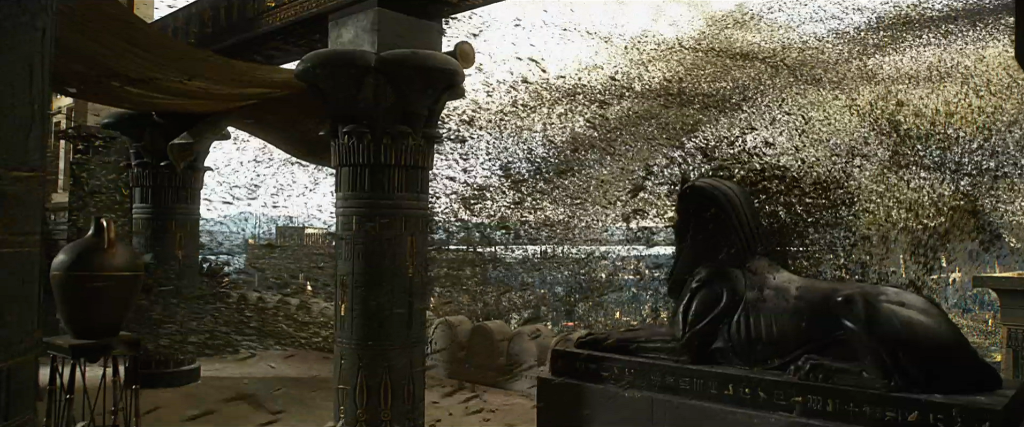
Egypt is hit with more plagues: locusts that devour crops, then darkness which becomes thick and tangible like fog, trapping the Egyptians in place for three days. Finally, the last straw, the death of the firstborn. By this time the Egyptians were so fed up with Pharaoh’s stubborn refusals that many of the firstborn Egyptians waged a rebellion on the government…
During the darkness something amazingly frightening happens. While the Egyptians are unaware, many of the Jewish people secretly die. Our ancient sages explain (Rashi on Ex 10:22 and 13:18 from earlier Medrashic sources) that the majority of the Jews did not want to leave, and died during the darkness. The Bible hints that only one in five Jews actually left Egypt in the Exodus. This sounds bizarre, but think of their perspective. They had been slaves for years, for generations. They have been whipped and beaten, starved, their children thrown into the buildings as bricks. Every aspect of their lives was subject to the Egyptian taskmasters. They grew used to this reality, developing PTSD.
For almost a year*, their captors have been punished with miraculous plagues, and have left the Jews alone. The slavery is over, and not only that, but the Egyptians had to humble themselves and buy water and animals from the Jews. Their former masters were now petrified of Jews. These people feel like kings. They were the new nobility of Egypt, held in high esteem (11:3). Why leave?
The problem is that the destiny of the Jewish people was to receive the Torah in the desert and then resettle in Israel, the holy land. Our mission was to receive the light of the Bible and become a light to all nations. Slavery in Egypt was a necessary step in this process, but staying in Egypt was never the destiny of the Jewish nation. These people were now living the good life in Egypt and don’t want to leave.
After many months of relative freedom and special status, they forgot slavery and thought Egypt was their true home. The majority of Jews were enjoying Egypt, and had the same mindset of Pharaoh: hold the course, don’t change your situation. Just like Pharaoh had become obsessed with not changing his mind even in the face of divine punishments, these Jews clung to their new chosen home of Egypt.
God decided that rather than letting these Jews remain in Egypt, it was better for them to perish. They did not want to leave to take part in the holy destiny of the Jewish nation. Likely they would have assimilated into Egyptian culture and become idol worshipers. It was a kindness from Above that they died secretly.
*The plagues were spread out over the course of one year (Mishna, Eiruvin ch.2).

There is a frightening lesson here for modern men. Sometimes we are in a certain situation, be it a place, a job, a romantic relationship. It has ups and downs. We may feel like a slave to our employer some days, other days we feel appreciated and valued. The same dynamic applies in relationships. Our default psychological response to the little ups and downs is to value and focus on the good times and ignore the bad. This compartmentalizing is a normal response to everyday stresses.
What is much harder to do is to stop responding and managing, take a step back, and look at the big picture. We need to ask ourselves: Is my current situation bringing me closer to my mission, my chosen personal destiny in life?
Your situation may be pretty good (today), but in the long run will it get you what you want out of life? Are you ignoring and not fixing the bad parts because you want this relationship to be right, you want her to be “the one”? You have to take a pause from the daily struggles and really ponder what it is you need out of life, and how to get it. Then you have to honestly evaluate what will get you there, and plan accordingly.
The Bible gives us a drastic message. 80% of the ancient Jews could not stop enjoying their new high status in Egypt and remember their ultimate destiny as Jews and home in Israel. Four out of five perished because they would not evaluate their current situation with objectivity. Pharaoh himself could not change his stubborn mindset until his nation was all but destroyed before his eyes.
Are we modern men any better than this? Men every day are locked in an Egypt of their own making. A lack of focus on the big picture, your mission, your destiny will leave you trapped.

 Red Pill Rabbi
3 thoughts on “Bo: Escape from the Pharaoh mindset”