Ki Tavo: ancient wisdom in a modern world

This week we study “Ki Tavo”, Deuteronomy 26:1–29:8.  This portion of the Bible describes the ritual of bringing the first fruits to the Temple in Jerusalem, agricultural tithes, and then commands the proclamation of blessings and curses on Mount Gerizim and Mount Eival. 

This ceremony of blessings and curses will happen after the Jews enter Israel.  That famous event is described in the book of Joshua, 8:30-35 and Talmud Sotah Daf 33, 36.

bc

Moses reminds the Jews that they chose to be God’s people and God selected them for a special mission (26:17).  Our ancestors chose to enter the eternal covenant with God, and Moses reminds them of the grave responsibility this entails, and the blessings it will bring. 

Then “Ki Tavo” turns very dark, with a lengthy account of the shocking calamities and atrocities that will befall the Jews when they stray to idolatry.  Through our long history, every single one of the horrible things the Bible warned actually took place.  This is the second time such curses are enumerated, the first is in Bechukotai, closing the Book of Leviticus.

Past is prologue

And you shall come to the priest who will be serving in those days, and say to him, “I declare this day to the Lord, your God, that I have come to the land which the Lord swore to our forefathers to give us.”  And the Kohen (priest) will take the basket from your hand, laying it before the altar of the Lord, your God. 

And you shall call out and say before the Lord, your God, “An Aramean sought to destroy my forefather, and he went down to Egypt and sojourned there with a small number of people, and there, he became a great, mighty, and numerous nation.  And the Egyptians treated us cruelly and afflicted us, and they imposed hard labor upon us. 

So we cried out to the Lord, God of our fathers, and the Lord heard our voice and saw our affliction, our toil, and our oppression.  And the Lord brought us out from Egypt with a strong hand and with an outstretched arm, with great awe, and with signs and wonders. 

And He brought us to this place, and He gave us this land, a land flowing with milk and honey  And now, behold, I have brought the first of the fruit of the ground which you, O Lord, have given to me.” Then, you shall lay it before the Lord, your God, and prostrate yourself before the Lord, your God.  26:3-10

This seems like a bizarre speech for a pilgrim to say when bringing a gift to the Temple.  Why recount ancient history starting with the Patriarch Jacob (or Abraham as Ibn Ezra explains) and the slavery in Egypt?  How is the past relevant to the Jew thousands of years later bringing his first fruits to the Temple?

Something we modern men lose out on is a sense of connection to history and ancestors.  Our society changes so rapidly that we don’t give much thought to the past.  When we do, most men assume people in our history were ignorant and primitive. 

There is bias against the past among many modern people, even though it was only through the success of our ancestors in our past that brought us into existence.  They overcame challenges and hard times we can barely imagine.  We have it easy.  Our ancestors from just a few generations ago would be shocked by how good we have it and how much we complain despite our blessings.

They lived in different worlds, and the past is gone forever.  But they were men with motivation, goals, thoughts, and plans for their life and world.  It is important for men to realize that we are very much like our fathers, grandfathers, and great grandfathers.  They were not so different than us where it counts, inside.

There is so much to learn from our ancestors, our Patriarchs.  We are their living legacy.  We look up to their examples, study and emulate them.  Can you imagine any other men from 4000 years ago with descendants that still care about what they accomplished and want to follow their paths? 

Each Jew in the holy land owed his ability to grow and harvest to the work of Abraham, Isaac, Jacob, and countless other ancestors who paved the way.  The ritual of bringing first fruits was a time to reflect on this and give thanks.

Appreciate what your own father, grandfather, and ancestors accomplished.  You can probably draw some lessons from them, even if you never met them face to face.  We all owe profound gratitude to our ancestors, this is not unique to Jewish wisdom.  Many eastern cultures respect and even revere ancestors.

It may be valuable to think, or write, about your own personal past, what you have overcome on your path to becoming whatever it is you are now.  Men grow through adversity; but many do not reflect on theae changes and incorporate it into their lives going forward.  

Some men learn the same life lessons over and over and never change their responses because they never stopped to think about how to use the past to improve their future. This is truly tragic, but perhaps other men are learning what not to do.

When you delve into your family and personal history, you get rooted in your identity.  Every experience you have shapes who you are.  When you recount them, consider how you grew through life experience, you know who you really are.  And then you can decide where you want to go from here.

Everybody must get stones

I want to focus our attention on a seemingly bizarre command that God gave the ancient Jews:

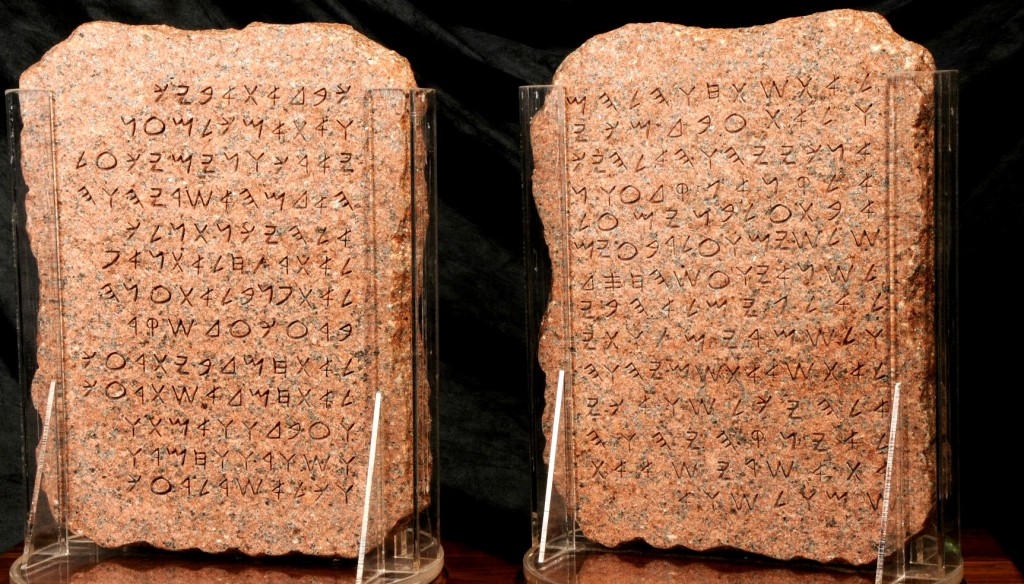
And it will be, on the day that you cross the Jordan to the land the Lord, your God, is giving you, that you shall set up for yourself huge stones, and plaster them with lime.  When you cross, you shall write upon them all the words of this Torah, in order that you may come to the land which the Lord, your God, is giving you, a land flowing with milk and honey, as the Lord, God of your forefathers, has spoken to you. 

And it will be, when you cross the Jordan, that you shall set up these stones, which I command you this day on Mount Eival, and you shall plaster them with lime…
You shall write upon the stones all the words of this Torah, very clearly (27:2-8).

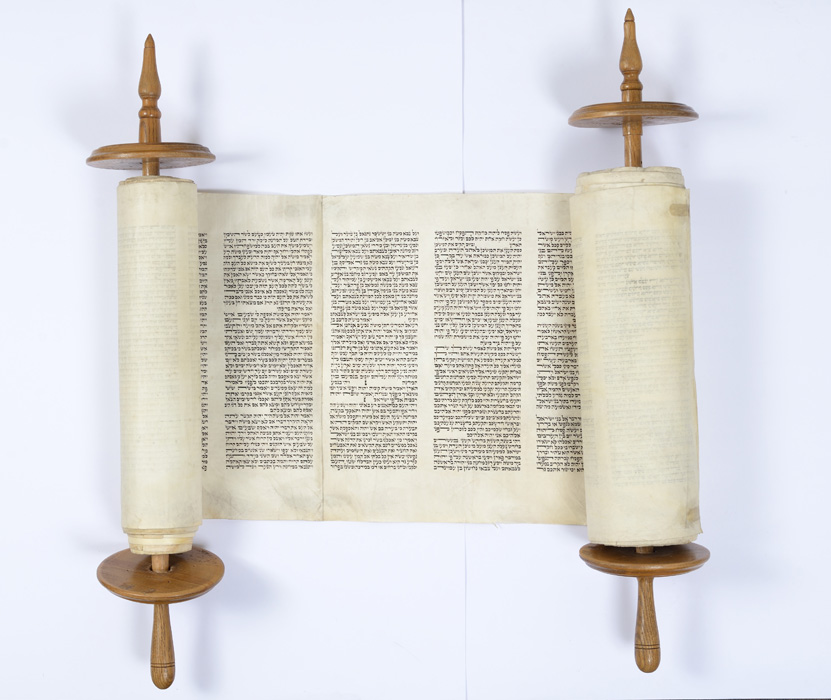
The Bible (Torah) has always been contained in scrolls prepared from hides, written one at a time from an existing scroll.  The first scroll was written by Moses, who also wrote a master scroll for each tribe.  All subsequent Torah scrolls were copied from those originals.  The scroll of the Word is an ancient symbol of the Jewish people, the people of the book.
So why were the ancient Jews commanded to copy the Bible onto rocks?  And why did we place them by Mount Eival, place of the ceremonial blessings and curses?

The Talmud (Sotah Daf 35-36) explains that “You shall write upon the stones all the words of this Torah, very clearly means translated into the 70 major languages.  The stones were meant to give foreign people access to the wisdom of the Torah. 

When they entered the holy land, non-Jewish people would be able to read the Torah and understand why the Jews were there and how they ran the country.  This could be comparable to writing the basic laws of the city on the outside of the city gates.  A visitor needs to know what to expect, the law of the land.

The Torah was an exclusive gift from God to the Jewish people; the other nations did not want to accept it (Deut 33:2, Medrash Sifri, Deuteronomy 343).  The Bible itself is the covenant and contract between the Jews and God.  Jews have been reluctant to teach the Bible to other nations. 

First of all, be aware that the Bible has both written and oral components.  Everyone knows the written parts: the Five books of Moses, the Prophets, and Writings.  The Oral law was given by God to Moses in basic form, and expanded over the generations as circumstances required.  Eventually the key parts were written down when Roman persecution made it difficult to safeguard the tradition orally. 

Now there is so much “oral law” written down that it dwarfs the written part.  There are many complex issues at play here, but the mainstream view allows Jews to teach the written Bible to non-Jews, but not the Oral law. 

History seems to bear this out, now more non-Jews read the Bible than Jews; our Word has been copied into every major language, as it was on those ancient stones.  [Koreans are known to study the Talmud, the key part of the oral law, as an intellectual exercise.]

Of course, there are items in the written Bible that are incomprehensible without the Oral part.  Both parts were given by God to Moses, the Oral law was passed through the generations as a basic framework and expanded greatly.  It’s huge.  A man could read the Bible and prophets in a week.  You can’t even read, let alone master, every aspect of the Oral law in a lifetime. 

Since the written Bible can be misinterpreted and the holy wisdom in it twisted without our oral tradition, we study and explain the Bible based on sources like Medrash and Talmud.  The Medrash contains eyewitness accounts of the events in the Bible, and later explanations filling in the details .  I would be misinforming you if I kept our discussion limited to the basic words of the text without giving the background and thousands of years of tradition about what the words really mean.

There is another issue of translating the Bible; something is always lost in translation.  It is better to read in the original language to get the nuance.  Our sages allowed and endorsed an Aramaic translation by Onkelus, a great sage who had been a Roman noble and nephew to a Caesar before he converted to Judaism about 2000 years ago.  Aramaic was the common language at the time. 

Onkelus created his translation from what he learned from his teachers, the ancient sages Rabbi Eliezer and Rabbi Yehoshua (Talmud, Megillah 3).  They had received the tradition of how to understand and translate the verses from their own teachers,  and those from their teachers, going all the way back to Moses in an unbroken chain. 

Onkelus did not inject his own understanding into the translation, but relied entirely on the original understanding of the Word that Moses had transmitted to Israel.  This was a great accomplishment both in his humility and intellectual prowess. 

It is likely that because he was a convert to Judaism he was more capable of accepting the ancient traditions than a natural born Jew, who would be tempted to incorporate his own personal commentary.

However, the translation of the Bible into Greek is counted as one of the major calamities in Jewish history (Masekhet Soferim 1:7).  This was because the Greek king Ptolemy who ordered the Rabbis to translate the Bible had an agenda of making it available to Greek speakers so they could analyze the Book to prove it false, and sway Jews to follow Hellenistic culture instead of the Word. 

If you are reading the Bible in translation you must consider the motivations of the translator.  Many translations are made with an agenda to prove the beliefs of the translator.  I recommend obtaining a Stone Chumash published by Artscroll, which along with an excellent translation also contains brief commentaries based on ancient sources, and the original Hebrew and Aramaic texts.
Beliefs or believers?

Where was this place anyway?  There is considerable debate amongst archaeologists.  Some identify the twin hills of Grizim and Eival as being near Elon-Moreh.  In Deut. 11:30, the Torah gives a geographic description:  “Both are on the other side of the Jordan, beyond the rising sun, that is in the land of the Canaanites who dwell in the Arabah near Gilgal, by the plains of Moreh”. 

Rashi, on this verse, says that “beyond” means far from where they were standing at the time, which was on the other side of the Jordan.  So Grizim and Eival not situated just across the Jordan, but well into the land.  The Talmud (Sotah 36) explains that miraculously the Jews travelled 60 mil, about 40 miles, deep into Israel that same day they entered.

This may be in the vicinity of Shechem.  The Bible associates Shechem with Abraham as the place of the original covenant:  “I will assign this land to your offspring” (Gen.12:7).  Jacob’s first camp upon his return to the land was in Shechem, he purchased a plot of land there (Gen. 33:19). 

Recall from our exploration of the Rape of Dinah that this fateful event took place in Shechem, with a prince by the same name being the rapist.  Shechem is a place of covenants, and the blessings and curses ritual was a reaffirmation of the covenant.

I mentioned that the stones with the Bible translations were something like writing the city laws on the gates.  If we assume the place where the stones were displayed is near Elon Moreh or Shechem, this falls apart, as these are well within the borders, not near the border.  A foreigner coming to the holy land would not see the Bible stones for quite a while. 

What he would have seen was the Jewish people working the land, serving God, offering hospitality and teaching wisdom.  The visitor may have been impressed by the people themselves and wonder what made them so great. 

Eventually, when he comes to the stones he gets the chance to study the sourcebook of this people.  However, the first and main influence on visitors was not the stones but the people themselves.

This is the key question: is a religion a group of beliefs

Or is it a group of believers and how they act?

In other words, do we identify a group by how they should behave in theory, according to their books and charters, or how they act in practice?

The Jewish people are famous for bringing the Bible, and monotheism, to the whole world.  Ethical monotheism is a Jewish innovation, along with universal literacy which was needed to read the book.  The importance of the Bible itself on human history cannot be stated. 

Recall that back then, everyone else was idolatrous and polytheistic.  Jews were the outliers, a tiny speck of monotheism in a sea of cults and idol worship which included raping temple prostitutes and burning children alive.  Everyone knew the Jews were very different.

But since the stones with the translations were a great way inside the Holy Land, foreigners wouldn’t know the actual laws until they had been in Israel for a while.  It was Jews themselves, not the Book, that was the main source of a inspiration. 

It was the Jewish people, acting in accordance with the Bible, which created a positive impression on other people.  By the time they got to Shechem, a visitor would have witnessed thousands of Jews going about their daily lives, and developed a curiosity about how these monotheists do it. 

If a foreigner saw Jews acting against the guidelines of the Bible, and then encountered the massive stones and read the rules those Jews were supposed to follow, he would realize their hypocrisy and reject monotheism.  Only if the Jews in practice were acting in according with the Law as written on the stones would the visitors be impressed.  The believers have to line up with the beliefs or it’s nonsense.

To make it practical: if there is a group, a club, nation, or anything, which has a set of rules, then what matters is not so much the written rules and bylaws, but how the group acts to apply (or ignore) their rules.  It is the believers in practice, not the beliefs in theory, which truly determines the identity and focus of the group. 

You can’t learn the full picture of any group from their written rules.  You need to go in and see how (and if) they actually implement those rules in real life.

Be on the lookout for groups that do not follow their stated mission, that ignore the uncomfortable parts of their supposedly holy texts or foundational laws.  This is deeply hypocritical and you may not want to be a part of such a group.  If their Book or bylaws or constitution is important to them, why don’t they follow it? 

When you are aware of this distinction, you will often find groups where practice diverges radically from theory.  In modern America, practically every major foundation, charity, and religion has veered away from the original stated purpose.  It can be hard to follow rules, and today it is often politically correct to go along with a modern reinterpretation that bends the old guidelines.

However, this can dilute and undermine the purpose of the group.  If you are trying to get your group to succeed, you may need to step in and get them back on the same page – back to the written document that lays out the basic goals and expectations.  Hold them accountable to their own stated rules.  Or start your own group.

The proof is in the cursed pudding

I have been in situations where men of a different faith admitted to me that yes, God had originally chosen the Jews but then tried to convince me that God had un-chosen the Jews in favor of whatever identity they were trying to sell. 

Their asserted proof was that the Jews went through so much terrible suffering over the millennia.  This was their evidence of a purported rejection by God, as we discussed at the end of our learning in Bechukotai.

The counter proof is that God told us all the suffering that would happen to us.  It’s all right here in Deuteronomy Chapter 28 (and Leviticus 26).  It was not a surprise rejection or a change of Divine plan for the Jewish people.

And you shall not turn right or left from all of the words I am commanding you this day, to follow other deities to worship them. And it will be, if you do not obey the Lord, your God, to observe to fulfill all His commandments and statutes which I am commanding you this day, that all these curses will come upon you and overtake you…” (28:14-15).

What follows is a list of the curses and tragedies that befell the Jewish people when we strayed from God.  This includes being invaded, murdered, sold as slaves, starvation so unbearable that parents ate their own children.  Plagues, exiles, rapes, beatings, hemorrhoids, horrible deaths and insanity.  Corpses left for the birds and beasts.

It’s all there, “If you do not observe to fulfill all the words of this Torah, which are written in this scroll, to fear this glorious and awesome name, the Lord, your God,” 28:58.  History being mean to the Jews is no proof against Judaism.  Instead it proves the truth of the Bible.

God Himself gave us the punishment, but God Himself says He will never change His covenant with us (Genesis 17:7, Lev 26:42-45, Deuteronomy 7:7–8, Psalm 89:34, 105:8-9).  After this section of curses, including a warning to individuals hiding their idolatry in next weeks reading, the Bible promises:

And it will be, when all these things come upon you the blessing and the curse which I have set before you that you will consider in your heart, among all the nations where the Lord your God has banished you, and you will return to the Lord, your God, with all your heart and with all your soul, and you will listen to His voice according to all that I am commanding you this day you and your children, then, the Lord, your God, will bring back your exiles, and He will have mercy upon you.

He will once again gather you from all the nations, where the Lord, your God, had dispersed you. Even if your exiles are at the end of the heavens, the Lord, your God, will gather you from there, and He will take you from there.

And the Lord, your God, will bring you to the land which your forefathers possessed, and you will take possession of it, and He will do good to you, and He will make you more numerous than your forefathers.

And the Lord, your God, will circumcise your heart and the heart of your offspring, so that you may love the Lord your God with all your heart and with all your soul, for the sake of your life. (30:1-6)

The punishments and curses were not an abrogation of the original covenant. That contract is still in effect, and the curses are the penalty clause when our ancestors breached the contract’s provision on idolatry. 

But the contract itself was always in force and still is.  God doesn’t break promises.  Amos 3:2 “You alone have I singled out Of all the families of the earth— That is why I will call you to account for all your iniquities.” 

If there is a commercial contract and one side fails to deliver the goods, they pay the penalty specified in the document.  If the contract states that a failure to perform abrogates the contract then it’s over, but the Bible says the opposite.  God was enforcing His boundaries against idolatry, just as He explicitly promised our ancestors in the Bible, the contract between God and the Jews. 

People who tell you otherwise fundamentally misunderstand the nature of God’s covenant with the Jews, along with contracts and relationships generally.  Naturally, when you want nothing to do with someone who offended you or failed you, then you ignore them.  You ghost the person who violates your boundaries. 

God punishing the Jews is proof that God was not ignoring them or breaching the covenant.  You don’t need to punish when there is no more relationship.

When you, as a modern man, decide you are done with a relationship, you don’t need to punish her.  Just walk away.  You can always find another.  Your action is the consequence of her behavior and your decision to seek better for yourself.  It is not a punishment, that isn’t worth your time and effort anymore.

Only when there is something there really worth saving and maintaining do you need to do the work to correct people and get them to behave better in the future.  

Punishment and boundary enforcement is to improve the relationship, not to destroy it.  If your son says bad words (and you don’t allow that) then you punish him, because you have a relationship and a responsibility to him.  If some kid at the mall says the same bad words you can ignore him. There is no relationship creating any responsibility.


The Jew in exile and you

The major punishment on the Jews is exile.  Most of the Jewish people are actually still in exile scattered around the world.  There is a deeper, more hidden exile inside Israel itself.  There the mainstream culture, government and media there are mostly dominated by ideas that are out of alignment with conventional Jewish values.  However, since it is the holy land and there are spiritual benefits to being there, it is harder to realize this level of exile.

Exile is not a punishment for people from other nations, because to a large degree they are able to assimilate and eventually become comfortable in the new society.  This is not the same for Jews.  In America it is much easier, yes, and we love America for this

But for 99% of history in 99% of the world, Jews were at best second class and not even citizens.  And often it was much worse than that.  A Jew living a conventional Jewish life never felt fully at home in exile. 

Sadly, many Jews abandoned Jewish values so they could blend in and feel comfortable.  One of the recurring concepts in European history is that whenever Jews were allowed to or tried to assimilate into the mainstream culture, anti-Semitism arose in that society.  Some of us got the message of exile, and reattached to the Torah and God instead of trying to join the secular society.

Ironically, this history discrimination gives all humanity a hope.  Jews, because we were set apart, maintain the ancient wisdom that was mainly lost from modern secular society.  This includes acknowledging biology and gender roles, remembering the importance of family, and living with specific goals in mind. 

Conventional Jews still honor our elders, especially our ancient Patriarchs and Matriarchs, and teach our children to emulate them.  We teach children to honor elders, and husbands and wives to honor and respect one another. 

Conventional Jews still keep the same values as our ancestors, even though our day to day lives are quite modern.  Being exiled and kept apart from mainstream life allowed us to keep this ancient wisdom alive.  Wisdom that was once shared by most of mankind, that men are men and women are women.  That men, women and children are stronger together, in a traditional family. 

The exile which punishes the Jews also allows our ancient wisdom to be maintained and spread in the modern world.  We are a window into humanity’s past, allowing all to see basic concepts about men, women, and families that were lost and discarded in today’s secular society.  This is one reason why you don’t have to be Jewish to use Jewish ideas and wisdom: we are a living archive of the wisdom of ancient humanity.

“The Nation of Israel is likened to the olive.  Just as this fruit yields its precious oil only after being so pressed and squeezed, so Israel’s destiny is one of great oppression and hardship, in order that it may thereby give forth its illuminating wisdom”  Medrash Exodus Rabbah 26.

Daily dose of wisdom, Eruvin 26: provoking Satan

Today the Talmud discusses the permissibility of carrying on Shabbat in a large garden, and brings a proof that some ancient royal gardens were the size of a city: “And it came to pass, before Isaiah was gone out into the middle courtyard, that the word of the Lord came to him, saying” (ii Kings 20:4).  In the biblical text, it is written: “The city [ha’ir],” but we read it as: “The middle courtyard [ḥatzer],” as there is a tradition to recite the word not as written.  From here it is derived that royal courts were as large as intermediate-sized cities.

Our sages ask what the prophet Isaiah was doing in the King’s garden, and explains that when King Hezkiya fell ill, Isaiah set up a Torah study to protect him the angel of death.  Our sages learn from Isaiah: Based on this, for a Torah scholar who took ill, one establishes an academy at the entrance to his home. The Gemara comments: This, however, is not a proper course of action, as perhaps they will come to provoke Satan against him.  Challenging Satan might worsen the health of a sick person rather than improve it.  [We have discussed how Satan is not an independent entity but a tool God uses to help us overcome impediments to personal growth.  The Satan is a servant of God, fulfilling only Divine will, not his own.]

Satan is also the angel of death and the “evil inclination” that is in within every man.  Part of the danger of your “evil inclination” is that the more you openly defy it, the more it tries to control you.  In general, a proud and brazen man gets more trouble and temptation in life.  A wise man is more subtle, perhaps he tells himself (and his “evil inclination”) that he will just learn for 10 more minutes and then go to the beach and look at pretty girls.  Then he does this again for another 10, and then another 10.  Then he is tired so he skips the beach.

You can use this method in your own applications.  Don’t take on too much at a time.  At the gym tell yourself one more set.  Then do that again.  In addition, don’t be too obvious that you are trying to be righteous.  People won’t like it, and your own inclination will resist you.

Daily dose of wisdom, Eruvin 25: shrinking boundaries

Today the Talmud discussed reducing the size of an enclosure to allow carrying inside it on Shabbat.  One of the methods is erecting a wall inside the existing wall.  Our sages debate the minimum distance from the original outer wall the new border needs to be.

This debate hints to our use of boundaries.  If we had a boundary that was too imposing and hard to enforce, we may need to step back from that and make a new line.  But if the difference from the original is small, it can look like you are just waffling on your boundaries and people can take advantage of you.  Peoople don’t realize you still have strong boundaries and will enforce them.

It is better to have less boundaries but strictly enforce them.

Daily dose of wisdom, Eruvin 24: angel and man

Today our sages discuss enclosing a large area for residential purpose, to allow carrying items there on Shabbat.  If this space was previously enclosed for other purposes such as for fields or livestock, they would need to make a breach in the wall more than 10 cubits, then rebuild the wall.  The Gemara asks if it is enough to demolish and rebuild the wall in sections (maybe to prevent animals from entering).  Rabbi Yochanon compares this to a sandal which had one strap break and get fixed, then the second strap break and be fixed.  Now this sandal is considered a new item and loses the ritual impurity it had before, even though it always had one strap.  However, since new material is here the original is considered gone it is considered a “new face” and a different item.  So too for the wall: even though each break and rebuild was small, these combine to make a new face.


Hizkiyah responded to Rabbi Yochanon “this is no mere mortal man”, or some say he said “like him is a real man”.

These versions of the compliment appear contradictory.  The first means he is like an angel, angels see the big picture and changes over vast time frames that mortal men cannot understand.  An angel would see that this wall was rebuilt across more than 10 cubits, even though a man viewing the wall during the repair process would see only a small breach. 
The second version gives us a key insight on what makes a man.  A man breaks and rebuilds himself a little bit every day.  These changes appear small to us in the moment, but they eventually combine to a massive amount of personal growth.  Changing yourself a little at a time, growing in wisdom one thought or goal at a time, eventually adds up to make you a totally new man.  A real, serious man realizes this fact of life and does not waste his opportunities to improve himself. 

This message should inspire us to fix ourselves when we can.  Back in Brakhot Rabbi Yochanon also taught us that someone who feels trapped in his situation needs to change his perspective.  Sometimes men are stuck in life because they have gotten used to tolerating suffering.  Rabbi Yochanon helped them see that this was holding them back and had to go for them to move on.  Now we see that we can accomplish great changes and become a new man even a little at a time.


Daily dose of wisdom, Eruvin 23: seek confirmation

The Mishnah today cites some legal rulings that Rabbi Elai heard from Rabbi Akiva, including one about Eruvin.  Rabbi Elai concludes: “Regarding these three rulings, I circulated among all of Rabbi Eliezer’s disciples, seeking a friend who had also heard these matters from him, but I could not find one.”

The background here is that Rabbi Akiva had thousands of students learning with him.  If no one else heard these rulings, perhaps Rabbi Akiva had retracted and decided not to teach them publicly.  The practical message from Rabbi Elai is to look for confirmation for your theories.  Get together with other men who are working on improving their lives and swap notes.  Hear what works for them and decide if you can apply it to your own situation.  Tell them what you have learned and compare your results.  The word Rabbi Elai uses means “friend” or “colleague”.  A real friend is a man who can help you improve in wisdom.

Daily dose of wisdom, Eruvin 22: tolerating discomfort for greatness

Today the Talmud notes that the verse in Song of Songs 5:11 Black [sheḥorot] as a raven [orev] means:

In whom do you find the words of Wisdom?  In him who, for the Torah’s sake, gets up early in the morning [shaḥar] and stays late in the evening [erev] in the study hall. Rabba said: In him who, for the Torah’s sake, blackens his face like a raven, i.e., who fasts and deprives himself for the sake of Torah study. 

Rava said: In him who makes himself cruel to his sons and other members of his household like a raven (which does not bring food for chicks) for the sake of Torah. This was the case with Rav Adda bar Mattana, who was about to go to the study hall to learn Torah, and his wife said to him: What shall I do for your children? How shall I feed them in your absence? He said to her: Are all the edible rushes in the marsh already gone?

A man must be willing to tolerate discomfort to succeed.  When you are waking at or before daybreak to grow in wisdom and improve your life, and you are also working late into the night, you are overcoming your want for more sleep, more rest, more comfort.  Our bodies want comfort while our souls want greatness.  Live as a soul and overcome your body’s pull towards comfort. 


This verse also gives practical advice: since men are busy with work and other people during the day, they need to carve out time alone to meditate and internalize their personal growth.  Early morning and late night are better times to be alone with your thoughts.  King David also used the night, when no one was around, to compose the Psalms and learn.

The last statement sounds amazing.  This man was willing to ignore his hungry children to go learn Wisdom, since his wife was able to gather edible plants for them.  Most men, even in ancient times, held a job and provided for their family.  Rav Adda was an exception, so dedicated to his mission that he left provisioning to whatever God would provide.  In ancient times this may have been somewhat easier since the culture he lived in appreciated the value of his mission.  We explained this regarding MGTOW.  A modern man needs to strike a balance between being engaged in his own growth and in helping those who rely on him.

Daily dose of wisdom, Eruvin 21: holy abstinence

Today the Talmud diverges from the subject of drawing water from wells on Shabbat and mentions some philosophical and esoteric concepts. Among these is an explanation of Song of Songs 7:14:

“And at our openings [petaḥeinu] are all manner of choice fruits [megadim],” this refers to the daughters of Israel who inform [maggidot] their husbands about their passageway [pit’ḥeihen], i.e., they tell them when they are menstruating. Another version of this interpretation is: They bind [ogedot] their passageway and save it for their husbands.

Why would the girls inform their husbands? The Bible requires abstinence for seven days after a woman begins menstruating (Leviticus 15:19). A righteous woman would inform her husband of this so they would not come to sin. The implication here is that the rest of the month the wife does not need to say anything about her availability for intimacy. She is assumed to be available, both physically and emotionally. This is the sign of a healthy relationship: neither partner withholds intimacy to influence or punish the other. When one partner needs affection, the other is ready.

The second interpretation is odd, of course a married woman cannot share her opening with anyone except her husband! The “Petach Einaim” explains that this is a praise to the women who approve of their husbands travelling abroad to learn Torah, even through they will be alone for a long time. The lack of regular marital intimacy causes them bodily pain. These women are choosing to put off their sex life to earn a greater spiritual life. Our sages teach that through such acts women earn a greater reward than the men.

In addition, the Gemara explains based on Ecclesiastes 12:12 that one must be more careful with the words of the sages than the words of the Bible itself. This requires a lot of explanation. A loose metaphor we can make is that the building your own path through life needs more effort than accepting outside wisdom and running your life based on that. Rabbinical law is based on and protects Biblical law, but is much more complex and addresses many more nuanced situations. As you go through life and figure out what works for you, you should be gaining in wisdom and developing rules for the situations you get into. Of course you need to start by learning existing wisdom, but the main effort is personalizing it to work in your life and help you grow towards your own mission.

Daily dose of wisdom, Eruvin 20: watering others and yourself

The Talmud is discussing the enactment of “pasei biraot” the corner boards around a well.  These allow drawing water from the well on Shabbat, even though the well is in the public domain and the area is mostly open except for the corners. 

The Gemara notes a concern that the man holding the bucket will follow the drinking animal out of the cornered off area, and explains that the allowance is when the man holds the animal in place, or draws water and pours it into a trough.

We see that even when we are taking care of the needs of others, we must be cognizant that we help them on our terms.  Many parents, and adults caring for their own elderly parents, tell me they can get burnt out through the energy they are expending.  You have to take care of yourself in order to take care of others. 
Interestingly, the Talmud notes that the allowance of corner boards for the well was only for the animals going to Jerusalem for a festival.  A regular man travelling would need to climb into the water source to drink.  Our sages assume that a man is willing to put more time and energy into taking care of his own basic needs than he is ready to invest in caring for others.  This is an important concept in modern culture, which often pushes men into putting others first at the expense of their own goals.

Ki Teitze: War Brides, cross dressing, bloody sheets, rape, and seduction

This week Jews around the world study Deuteronomy 21:10–25:19, “Ki Teitze” meaning When you go out to war.

The first law in this reading is about a beautiful woman captured in a war. A Jewish soldier during certain types of war was allowed to sleep with and marry such a woman after a unique expedited conversion process.  This is the Bible’s method of obtaining War Brides.

Ki Teitze also describes laws of inheritance, a rebellious son, returning lost items, adultery, accusations of infidelity, rape, and seduction. This is one of the critical sections of the Bible about relationships between men and women.

The Bible issues the famous command “A woman must not put on man’s apparel, nor shall a man wear woman’s clothing; for whoever does these things is abhorrent to the Lord your God” (22:5). We also learn the prohibition against returning an escaped slave (23:15), which was a rallying cry for American abolitionists in the 19th century.  The Torah gives us the requirement to pay a worker on time, and the laws of divorce and levirate marriage.  With God’s help, we will gain practical wisdom from a few of these amazing topics.

War brides

Women love winners.  Women naturally want to associate with men who have proved themselves in battle, or are on the dominant winning side.  During World War Two there was a rash of women in conquered France, Belgium, and other places sleeping with the occupying German soldiers.  When France was liberated, some of these women had their heads shaved as punishment for this disloyal behavior. 

More recently, there were scandals when soldiers in UN peacekeeping forces were found to be sleeping with women (and children) while deployed to protect the local people.  We can understand how these relationships made sense to the women, as these men were part of the dominant force in the area and could provide them with security and food in exchange for intimacy.

This is nothing new.  In ancient times, men who conquered other cities or tribes would take possession of the women as spoils of war.  Often the men on the losing side were dead or humiliated.  Their society was destroyed. 

The captured women had to adapt to the new conditions and accept the newly dominant men, or risk death.  Women who were able to go over completely to the winning side survived and thrived, often bearing the children of the invaders.

The ability of a woman to shift her allegiance from her original family and society to a new victorious people has been demonstrated again and again in human history.  Please read Rollo’s an essay on War Brides, written from an evolutionary understanding.  He explains how women seem to be hardwired to be capable of “moving on” through changing allegiances and romantic interests much more readily than men.

This applies on the micro level as well: a woman can quickly and easily discard a man and immediately enter into a relationship with a man she considers more of a winner.  Men may notice that after a bad break up, the woman has already moved on while he is still processing his own feelings.

The War Brides dynamic is not meant as a criticism of women; it a feature, not a bug.  In some cases it would be considered a God given gift.  It allowed women in terrible situations to quickly shift their focus onto the victorious men who had vanquished their own fathers and husbands. 

The women from the losing side would be able to connect with them and bear their children, ensuring their own survival.  It also explains how in modern times, women are faster to “get over” a previous relationship and move on to a new mate.

We have seen this biological reality play out throughout history.  When a new group invaded and was victorious, they killed out the fathers and husbands. With their families and culture decimated, women had to change their loyalty to the victors.  They did so in order survive live and bear new children. We are not blaming the women put into such a situation, they acted in their own best interest.

Throughout human history, the winners in war took the women from the losers.  This was common in ancient times and was considered absolutely normal.  Ancient Rome was especially proud of their abduction and mass rape of the Sabine women.

https://images.fineartamerica.com/images/artworkimages/mediumlarge/2/rape-of-the-sabine-women-theodoor-van-thulden.jpg

This historical reality undermines the unique loyalty that the Jewish women displayed through not abandoning their subjugated husbands for the dominant Egyptians, and their use of sexuality with their own husbands to continue the Jewish people.  Loyal Jewish women, as we explained, have demonstrated a capacity to override hypergamy and have made this power part of our heritage.

This female capacity to shift allegiance explains Stockholm Syndrome, in which kidnapped persons, especially women, begin to sympathize with their captors.  Some even become romantically attached to them, and may join their cause or kill on behalf of the very terrorists who attacked them and the society they were supposed to be loyal to (eg Patty Hearst). 

The first example of Stockholm Syndrome was Dinah the daughter of Jacob, who was kidnapped and raped by an idolatrous prince, but then didn’t want to leave when her brothers rescued her.

Whether you approach War Brides from an evolutionary, historical, or Biblical perspective, the topic holds vital lessons for modern men.

The Bible recognizes this reality of War Brides, as we discussed regarding the war of revenge on Midian for their sexual attack on the Jews.  That war was actually an outlier, as the non-virgin women were not taken as war brides, they were executed after the war instead. Typically in ancient war the men were killed and the women and children taken as spoils (Deut 3:6).

The fight with Midian was because the women were at fault for instigating the conflict, because they seduced Jewish men and manipulated them into idol worship.  The only women left alive were those who had never known a man, proving that they had not been involved in seducing the Jews (Number 31:18).

The implication from the war with Midian is that normally women could be taken as spoils of war.  The Jewish soldiers who attacked Midian did indeed originally take all of the women, and had to be told by Moses to sort out the guilty non virgins for execution.

But how could it be that the holy Jewish army, under the guidance of God and Moses, took women as spoils at all? 

This week the Torah describes the allowable method for a Jewish soldier to take a War Bride (isha yafat to’ar).  The Jewish soldiers in the war with Midian were already aware of this law, as the entire Torah was given as Sinai.  However, they were unaware that it would not apply in this war (see Sifte Chochamim on 31:50, and Tosafot Shabbat 64a “midei hirhur”). 

When you go out to war against your enemies, and the Lord, your God, will deliver them into your hands, and you take captives, and you see among the captives a beautiful woman and you desire her, you may take her for yourself as a wife.

You shall bring her into your home, and she shall shave her head and let her nails grow.  And she shall remove the garment of her captivity from upon herself, and stay in your house, and weep for her father and her mother for a full month.

After that, you may be intimate with her and possess her, and she will be a wife for you. And it will be, if you do not desire her, then you shall send her away wherever she wishes, but you shall not sell her for money. You shall not keep her as a servant, because you have afflicted her. (21:10-14).

Why would they shave her head, remove the garment of her captivity and have this foreign woman sit around the house mourning and crying for a month? 

During the war, these women would be trying to look more attractive so they would end up taken by the winners as prize wives.  The most beautiful women would likely be taken by the highest ranking officers or awarded to the bravest soldiers.  A woman who improved her attractiveness would be more likely to end up with a more powerful or higher status man.  

This “garment of her captivity” she was captured in could even be golden lingerie, as the Midianite women used to entice Jews.  They would do their hair and nails before the battle. The women wanted the winners to be interested in them after the battle. This was to help these women survive and become mates to the best men they could attract.  A woman who did not make an effort to appear attractive would probably be assigned to menial work as a slave instead.

The Bible commands the soldier to strip the captured woman of these extra attractive factors.  Without coifed hair, sexy clothing and makeup, and mourning for her original family, this woman would no longer be especially attractive to the Jewish soldier who had taken her home.  Seeing her like this, he may change his mind and decide not to marry her. 

That is part of the reason the Bible requires this procedure.  We want a man to marry based on a firm knowledge of who a woman is (and vice versa), not on the basis of mere looks and a moment of attraction while the hormones from winning a battle are raging.  You have probably heard the joke that a man doesn’t really know what his wife really looks like until after the marriage when he sees her without makeup. 

We explained that the Bible does not endorse actual arranged marriages, but instead arranges conditions so men and women can get to know one another on a real level.  During this month, the soldier gets to know her while the captured woman has a chance to mourn for and wean herself from her family and idolatrous culture. 

She also gets to see from the inside what Jewish society is all about, and think about if she wants to be part of it.  She gets time to decide if this specific soldier would be a good husband for her, and if she can commit to living with him.

If this woman feels that he would be, she will behave well, make herself look good despite her lack of hair, and try her best to get along with him.  She has a degree of choice in this marriage.  Indeed, the law is that the Jewish soldier cannot force himself on a captive.  If she makes herself repulsive or disagreeable, the Jewish man won’t want to marry her.  Even so, he is not allowed to sell or enslave her, he must either marry her or set her free (21:14). 

This highlights the critical difference between the Bible’s War Brides and normal treatment of captured women in ancient times.  Women captured in war by other nations could be literally raped to death by gangs of soldiers passing her around during the celebration, or brutally enslaved for the remainder of her short life in wretched conditions. 

The Torah requires the Jewish soldiers to afford a captured woman the opportunity to mourn and adjust, along with a degree of dignity and choice in her fate.  The Bible also made one soldier responsible for one woman.  When one man chose to take this woman home to convert, he would of course protect her from the other soldiers.

The Biblical concept of War Brides, while it could be criticized by modern standards, is vastly unlike the normal procedure that followed war in ancient times, which was humiliating, dehumanizing, and often deadly to women.


A concession to human nature?

There is an ancient disagreement in Jewish law if the soldier is allowed to be intimate with this woman on the battlefield before taking her home, or if he must first wait the full month while she mourns (Talmud Kiddushin 68). 

Rashi, writing about 1000 years ago, states that the entire reason for this commandment is to a sop to our biological nature, to give a permitted outlet for men who just won a war and are flooded with hormones.  This explanation implies that they did the deed immediately after the battle before bringing her home and waiting 30 days for the official conversion and marriage.

There are hints in scripture that the Jewish soldiers did indeed sleep with women on the battlefield before they went through the entire process described.  However, the law is that a Jewish soldier can only do so with the consent of the woman.

Numbers 31:19 states that the women captured in the war with Midian needed to be purified before they entered the Jewish camp. If they still had the status of being non Jews, they would not have been ritually impure at all. It seems that the first act of intimacy with a Jewish man who planned to take her home and marry her already set her on the path to full Judaism.

There is an infamous episode between King David’s children that also shows this. Amnon, David’s eldest son, became obsessed with David’s daughter Tamar (II Samuel ch. 13).  Recall that King David had 18 wives, and Tamar was a half sister to Amnon (II Samuel 3:3).

Amnon feigns ill and asks for Tamar to bring him food, then seizes her (verse 11).  Tamar, trying to convince Amnon not to rape her, says something bizarre (verse 13):  “Please speak to the king; he will not refuse me from you (for marriage)”.  Of course a brother cannot marry his half sister (Leviticus 18:9), so why does Tamar say the king would allow this? 

Tamar’s mother was Maacah, princess of Geshur, daughter of king Talmai.  David defeated Talmai and took Maacah as a war bride (See commentaries on II Samuel 3:3).  Tamar was hinting to Amnon that she was conceived before her mother fully converted, so she was biologically but not legally a half sister to Amnon.  Since they were not legally related, they could technically marry, and Tamar felt David would allow this, or was trying to get Amnon to stop.  See Talmud, Sanhedrin 21. 

Since the actual conversion and marriage was after the 30 day waiting period, this implies David had impregnated Maacah just after the battle, before bringing her home to Jerusalem.  Despite her legal logic, Amnon would not want to wait and gave into his lust and raped Tamar, then hated her (II Samuel 13:15).  Even at this point, Tamar was willing to marry him to avoid the shame (16), reminding us of Dinah’s traumatized reaction after being raped by Shechem.

The allowance of taking a war bride was never something encouraged.  Rashi explaining 21:11 cites the Talmud in Kiddushin 21b that this command was only given to help a soldier control his evil inclination by giving a permissible course of action when he might otherwise do worse.  Without a healthy outlet, men turn to unhealthy and destructive outlets for their passions and natural aggression.

Rashi bring the Medrash Tanchuma which points out from scriptural context that taking a war bride was associated with family difficulties:  The law of the war bride is followed by the inheritance procedure of a man with two wives.  If his first-born son, who is entitled to double inheritance, is the child of his less favored wife, the father cannot give the portion of the first-born to the child of his favored wife. 21:15-17. 

This hints that bringing in a war bride can cause dissension and strife among his wives and children.  After this, the Bible follows with the topic of a rebellious son (ben sorer u’moreh). 21:18-21.  The prime example of this is Avshalom (Absalom). Though he did not meet all the technical requirements of the rebellious son, there is a debate in the Talmud if a true rebellious son that met all the technical details ever happened, so Avshalom is an excellent illustration.

Maacah, mother of Tamar, was also the mother of Avshalom, who was born after Tamar.  David did not effectively chastise or discipline Avshalom.  This was before Proverbs 13:24 “He who spares the rod hates his son” was written, as King Solomon wrote Proverbs.  King David did not respond to Avshalom killing of Amnon to avenge Tamar’s honor.  After that act, Avshalom fled to Geshur.  2 Samuel 13:28–29. 

Keep in mind Avshalom’s mother had been the princess of Geshur, her father was the last king.  Perhaps David was reluctant to scold him since it would drive Avshalom away from David and into Geshur.  Avshalom could have been accepted as an heir to the throne in Geshur and become a political rival to David.  A man who takes a war bride had to be concerned about the loyalty of his wife and her children. 

Ultimately, Avshalom did betray David with tragic consequences.  Obviously bringing foreign women into the household was not without risk.  Absalom ended up rebelling against David, violating his concubines, and leading Israel into a civil war (II Samuel 15).  Despite this, David blamed himself for Avshalom’s bad behavior and ultimate death (II Samuel 19:1).

https://i.pinimg.com/736x/00/32/9d/00329dfc9259f49983aecdf33a3db6b5.jpg

Psychological warfare

The Talmud (Gemara) verifies that in the time of King David, Jewish soldiers took war brides:

Rav Yehudah also said in Rav’s name: David had four hundred children, and all born of war brides, they had long hair and all drove golden carriages.  They used to march at the head of the armies and were men of power in the household of David.  Sanhedrin 21

It is not stated that all 400 were the biological sons of David, they could have been offspring of his soldiers as well.  Normally Jewish men do not grow their hair long, which was an idolatrous style. This was allowed to publicize that these men were the sons of captured women.  They appeared at the front lines not necessarily to fight, as gold plated chariots would be heavy, but for psychological warfare. 

Showing off men who were sons of war brides would intimidate the enemy. Seeing the sons of captured women would remind them the reality that their own women could be taken and sire sons for the Jews.  The enemy soldiers would see their own women dolled up and realize that there was a good chance the Jews would be enjoying them tonight.  This would be an effective tactic in ancient warfare, when it was normal for the women to go to the victors.

We mentioned in our discussion of how Hanukkah is a Red Pill holiday about frame how the Greeks tried to impose their power over the Jews.  One of the heinous decrees against the Jews was “jus prima noctis”, the law allowing the Greek governor to take a bride by force and rape her on her wedding night (Gemara Ketuvot 3).  This was a sort of sexual terrorism.

Women love winners; and nothing displays a winning streak quite like taking the losing side’s women to sire more winners.  As the Talmud hints, sex is about power.  Both Jews and non Jews understood the psychological value of female loyalty to men.

In the case of the women captured by the Jewish army, they would end up married to the soldier or set free.  While in modern times this is shocking, this fate was infinitely better than what most women suffered when captured in ancient wars.  The Bible also makes one soldier responsible for one woman, preventing gang rape and dehumanizing abuse.

deuteronomy-22-5-michelle-greene-wheeler

Masculine men and feminine women

A woman must not put on man’s apparel, nor shall a man wear woman’s clothing; for whoever does these things is abhorrent to the LORD your God. 22:5

This statement is politically incorrect in modern secular American society, which now appears to value the “rights” of transgendered people to use whatever bathroom they want over normal people’s right to use a bathroom without that kind of thing. 

A grown man who thinks of himself as a woman can now share a bathroom with little girls, and the girls are accused of bigotry for objecting.  Inmates in women’s prisons become pregnant from other inmates who consider themselves to be women and demand that their delusion is accepted.

Our sages explain that “man’s apparel” includes military weapons. 

https://lh5.googleusercontent.com/-ltcIVPK_qe19uuwLq_LFZC1ymoCSOy0gVe6CVXtkwtKgBK4sGur9XrcVMg9DsLsBz9s2_nghxgnXU1kMumOtukOuYhju4CMW3UkgkClKfcnTA6ChExCi4EweA?.jpg

Obviously in a time of danger women would be permitted and required to bear arms to defend innocent lives.  But generally, it is men who do so, since men have been better equipped by our Creator for combat and aggression.  Men and women are built differently, that is biological reality.

This is a complex issue, as our culture values traditional gender roles. However, in modern Israel there is always some level of danger.  There are rabbinical opinions that both men and women should serve in some way to protect the country.  We should keep in mind that while modern technology makes it possible for women to fight wars, this is not the ideal situation.

https://th.bing.com/th/id/OIP.BckLyxmDgBg8k3omRzLdlwHaHa?pid=Api&rs=1&quot

In normal conditions, men are expected to look and act like men, and women like women.  Rashi brings the Talmud (Nazir 59) explaining that cross dressing was often used for a woman to sneak in to where men were or vice versa for obscene or adulterous purposes.  Suffice it to say that modern transgenderism takes this a step further in denying actual biological reality and normalizing mental illness.

Virginity and adultery

We have discussed how ancient society valued virginity.  There is an especially juicy law on the Book, which is often misunderstood:

If a man takes a wife, is intimate with her and then despises her, and he makes libelous charges against her and gives her a bad name, saying, “I took this woman, and when I came to her, I did not find any evidence of virginity for her.” 

Then the girl’s father and her mother shall obtain evidence of the girl’s virginity, and take it out to the elders of the city, to the gate. And the girl’s father shall say to the elders, “I gave my daughter to this man as a wife, and he despised her; And behold, he made libelous charges, saying, ‘I did not find evidence of your daughter’s virginity.’ But this is the evidence of my daughter’s virginity!’

And they shall spread the garment before the elders of the city. Then, the elders of that city shall take the man and chasten him. And they shall fine him one hundred [shekels of] silver because he defamed a virgin of Israel, and he give it to the girl’s father. And she shall be his wife; he shall not send her away all the days of his life.

But if this matter was true and no evidence of the girl’s virginity was found they shall take the girl out to the entrance of her father’s house, and the men of her city shall pelt her with stones, and she shall die, for she did a disgraceful thing in Israel, to commit adultery in her father’s house. So shall you clear away the evil from among you. (22:13-21)

First you need to know that the parents need not show a literal bloody sheet to clear the wife.  Any valid evidence or testimony would suffice, maybe girl had been fond of horseback riding, which was assumed to loosen hymens, or had required a medical procedure or had been injured in a way that could open her up before marriage (Talmud, Ketuvot, first chapter). 

The girl herself is only liable to punishment if she was claiming to be a virgin when she got engaged but then was not a virgin on her wedding night. She can exculpate herself by admitting that she lied to mislead the man and was in fact not a virgin when betrothed.  In those times, it was considered shameful for a woman to lose her virginity before marriage, as we will see below. See also Yevamot 69.

Without any explanation, it is possible that the girl who had claimed virginity had indeed slept with someone else during the engagement.  That is a capital crime, since Jewish engagement or “Kiddushin” actually effects the first stage of a marriage. 

She was not being punished for being a non-virgin, that isn’t a crime. Her sin was sleeping with another man while already engaged, since she was legally a married woman.

The Bible makes this clear in the law of rape 22:23-24: “If there is a virgin girl betrothed to a man, and [another] man finds her in the city, and lies with her, you shall take them both out to the gate of that city, and you shall pelt them with stones, and they shall die: the girl, because she did not cry out [even though she was] in the city, and the man, because he violated his neighbor’s wife.  So shall you clear away the evil from among you”.

Here the man did not overpower this betrothed woman, he simply found her, implying that she went along with his advances. We will see below that if he actually rapes her she is not at fault or blamed.

This law of the non-virgin bride was never about punishing women for losing their virginity. The entire purpose is to prevent adultery and discourage lying about personal experiences to lure a man into marriage. 

It is not uncommon today for women in mainstream society to at least omit certain parts of her sexual past when she is trying to get married. However, with the rise of social media, it is becoming easier to check out someone’s past, and a wise man will do so thoroughly before committing.

Men innately understand that a woman who has been with less partners is a better choice for marriage.  This is why women will call another woman a slut as an insult, this means she is not worth a man’s commitment due to her likelihood of cheating. 

Modern research, based on data compiled by the CDC National Survey of Family Growth, confirms what men instinctively feel, showing that women with zero or minimal experience prior to marriage are more likely to be happy in a marriage and less likely to divorce.

wolfinger-sex-partners-divorce-figure-1-1

The Bible teaches these concepts not to oppress women, but to prevent people from sleeping around when betrothed and to discourage lying about past sexual experience to lock down a man.  Yes, a woman who falsely claimed virginity would experience public shame when outed as a liar.  Because a woman would be reluctant to admit her experiences, this pressure is needed to encourage complete honesty about her sexual past.

Did she cry rape?

The above rule regarding rape applies in the city, a place where we assume other people are usually within earshot.

But if a man finds the betrothed girl in the field, and the man overpowers her and lies with her, then only the man who lay with her shall die. Whereas to the girl, you shall do nothing the girl did not commit a sin deserving of death, for just as a man rises up against his fellow and murders him, so is this case. Because he found her in the field.  The betrothed girl had cried out, but there was no one to save her. 22:24-25.

The Bible distinguishes a woman being raped from a woman taking part in the intimate activities on her own accord.  The bright line rule is resisting or “crying out”.  In the field there are few people present, so her crying out won’t bring help.  In circumstances like those, she does not need to cry out to prove her innocence.  The Bible states that the court should assume she did cry out or resist but no one was there to help.  

Ancient commentators point out that in some circumstances a women in the city also need not cry out, pointing out that during Greek and Roman occupations their soldiers were allowed to rape women with impunity.  A woman resisting or screaming for help would risk being  killed, and having the men who came to her aid killed by the invading soldiers.  Under such conditions a woman doesn’t need to cry out for the court to find her innocent.

The assumption is that a woman crying rape would immediately bring men who would kill the rapist.  “Just as a man rises up against his fellow and murders him, so is this case” teaches that men are allowed to kill a rapist caught in the act, just as men are allowed to kill to stop a murder.  We can assume than unlike in modern times, accusations of rape were saved for actual honest to goodness rapes.  When accusations have immediate and deadly consequences, this deters false accusations.

The Shotgun wedding

The above laws are for a betrothed women.  Again, since Jewish betrothal enacts the first stage of marriage she is a married woman from her engagement (nowadays we combine the engagement and marriage at the same ceremony).  However:

If a man finds a virgin girl who was not betrothed, and takes hold of her and lies with her, and they are found, the man who lay with her shall give fifty shekels of silver to the girl’s father, and she shall become his wife, because he violated her.  He shall not send her away all the days of his life (22:28-29).

This law may sound barbaric to modern people.  However, it is actually very pro-women. 

The words in the verse show us that this man is more of a seducer than an outright rapist.  Here (28) it says he held her and laid with her, but in the rape of a betrothed woman (25) it uses an emphatic verb overpowered her (hehezik) and says “he overpowered her, this man, and laid with her”.  Here is states “they are found”, implying the woman is actively involved in the intercourse and was embarrassed to be found.

Keep in mind that if this act is rape, the woman can cry out, which brings armed men to her aid to kill or capture the rapist.  So if she doesn’t want to be with this man, she has a very good chance of getting him killed and clearing her name by simply screaming.  However, she has an alternate choice of forcing him to marry her and then never divorce her. 

The Talmud explains that she does not have to marry him if she does not want to (Ketuvot 30).  But after they get down and she does not scream, she can make him stuck with her. 

This might have been an attractive option for a woman to lock down a man who wanted sex without commitment.  This law may be the Bible’s response to men who are looking to seduce young women without intending to commit to marriage.

When such a man was trying to seduce a girl, she could go along with it knowing that she could then take him to court and force him to marry her.  He merely wanted to get in her robes, but she planned to entrap him into marriage.  This law allows a woman to lock down an alpha man who normally would leave her without any security after seducing her.

Again, like the month period for the war bride, this law gives a woman in a limited circumstance a choice of how to respond.  She can reject the man in question or even get him killed, or she can choose to agree to his advances and gain the security of marriage by locking him down. 

The Bible recognizes that people are not always in ideal situations. Obviously it would be better not to be captured by an invading army. However, life is not perfect. Even in such scenarios human beings should still be granted the dignity of making their own choices regarding their mate.

Don’t root through the garbage

Deut 24:1-4 discusses the rules of divorce and remarriage.  When a man divorces his wife, if she remarries after that then he can never take her back.  In addition, a priest (Cohen) could never take back a divorced wife due to their prohibition on marrying a divorcee.  This shows the seriousness of marriage and divorce. 

The Bible also contains wisdom for modern men.  When you are done with a relationship and it does not work for you, let it go.  Don’t try to recreate a failing relationship, marriage or business.  Get out, file bankruptcy if you have to, and move on in life.  Some men put this as “don’t root through the garbage after you take it to the curb”. 

At the very least, a man needs to understand that after a woman moves on to another man, he can never go back to what they had before.  As we explored above by War Brides, women are able to move on faster and more completely than men can.  Don’t be stuck mourning while she is doing something new.  Keep this fact of female nature in mind and focus your energies on new pursuits.

Your brother’s wife’s keeper

Ki Teitze also reiterates the commandment of Levirate marriage (Yibum): If brothers reside together, and one of them dies having no son, the dead man’s wife shall not marry an outsider.  Rather, her husband’s brother shall be intimate with her, take her a wife for himself, thus performing the obligation of a husband’s brother with her. The first son that she bears shall be counted for the dead brother, that his name may not be blotted out in Israel. (25:5-6)

We discussed this concept regarding Judah and Tamar, and by Ruth and Naomi.  Standing in for the deceased is taking over responsibility and continuing the legacy of the brother.  This is also one of the circumstances under which a man may have more than one wife.  In a mystical sense, the widow and brother are rebuilding the line of the deceased, and repairing the damage inflicted when Cain murdered Abel.

This sounds bizarre in modern times, but was actually an important protection for widows by incentivizing her husband’s brothers to care for her.  This woman, her own husband deceased, is not rejected but kept in his family and provided for.  Jewish law allows either the brother and the widow to refuse this marriage and undergo a different ritual called Halitza, to allow her to marry outside the family (25:7-10).  Most Jewish communities practice Halitza today instead of Yibum.

However, we can understand the practicality and message of Yibum.  The widow enjoys the security of remaining in the family and her home, while the brothers of her husband have the opportunity to join her to create an heir to their deceased brother.  Both men and women have a responsibility to their current family and to the next generation.

The Bible teaches these laws regarding war brides, rape, and marriage not to oppress or control, but so that we understand how men and women can come together in a healthy way.  Each gender has a unique contribution to make to form a stable family.  Learning how ancient societies functioned shows us the profound wisdom of the Bible and teaches us practical lessons.


Daily dose of wisdom, Eruvin 19: qualifying to her and losing your religion

Today the Talmud continues describing philosophical concepts, noting that when a man is sentenced to death by a human king, they gag him so he does.not curse the king.  When a man is sentenced to death by God, he accepts Divine judgement silently.  This of course is when he realizes that his death is the product of God’s decision, this is not simple.  Many times humans get involved…

Our sages note that a Jew sent to Hell can be pulled out by our patriarch Abraham, provided he was not sleeping with an idolater.  If he was, she stretches his foreskin and Abraham does not recognize him as a Jew.  This could mean that the Jew literally stretched the skin of his penis to appear like a foreskin in order to appear like an idolater and join their society.  We have traditions that some Jewish men did this during the Greek occupation of Israel to join the Greeks.  The loyal Jews killed these traitors during the Chanukkah war.

This statement “she stretches” hints that she influenced the Jewish man to act like an idolater:  he changed his behaviors and identity to appeal to her. He was trying to qualify to her standards to win intimacy form her.  He was seduced to the point that he was willing to give up his Jewish identity to get her in bed.

Men can give up everything to get a girl, and that can take him to Hell.  Don’t give up who you are to become what she wants.

The Gemara also notes that there are three main entrances to Hell, including the valley of Hinnom, “gey Hinnom”, a place used for immorality.  This is the origin of the word Gehinnom.